
Vandaag of morgen in huis

Kwaliteit gegarandeerd

Welkomstaanbiedingen ontgrendelen: GRATIS bezorging | Tot 80% korting | Gratis 30 dagen JoyPlus-proefperiode
Download de app
As a Joybuy Product Recommendation Officer, I see these questions every day. Since the iPhone 15 switched to USB-C, the search for the perfect charger and cable is more relevant than ever. You have a drawer full of old chargers, but none of them seem to charge your new devices quickly. Or perhaps you're looking for a single solution for your laptop, phone, and tablet, without a tangle of cables.
This article is designed to help. We'll walk through the specifications you need to look for and provide a few concrete recommendations, so you can make an informed choice that fits your devices and lifestyle.
The world of chargers can seem technical, but it all comes down to a few key points.
A charger's power, measured in Watts (W), determines its charging speed. A standard USB port delivers about 5W, which is very slow for modern devices. Fast charging requires more.
The technology that manages this is called Power Delivery (PD). A charger with PD communicates with your device to deliver the correct, safe amount of power. Therefore, always choose a charger that supports PD.
You'll see the term GaN charger appearing more and more. GaN stands for Gallium Nitride, a material that replaces traditional silicon components in chargers. The benefits are practical:
A multi-port charger is convenient for charging your phone, earbuds, and laptop simultaneously. However, pay attention to the total wattage and how it's distributed across the ports. A 100W charger with four ports won't deliver 100W to each port.
Don't forget the USB-C charging cable either. A low-quality cable can be the weak link and throttle your charging speed. For high-power devices like a laptop, you need a cable that can handle that wattage (e.g., 100W or even 240W).
Based on the criteria above, we've selected a few products that meet different needs.
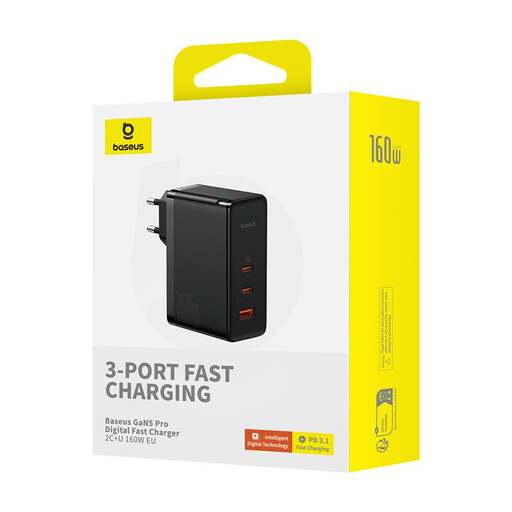
Why It Stands Out This charger from Baseus is a powerhouse. With a total output of 160W and three ports, it can handle virtually any combination of devices, including a demanding MacBook Pro. The included 240W cable ensures you can get the most out of the charger right away. The digital display showing the charging wattage is a practical bonus.
Advantages
Who Is This For? For the user seeking a powerful, all-in-one solution for their desk or travel bag. Ideal if you want to fast-charge a laptop, phone, and other gadgets at the same time.
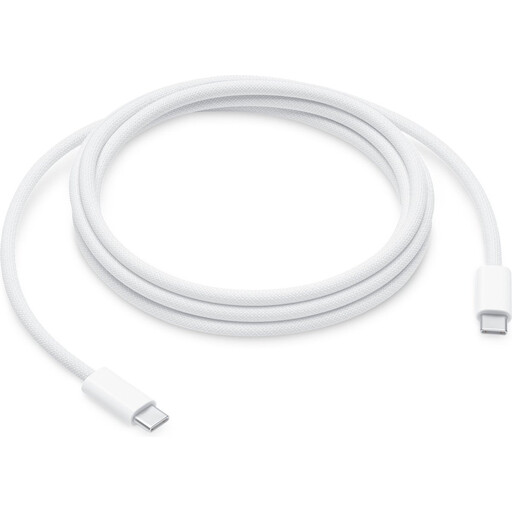
Why It Stands Out Sometimes, all you need is a reliable cable. This official Apple charge cable is designed for durability and performance. Its braided design prevents tangles and fraying, and with support for up to 240W, it's ready for the most powerful chargers of today and tomorrow. The two-metre length offers extra freedom of movement.
Advantages
Who Is This For? For Apple users looking for a replacement or an extra-long, durable USB-C charge cable. Perfect for pairing with a high-power USB-C adapter for a MacBook or iPad.
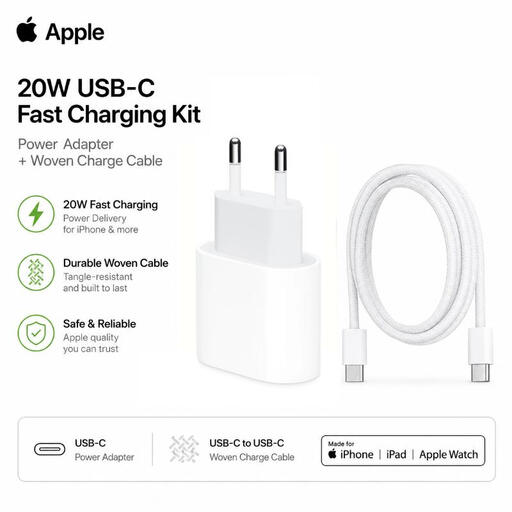
Why It Stands Out For those who value simplicity and reliability, this kit is the most straightforward solution. It includes the official Apple 20W USB-C Power Adapter and a matching one-metre braided USB-C cable. This is exactly what you need to fast-charge an iPhone 15. According to Apple, it can charge a compatible iPhone to 50% in about 30 minutes.
Advantages
Who Is This For? For the iPhone user who wants a simple, official, and complete charging solution that's guaranteed to work perfectly, without having to compare specifications.
These recommendations are a great starting point, but perhaps you need something slightly different. A longer cable, a different colour, or a charger with a specific wattage? Browse our full range for more options that suit your needs.
Discover more Type-C Charging Cables and Adapters
Generally, yes. The USB-C standard is universal. However, for fast charging, you need an adapter that supports Power Delivery (PD) with a minimum output of 20W. A lower-wattage charger, like one from an old phone, will charge your iPhone significantly more slowly.
A GaN charger uses Gallium Nitride instead of silicon. This allows the charger to be more compact, lightweight, and energy-efficient than traditional chargers with the same wattage. They also generate less heat while charging, which improves their lifespan.
This depends on the model. A MacBook Air is typically fine with a 30W-45W charger. A MacBook Pro requires more power, often between 67W and 140W. Check your MacBook's specifications or its original charger to find the recommended wattage. Using a more powerful charger won't cause any harm; the device will never draw more power than it needs.
