
Vandaag of morgen in huis

Kwaliteit gegarandeerd

Welkomstaanbiedingen ontgrendelen: GRATIS bezorging | Tot 80% korting | Gratis 30 dagen JoyPlus-proefperiode
Download de app
The sunscreen aisle can be overwhelming. Dozens of bottles promise perfect protection, but in reality, the search often ends with a sticky, white cast or a product unsuitable for daily use. Before you buy another bottle that gets relegated to the back of the cabinet, it's helpful to recognise a few common pitfalls.
Many consumers fall for marketing claims that sound better than they are. Take the promise of "fully waterproof" protection, which is technically impossible; any sunscreen must be reapplied after swimming or sweating. Another pitfall is the singular focus on a high SPF, while protection against UVA rays—which penetrate deeper into the skin and contribute to ageing—is just as important.
This guide will help you see through the marketing jargon and choose a sunscreen that truly suits your skin and lifestyle.
You don't need to decipher an entire ingredient list to make a good choice. Pay attention to the following three key points, and you'll be well on your way to the right purchase.
The SPF (Sun Protection Factor) on the packaging indicates how well a product protects against UVB rays, the radiation that causes sunburn. A sunscreen with SPF 50 is a solid choice for most situations.
But protection against UVA rays is at least as crucial. These rays are present all year round and contribute to premature skin ageing, such as wrinkles and dark spots. Look for the term "broad-spectrum" or the UVA logo (the letters 'UVA' in a circle) on the packaging. This guarantees that the UVA protection is proportional to the SPF, as recommended by the European Commission. Popular Korean sunscreens often use the PA system (PA+ to PA++++), where PA++++ offers the highest UVA protection.
Not every sunscreen is suitable for every skin type. The texture and ingredients determine how the product feels and reacts on your skin.
One of the biggest annoyances is a sunscreen that leaves no white cast. This white layer is usually caused by older mineral filters. Modern formulas, both chemical and mineral, have improved significantly. Chemical filters are naturally transparent. Mineral filters are now often 'micronized' (broken down into smaller particles), making them much less visible. A light 'fluid' or 'gel' texture typically absorbs faster and leaves less residue than a thick cream, which is especially pleasant for a facial sunscreen.
Based on these criteria, we have selected a number of products that align with specific user profiles.
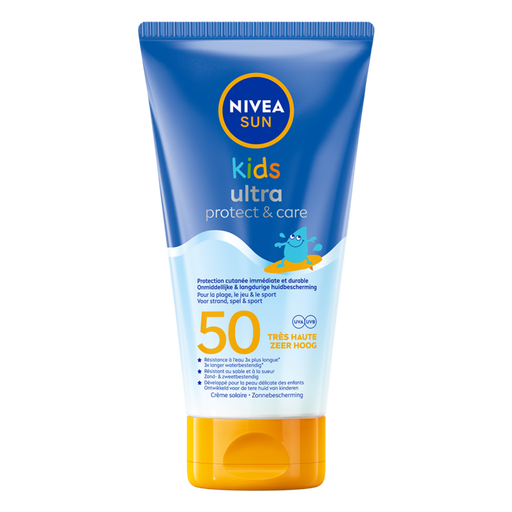
Why This Fits Their Persona: Ideal for parents seeking a reliable, water-resistant sunscreen for their active children. The formula is designed for beach days and outdoor play, where sweat and water resistance are essential.
This product offers clear broad-spectrum UVA/UVB protection and is specific about its water resistance. According to NIVEA, the formula is extra water-resistant, which provides more clarity than the vague term 'waterproof'.
Specially developed for sensitive children's skin, and its skin compatibility is approved by paediatricians. The formula is also sweat and sand resistant.

Why This Fits Their Persona: Perfect for those who see sun protection as an extension of their skincare routine. This popular Korean sunscreen combines high protection with nourishing ingredients for a hydrated, radiant finish.
This product addresses the most common complaints: it has a lightweight texture that leaves no white cast or sticky feeling. It also offers high UVA protection (PA++++) in addition to SPF 50+.
The formula is enriched with 30% rice extract and probiotics, which hydrate and soothe the skin. It feels more like a lightweight day cream than a traditional sunscreen.
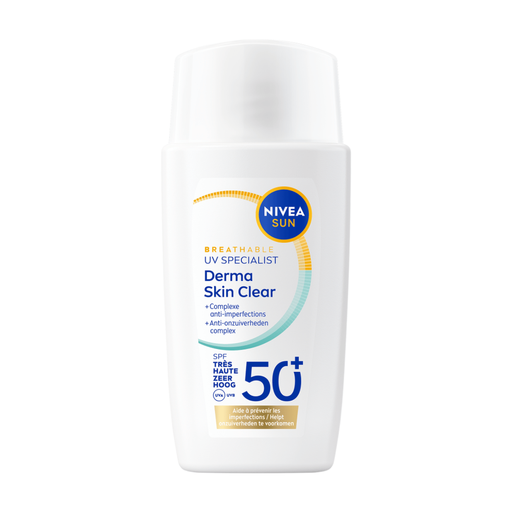
Why This Fits Their Persona: Suitable for those who want to use a daily facial sunscreen without risking a shiny complexion or breakouts. The formula is specifically tailored to the needs of oily and blemish-prone skin.
This product goes beyond just sun protection. It tackles the problem of oily skin by absorbing excess sebum and providing a mattifying effect, so it doesn't feel like a heavy, pore-clogging layer.
The non-greasy fluid contains niacinamide and an 'Anti-Blemish Complex'. According to NIVEA, this provides an 8-hour mattifying effect and helps prevent blemishes.
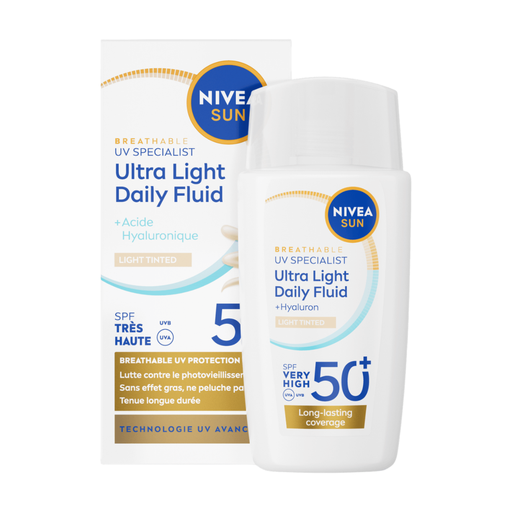
Why This Fits Their Persona: For those who want to combine protection with a light, even complexion. This tinted sunscreen functions as a light foundation and sun protection in one, ideal for a quick morning routine.
A white cast is not an issue here, as the formula contains tinted pigments. It combines the need for protection with a cosmetic benefit, making it a practical product for daily use.
The ultra-light fluid absorbs instantly without leaving a sticky or greasy feeling. The tinted pigments provide a natural, even complexion and hydrate the skin.
We have compiled a complete, up-to-date list of products that fully meet these strict selection criteria and UK/EU regulations.
A common mistake is applying too little. For the face and neck, the 'two-finger rule' is often recommended: a line of sunscreen on your index and middle fingers is usually sufficient. For your entire body, you can count on about 30-35 ml, which is equivalent to a full shot glass. Reapply every two hours, and more frequently after swimming, towel-drying, or heavy sweating.
Check the packaging for an open jar symbol with a number inside (e.g., '12M'). This number indicates how many months the product is good for after opening. If the sunscreen smells strange, has changed in colour or texture, or if the expiration date has passed, it's time to replace it. The effectiveness of the UV filters can diminish over time.
Mineral sunscreens (with zinc oxide and/or titanium dioxide) form a layer on the skin that reflects UV rays. They work immediately upon application and are often recommended for sensitive skin. Chemical sunscreens contain filters that absorb into the top layer of the skin and convert UV radiation into harmless heat. They are often lighter in texture and do not leave a white cast. Both types offer effective protection; the choice is mainly a matter of personal preference.
