
Vandaag of morgen in huis

Kwaliteit gegarandeerd

Welkomstaanbiedingen ontgrendelen: GRATIS bezorging | Tot 80% korting | Gratis 30 dagen JoyPlus-proefperiode
Download de app
A stick blender seems simple: plug it in, press a button and blend. But models vary considerably in power, accessories, controls and ease of cleaning. If you only look at the wattage, you could end up with an appliance that splashes, heats up quickly or is awkward to use with larger quantities.
This buying guide will help you choose the best stick blender for your needs. Rather than relying on bold marketing claims, it focuses on verifiable specifications and practical considerations.
A higher wattage doesn’t automatically mean better results every time. The design of the blade guard, the shape of the blending foot and the controls all affect how efficiently ingredients are processed. A powerful stick blender is particularly useful if you regularly prepare hard vegetables, nuts or thick mixtures.
Check the recommended operating time, too. Some models can only be used for short periods before they need to cool down. This is important when you’re making a large pan of soup.
A set with a whisk, chopper and measuring beaker sounds versatile, but the bowl’s capacity determines how much you can actually process at a time. A stick blender with a chopper that has a 500 ml capacity is handy for herbs, onions and small portions. A larger blending beaker may be more practical for a family.
Also check exactly what’s included. A model with just a blending foot is different from a 2-in-1 stick blender or a multi-function stick blender with a whisk and chopper.
An anti-splash stick blender can help reduce splashing, but technique still matters. Keep the blending foot fully submerged in the ingredients and start on a low speed if available. Also check whether you can use it in a non-stick pan. A blade guard designed to be less likely to touch the bottom can be useful.
A modest motor is often enough for smoothies, sauces and soft vegetables. If you also want to process nuts, hard vegetables or firm mixtures, look for models with around 600 watts or more. This doesn’t guarantee a particular result, but it gives you a useful point of comparison.
A stick blender with a turbo setting gives you a temporary boost in speed. This is handy for thick mixtures, but use the turbo setting as instructed in the manual and avoid running the blender continuously for too long. Multiple speeds give you more control over things like whipped cream, batter and soup.
A stainless steel blending foot is easy to rinse and suitable for hot ingredients if the manufacturer says it is. Always check the maximum temperature. Some product manuals recommend letting liquids cool below 80 °C first.
The shape of the blade guard affects how ingredients flow through the blender. A closed or specially shaped foot can help reduce splashing, but it won’t necessarily suit every pan or bowl. Look for a secure fitting and a blade that is less likely to touch the bottom.
A dishwasher-safe stick blender can save time, but this usually only applies to detachable accessories. The motor unit, plug and cable must not be immersed in water. Check the manual to see which parts can actually go in the dishwasher and at what temperature.
For everyday use, these accessories are the most practical:
A capacity of 500 ml is ideal for small portions. A 600 to 800 ml blending beaker gives you more room for a smoothie or sauce, but don’t fill it above the marked limit.
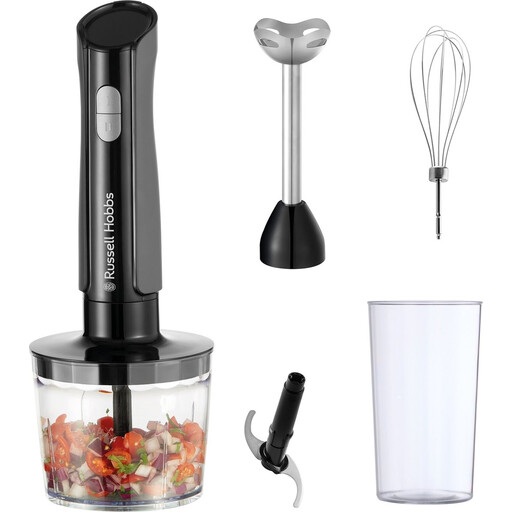
Why it suits this profile: This set lets you blend, chop and whisk without needing a large kitchen appliance. The chopping bowl has a capacity of 500 ml and the blending beaker holds 600 ml.
The accessories are clearly specified, and the detachable parts are listed as dishwasher-safe in the product information. So you’re not paying just for a standalone blending foot.
500 watts, two speeds, a whisk and a chopper. The product specifications list the model’s weight as 1.09 kg.

Why it suits this profile: This model is designed for users who want plenty of control. The product specifications list 25 speeds, a turbo function and a chopper with three texture settings.
The range of settings lets you adjust the speed for thin sauces and thicker mixtures, rather than relying on a single fixed turbo setting.
1000 watts, SplashControl according to the product description, and dishwasher-safe parts according to the listed specifications.
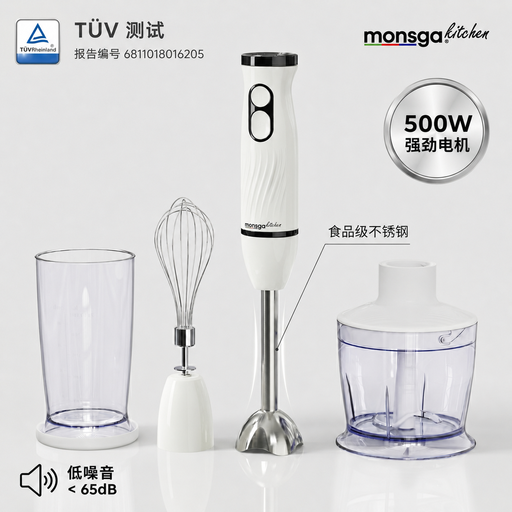
Why it suits this profile: According to the product information, the extended 36.5 cm body is designed for deeper pans. The set includes a whisk, a 500 ml chopper and a 500 ml measuring beaker.
The manufacturer lists an anti-splash design and protection against direct contact with the bottom of the pan. This can be useful when blending in non-stick cookware; check the manual for your pan.
Standard and turbo settings, a 1.5-metre cable, and detachable accessories listed as dishwasher-safe and BPA-free in the product information.
We’ve put together a complete, up-to-date list of products that meet these strict selection criteria and the applicable European safety regulations.
Look for a model with enough power, a splash-resistant foot and a measuring beaker large enough for your portion. When making hot soup, follow the temperature limit in the manual. Use the stick blender gently and keep the blade guard below the surface to help prevent splashing.
Yes, if you regularly make whipped cream, egg whites or light batter. A whisk won’t replace a full-sized food processor for heavy doughs, but it’s handy for small quantities and everyday baking.
It depends on how you use and maintain it, and on the maximum operating time allowed. Let the motor cool down when the manual says to, don’t overload the chopper and clean the accessories straight away. Before you buy, also check the warranty and whether replacement parts are available.
