
Vandaag of morgen in huis

Kwaliteit gegarandeerd

Welkomstaanbiedingen ontgrendelen: GRATIS bezorging | Tot 80% korting | Gratis 30 dagen JoyPlus-proefperiode
Download de app
Reheating a meal, breathing new life into yesterday's leftovers, or quickly defrosting an item. For these daily tasks, a complex combination microwave is often overkill. A solo microwave is designed for one purpose: heating food efficiently and quickly. It's ideal for students, small households, the office, or anyone who appreciates simplicity.
But how do you choose the right model? The market offers a wide range of options, from power levels to control types. As a Joybuy Product Recommendation Officer, I'll help you understand the specifications so you can find a model that fits your needs, without paying for features you won't use.
Before we dive into the recommendations, here are a few key factors to consider that will help you make your choice.
For most households, a compact microwave with a 20-litre capacity is more than enough. This easily fits a standard dinner plate or a frozen pizza. The power, expressed in watts, determines how quickly your food heats up. An 800-watt microwave is a common standard that ensures fast and even heating. Models with 700 watts are also a great choice for basic tasks and are often slightly more affordable.
The controls are a matter of personal preference. A simple microwave with a rotary dial is straightforward and intuitive: you turn the dial for the time and power, and the appliance starts. This is often a favourite among seniors or in environments where many different people use the appliance, like an office. Digital controls with push buttons and a display offer more precision and often include preset menus.
Most microwaves have a glass turntable that ensures microwaves are distributed evenly. The downside is that cleaning it can be a chore, and you're limited to round plates. A microwave without a turntable, also known as a 'flatbed' model, uses a different technology to heat the food. The main advantage is the flat interior: it's easier to clean, and you can also fit square or rectangular dishes inside.
Based on specifications and functionality, we've rounded up some popular choices for you.
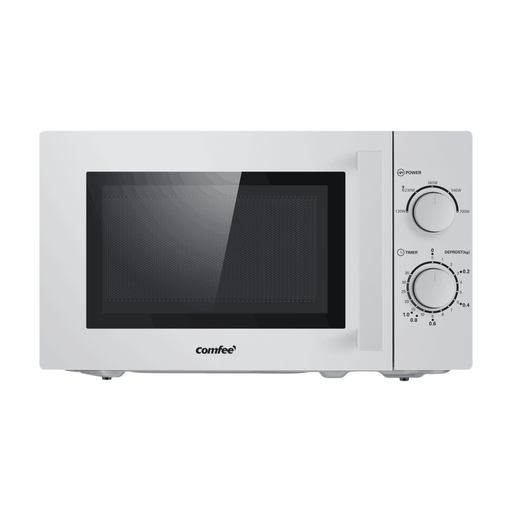
Why it stands out: This model from Comfee is the definition of a no-nonsense freestanding microwave. With two clear rotary dials, you can easily set the power (from 5 levels) and the time. No complicated menus, just pure functionality.
Advantages:
Who is it for? Perfect for students in dorms, as a secondary appliance in the pantry, or for seniors looking for a simple microwave with a rotary dial.
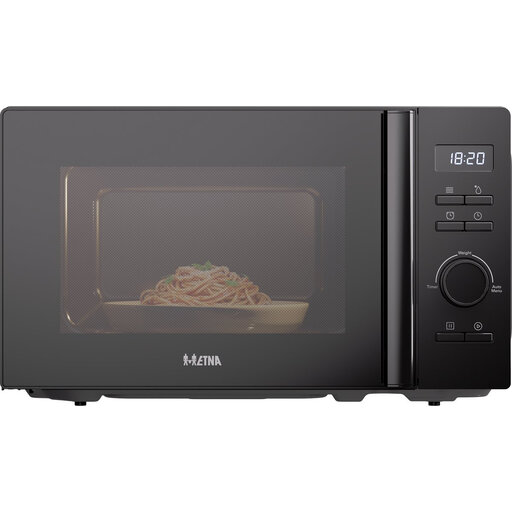
Why it stands out: The ETNA SMV820 combines the convenience of a rotary dial with the modern addition of an LED display and automatic programs. With 800 watts of power, your meals will be up to temperature in no time.
Advantages:
Who is it for? For small households that want a bit more functionality and speed but wish to avoid the complexity of a combination microwave. Its sleek black design fits well in a modern kitchen.
View the ETNA SMV820 Solo Microwave
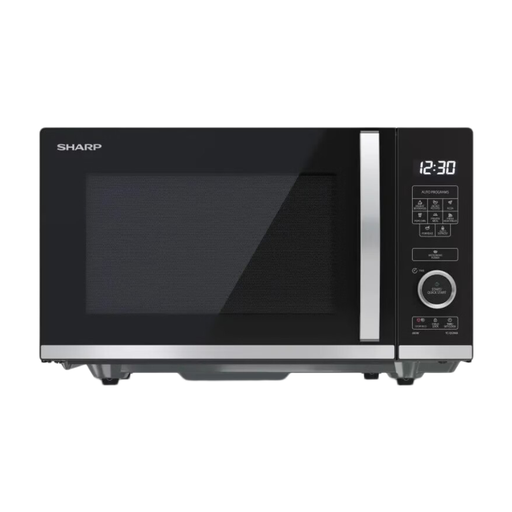
Why it stands out: This is a microwave without a turntable. The 'flatbed' technology provides a completely flat interior. This makes cleaning significantly easier and offers more flexibility for the shape of your cookware.
Advantages:
Who is it for? For anyone who hates cleaning a turntable or regularly uses larger, oddly shaped dishes. It's also a great choice for families thanks to the child lock.
View the Sharp YC-QS204AE-B Flatbed Microwave
A solo microwave is an excellent choice for specific tasks. If you're looking for a model with grill or oven functions, or simply want to compare more options, there are countless variations available to suit different needs and kitchens.
View our full range of kitchen microwaves and ovens
A solo microwave is designed exclusively for heating and defrosting food with microwaves. A combination microwave combines this function with other heating technologies, such as a convection oven and/or a grill. This means you can also bake and brown food.
For most basic tasks, a power level between 700 and 900 watts is ideal. An 800-watt microwave is often considered a good middle ground, offering both speed and efficiency. Higher wattage isn't always better; it's about matching the power to the size and intended use of the microwave.
Not necessarily better, but different. A 'flatbed' model is easier to clean and offers more flexible space. A traditional model with a turntable is considered by some to be more reliable for very even heating, although the technology in flatbed models has improved significantly. The choice depends on your personal preference for convenience or tradition.
