
Vandaag of morgen in huis

Kwaliteit gegarandeerd
Download de app
Categorieën

Buying a power bank seems simple until you look at the specifications: mAh, Watts, Power Delivery. The wrong choice can mean slow charging, a power bank that takes hours to recharge itself, or a model that can't even power your new laptop. The result is frustration and an unused device collecting dust in a drawer.
This guide will help you make an informed decision based on factual specifications. We'll explain the most important parameters and highlight several models for different use cases.
To find the right portable charger, it's important to understand four technical aspects: capacity, charging speed, connections, and size.
Capacity, expressed in milliampere-hours (mAh), determines how many times you can charge a device. A higher value means more energy.
Charging speed is expressed in Watts (W). A higher wattage means faster charging, provided your device supports it. Pay attention to the charging protocol. Power Delivery (PD) is the current universal standard for fast-charging power banks via USB-C.
Most modern power banks are equipped with USB-C and USB-A ports. A USB-C port that supports Power Delivery can often both deliver power (output) and receive it (input), meaning you can also recharge the power bank itself quickly. Multiple ports allow you to power several devices simultaneously.
High capacity almost always comes with increased weight and a larger size. You'll need to find a balance between portability and power. A compact power bank fits easily in your pocket, while a 20,000 mAh model or larger is better stored in a backpack.
Based on the criteria above, we have selected models suitable for different users.
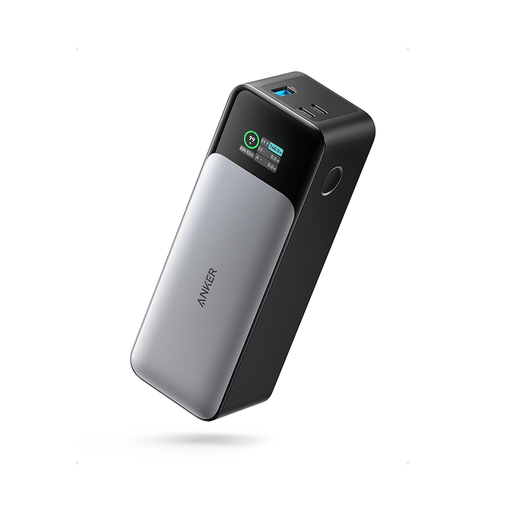
Why this product: This model is designed for users with high power demands. With an output of up to 140W and support for the Power Delivery 3.1 standard, it's one of the few power banks that can charge modern, demanding laptops at full speed. The digital display shows real-time information about the charging status and power output.
Key Features:
Who is this for: Professionals, students, and travellers who need to charge their high-end laptop (like a MacBook Pro), tablet, and smartphone simultaneously on the go without compromising on speed.
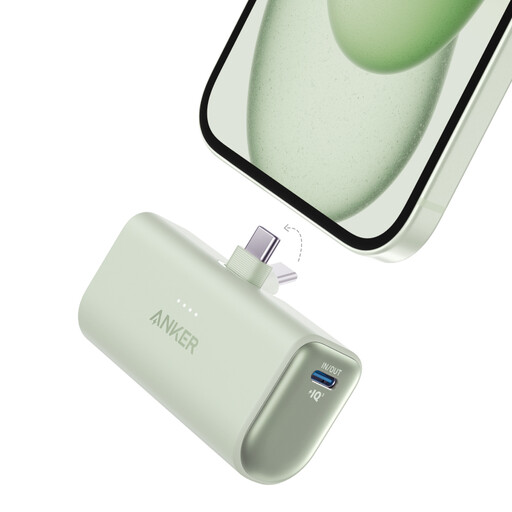
Why this product: The key feature of this model is its built-in, foldable USB-C connector. This means you don't need a separate cable to charge your Android phone, iPad, or other USB-C device. Its ultra-compact size makes it an ideal companion for daily use.
Key Features:
Who is this for: The daily commuter or city dweller looking for a lightweight, convenient solution to top up their phone at the end of the day. Perfect for a jacket pocket or a small handbag.
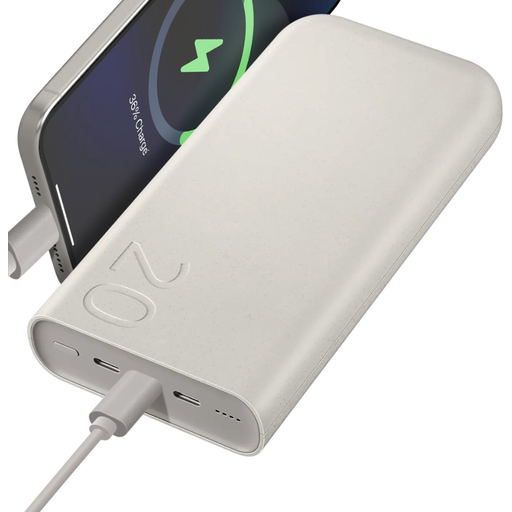
Why this product: This Samsung power bank offers a balanced combination of high capacity and fast-charging capabilities. With 20,000 mAh and 45W Super Fast Charging (via a single port), it's powerful enough for most tablets and even some laptops, while its three USB-C ports offer the flexibility to charge multiple devices at once. According to Samsung, the casing is partially made from UL-certified recycled materials.
Key Features:
Who is this for: The all-around user seeking a reliable, powerful power bank for phones, tablets, and potentially a compatible laptop. A great choice for weekend trips and intensive daily use.
The models above are geared towards specific situations. If you're looking for something different, such as a model with another capacity, a different brand, or a specific colour, there is a wide range of options available that might better suit your unique needs.
Browse our full range of portable chargers and power banks.
1. How many times can I charge my phone with a 20,000mAh power bank? This depends on your phone's battery capacity. An average smartphone has a battery of around 4,000-5,000 mAh. In theory, you could charge it 4 to 5 times. In practice, however, this number is lower because energy is always lost during the transfer process (usually around 20-30%). Therefore, you can expect about 3 to 4 full charges for an average phone with a 20000mAh power bank.
2. What is the difference between Power Delivery (PD) and Quick Charge (QC)? Both are fast-charging protocols. Power Delivery (PD) is a universal standard that primarily works via USB-C and supports a wide range of devices, including Apple products and laptops. Quick Charge is a technology from Qualcomm, found mainly on Android phones with a Snapdragon processor. Many modern power banks support both protocols for maximum compatibility.
3. Can I take a power bank in my carry-on luggage on a plane? Yes, power banks must be carried in your carry-on luggage and are not allowed in checked baggage. Most airlines have a limit of 100 Watt-hours (Wh) per battery. You can calculate the Wh value using the formula: (mAh / 1000) x V = Wh. For example, a 20,000 mAh power bank with a standard voltage of 3.7V is 74 Wh ((20,000 / 1000) x 3.7), which is well within the limit. Always check the specific rules of your airline before departure.