
Vandaag of morgen in huis

Kwaliteit gegarandeerd

Welkomstaanbiedingen ontgrendelen: GRATIS bezorging | Tot 80% korting | Gratis 30 dagen JoyPlus-proefperiode
Download de app
An electric car offers freedom, but that freedom ends where the charging options do. A fixed charging station isn't an option for everyone due to high installation costs, a rental property, or simply the desire to charge on holiday or at a friend's house. A portable EV charger seems like the perfect solution, but the market is flooded with models that overpromise and underdeliver. Before you invest, it's crucial to understand the common pitfalls.
Many buyers fall into two major traps:
smart charger with an app sounds modern, but often the app is clunky or the features are unnecessary gimmicks. The real value lies in being able to schedule charging sessions to take advantage of off-peak rates, not in colourful graphs you'll never look at again after a week.electric car charger can be a hazard if corners have been cut on safety. Without adequate protection against leakage current (Type B), overheating, or voltage spikes, you're endangering not only your car but also your home.A good portable EV charger is an investment in convenience and safety. Let's look at the specifications that truly matter.
To avoid a bad purchase, focus on three technical aspects. These determine the speed, safety, and ease of use of your charger.
The charging power, expressed in kilowatts (kW), determines how quickly your car charges. The choice depends on the connection in your fuse box and your car's charging capacity.
Important: The charging speed is always limited by the weakest link: the power connection, the charger itself, or the car's internal on-board charger.
A smart charger with an app is only truly useful if its features help you save money and give you control. Look for the following capabilities:
The Type 2 charging cable with control box is the brain of the charger. It contains the crucial safety components. Always check for the following specifications:
portable EV charger that you'll use in various conditions.Based on these criteria, we have selected a number of models that suit different user profiles.
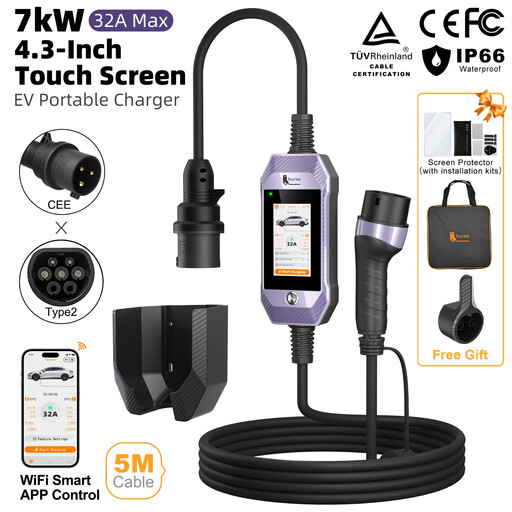
Why This Fits Their Persona: Ideal for most households with a single-phase connection. This charger offers the flexibility to charge at home and take it with you on the go. The app functionality is focused on cost savings by scheduling charging during off-peak hours.
This charger focuses on the smart features that really matter: scheduling charging sessions and adjusting amperage via the app. No unnecessary frills, just direct control and cost savings.
The clear 4.3-inch touchscreen provides instant insight into the charging status, while the app offers remote control. The charger is equipped with dual temperature monitoring for extra safety.
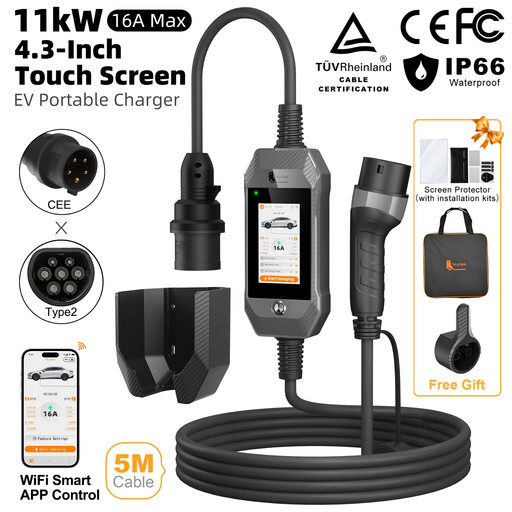
Why This Fits Their Persona: For those who have a 3-phase connection and want to charge faster. The 11kW 3-phase charger capacity significantly reduces charging time, ideal for those who drive more miles daily. Its portability makes it a perfect companion for work or family visits.
This model avoids the pitfall of a charger that's too slow. It makes optimal use of the 3-phase connection. According to Feyree's specifications, it features Type B (AC30mA + DC6mA) leakage current protection, which is a crucial safety feature.
Combines the speed of 11kW charging with the flexibility of a portable design. The app provides comprehensive charging data, which helps to optimise charging behaviour and costs.
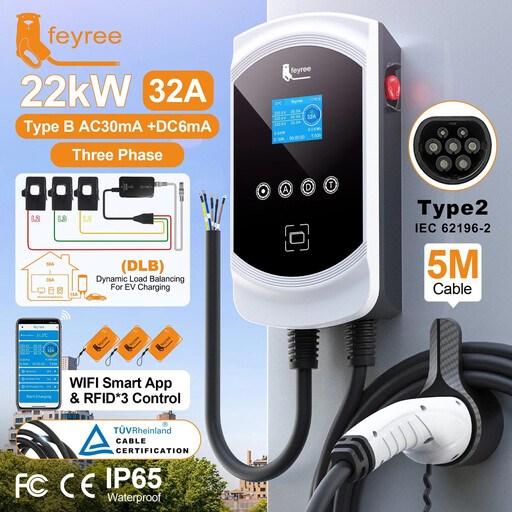
Why This Fits Their Persona: This is not a portable charger, but a fixed wallbox for the user seeking the ultimate smart home solution. The charger with load balancing prevents overloading the home's electrical grid, a must-have for anyone with solar panels, a heat pump, and an EV.
This model addresses a problem many people only discover when it's too late: an overloaded electrical grid. Dynamic Load Balancing (DLB) is a truly smart feature that automatically adjusts the charging power based on the total electricity consumption in the house.
The DLB feature ensures worry-free charging without the risk of a power outage. With a capacity of up to 22kW, this wallbox is also future-proofed for faster cars.
We've compiled a complete, up-to-date list of products that meet these strict selection criteria and safety regulations.
The charging time depends on three factors: your car's battery size (in kWh), the charger's power output (in kW), and the car's maximum charging speed. A simple calculation is: Battery Size (kWh) / Charging Power (kW) = Charging Time (Hours). A car with a 60 kWh battery will take about 8.5 hours to charge with a 7kW charger. With an 11kW 3-phase charger, this is reduced to just 5.5 hours.
Although many portable chargers have an IP rating that protects them from rain and dust (like IP65), they are primarily designed for flexible and temporary use. For a permanent, unprotected outdoor installation, a fixed wallbox is often a more robust and safer choice. When using a portable charger, always ensure that the control box and plug are not in puddles of water and are protected from extreme weather conditions.
Yes. For a charger with a power output of 11kW or 22kW, a 3-phase power connection in your fuse box is required. A 7kW charger can operate on a powerful single-phase circuit (32A), which is standard or easier to install in many homes. Always check your fuse box specifications before purchasing a charger to avoid disappointment.
