
The workshop storyteller
Wants to photograph the maker at work while keeping the tools and surroundings recognisable in the shot. Nikon and Sigma explain how focal length and camera type affect the angle of view.


If you want to show the maker and some of the workshop, start with a suitable standard prime or standard zoom. A zoom makes it easier to switch between portraits and the workbench. For small details, check the minimum focusing distance and magnification for the exact model, while a longer portrait lens is best suited to situations where you have enough room to step back and the face is the main focus. Before buying, check your camera’s lens mount and sensor size, as the same focal length won’t give you the same angle of view on every camera body.
Wants to photograph the maker at work while keeping the tools and surroundings recognisable in the shot. Nikon and Sigma explain how focal length and camera type affect the angle of view.
Wants to capture hands, materials and small steps as well as a portrait, so compares the focusing distance and magnification of the exact lens. Sigma and Canon provide model-specific information for this.
Focuses mainly on individual portraits and can stand far enough back. Nikon and Canon describe lenses for portraits and close-ups, but the angle of view and capabilities vary by model and camera body.
Best when: you want to photograph a maker with some of the workshop in the shot and a fixed focal length suits your camera.
Bear in mind: you can’t reframe from the same spot using a zoom ring; on APS-C, the angle of view may be narrower.
Best when: you want to switch between the maker, the workbench and close-up details during the same visit.
Bear in mind: the maximum aperture and minimum focusing distance may vary by lens and zoom setting.
Best when: an individual portrait is your priority and you have enough room to stand back.
Bear in mind: the narrower framing can make it difficult to include the workspace in a small room.
| Consideration | What to check before buying | Who is this important to? |
|---|---|---|
| Maker and workshop together | Compare focal length and sensor size; consider whether you can reframe from the space available. | I want to show the tools and surroundings alongside the maker, not just their face. Around 36% of consumers put workshop context at the top of their buying priorities. |
| Available light and movement | Check the maximum aperture of the exact model and consider the shutter speed needed to capture moving hands. | If I want to capture the making process in available light, I consider both the aperture and movement. Around 29% of consumers give this combination top priority. |
| Small details of the work | Compare the maximum magnification and minimum focusing distance, including at different zoom settings if relevant. | Close-up specifications matter most if you want to clearly show small actions or materials. Around 21% of consumers put details of the work first. |
| Individual portrait | Check that you have enough room to get the framing you want and look at the angle of view for your sensor size. | I prioritise an individual portrait over a wide shot of the making process. Around 14% of consumers put portraits first when buying. |
The mount determines whether a lens fits your camera, while the sensor size also affects how much of the scene appears in the frame. Canon, for example, says that RF lenses don’t fit EOS M or EOS DSLR cameras.
Make a note of the exact camera model and check the mount on both the camera body and lens. Find out whether you need an adapter for that combination.
If you need an adapter, remember to factor it into your choice separately.
Magnification and focusing distance vary by model; with a zoom, the stated figure may also change depending on the focal length.
Compare the magnification and focusing distance of the exact lens at the zoom setting you plan to use for photographing hands or materials.
A narrower framing may require you to stand further back and can show less of the workspace.
First decide whether you want the maker, their hands and the workbench all in the shot. Then choose a lens and angle of view that suit the space and camera body.
Canon describes a range of RF lenses for EOS R cameras: a 50mm prime for standard framing and an 85mm model for portraits and close-ups.
The FE 50mm F1.8 is a standard prime with a Sony E mount. Sony describes its use on full-frame and APS-C cameras.
The NIKKOR Z 50mm f/1.8 S is a standard prime for the Nikon Z system; the final framing also depends on the camera body.
The 18–50mm F2.8 DC DN | Contemporary is an APS-C standard zoom for switching between environmental portraits and details of the work.
The 28–75mm F/2.8 Di III VXD G2 is a standard zoom range for compatible full-frame mirrorless cameras.
These Joybuy picks include a Sony E 50mm prime for individual portraits and a Sony E wide-angle prime for wider workshop shots. Check the mount and camera compatibility of the exact version before choosing.
 Image unavailable
This fixed Sony E prime is suited to individual portraits; check that this version fits your camera body.
50 mm; maximum aperture f/1.8; Sony E mount.
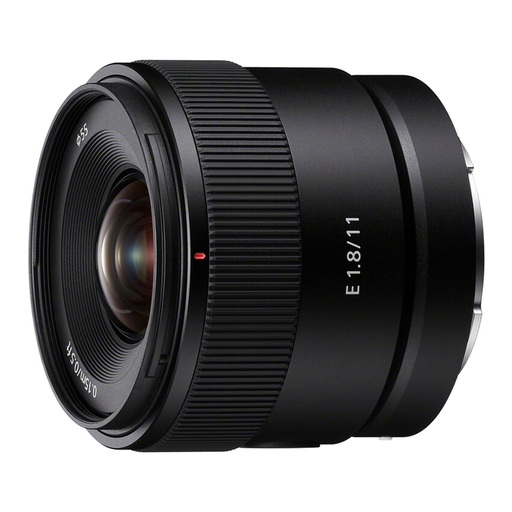 Image unavailable
This wide-angle prime is an option when you want to include plenty of the workshop in the frame; consider whether the wide angle suits the portrait you want to take.
11 mm; maximum aperture f/1.8; APS-C; Sony E mount.
No. Check the exact mount on the camera and lens, and find out whether you need an adapter. Canon, for example, says that RF lenses are designed for EOS R cameras and don’t fit EOS M or EOS DSLR cameras; you need a suitable adapter to use EF lenses on EOS R cameras.
Check your focus point and try a smaller aperture if you need more of the scene to be in focus; for moving hands, consider the shutter speed too. Nikon explains how aperture and shutter speed work together to affect a photo, and an f/1.8 lens doesn’t always have to be used at f/1.8.
For a consumer purchase in the Netherlands, ACM ConsuWijzer says the seller must offer an appropriate free remedy if a product breaks sooner than you could reasonably expect under normal use. Online purchases also generally come with a 14-day cooling-off period after delivery; check the applicable exceptions and returns policy.
Don’t assume that you can: the Dutch Data Protection Authority describes recognisable images as personal data and says that, outside strictly personal use, an applicable GDPR legal basis is required. Discuss the intended use of the photo with the maker and the school; the specific rules for recognisable photos of pupils under 16 don’t automatically apply to an adult maker.