
Vandaag of morgen in huis

Kwaliteit gegarandeerd

Welkomstaanbiedingen ontgrendelen: GRATIS bezorging | Tot 80% korting | Gratis 30 dagen JoyPlus-proefperiode
Download de app
Imagine this: you're in a deserted car park after a long day at work, or you've just arrived at your holiday destination, and your car won't start. A dead battery. Or perhaps you notice one of your tyres is dangerously low, far from the nearest service station. These are situations you'd rather avoid. A jump starter with a compressor is an all-in-one solution that makes you self-reliant in moments like these.
This isn't just a tool for mechanics; it's a practical device for every car owner. In this article, we'll help you make the right choice by breaking down the specifications and highlighting a few popular models. This way, you'll know exactly what to look for to suit your needs.
The market offers many choices, and the specifications can be overwhelming. Let's keep it simple and focus on the three most important factors.
The starting power, expressed in Amps (A), determines if the jump starter is powerful enough for your vehicle. A higher number means more starting power. Take a close look at your car's engine:
The built-in air compressor, also known as the jump starter with tyre inflator, is the second core function. The maximum pressure is indicated in PSI (Pounds per Square Inch). For a standard car tyre, a compressor that can go up to 150 PSI is more than sufficient. Useful features to look for include:
Modern jump starters are often more than just a 12V jump starter. Many models also function as a power bank with jumper cables, allowing you to charge your phone or tablet via USB ports. A built-in LED light with different modes (torch, strobe, SOS) is a valuable addition for emergencies in the dark. Also, pay attention to the size and weight; a compact, portable jump starter fits easily in your glove compartment or trunk.
Based on the criteria above, we have selected models that cover a range of needs.
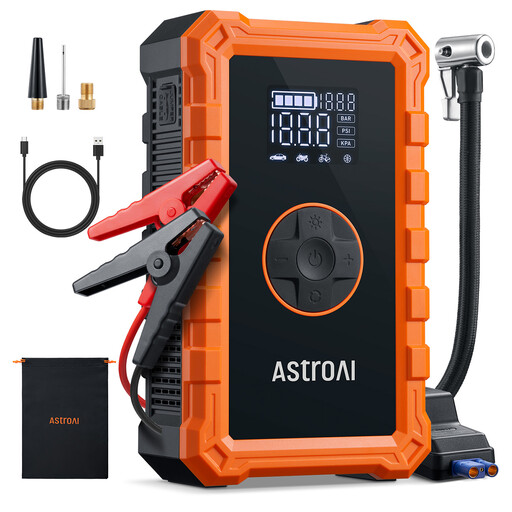
Why This Model Stands Out: The AstroAI S8 is a compact and user-friendly model. Its most striking feature is the bright 2.4-inch screen, which clearly displays the status, battery level, and tyre pressure, even in bright sunlight.
Advantages:
Who is this a good choice for? This is an excellent all-rounder for the average car owner with a petrol car or a smaller diesel vehicle. The focus on ease of use and the clear screen make it an accessible emergency car starter for everyone.
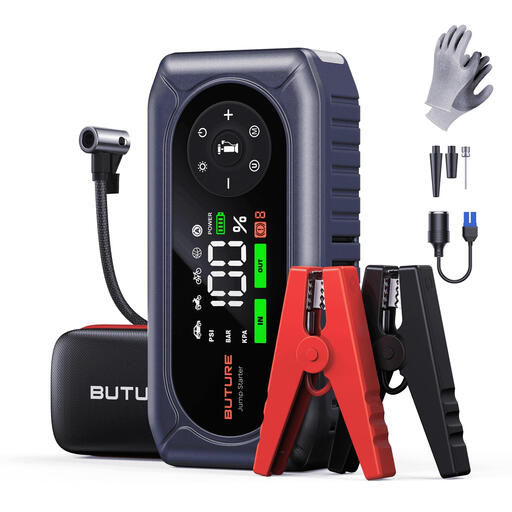
Why This Model Stands Out: The BUTURE BC02 delivers an impressive 4500A of starting power. This makes it suitable for a wide range of vehicles, including heavy-duty SUVs, vans, and trucks. The manufacturer emphasizes its robust build and 10-layer safety protection.
Advantages:
Who is this a good choice for? Ideal for owners of larger vehicles such as SUVs, RVs, boats, or light-duty trucks. It's also a great option for those who simply want the peace of mind that comes with extra starting power.
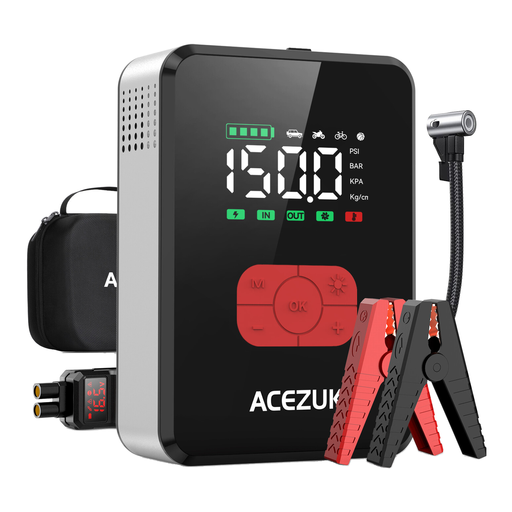
Why This Model Stands Out: With a peak current of 7000A, the ACEZUK M06 is one of the most powerful models in its class. The manufacturer claims it can start virtually any 12V vehicle, including large diesel engines up to 12L. A unique feature is the smart clamp, which has its own small screen for additional safety feedback.
Advantages:
Who is this a good choice for? This jump starter with air compressor is aimed at users with very heavy-duty vehicles, such as large RVs, agricultural vehicles, or trucks. It is also an option for professionals who need a reliable and powerful tool.
Didn't find the perfect match for you? No worries. There are various types of jump starters, each with its own specifications, from compact power banks to professional workshop models. If you want to explore a wider range, you can find more choices in our category.
Check out our full range of Jumper Cables for more choices.
1. Can I use a jump starter for any car? Most jump starters are designed for standard 12V vehicles, which includes almost all passenger cars, motorcycles, and SUVs. However, it is crucial to check that the starting power (Amps) and the recommended engine size (Liters) match your vehicle. For older cars or heavy-duty trucks with a 24V system, you will need a different type of jump starter.
2. How often should I charge a jump starter? Even when not in use, a jump starter will slowly lose its charge. It's good practice to fully charge it every 3 to 6 months. This ensures it's ready for use when you need it. Preferably, store it in a cool, dry place and not permanently in a car parked in direct sunlight.
3. Is a jump starter with a compressor safe to use? Yes, modern jump starters are designed with safety as a priority. Most models have built-in protection against common mistakes, such as connecting the clamps incorrectly (reverse polarity), short-circuits, overheating, and overcharging. This minimises the risk of sparks or damage to the car's electronics, even for novice users.
