
Vandaag of morgen in huis

Kwaliteit gegarandeerd

Welkomstaanbiedingen ontgrendelen: GRATIS bezorging | Tot 80% korting | Gratis 30 dagen JoyPlus-proefperiode
Download de app
A dead battery or a flat tire always happens unexpectedly. Being stranded on the roadside waiting for assistance is not only frustrating but also costs time and money. A jump starter with a compressor seems like the ideal all-in-one solution. However, the market is flooded with models that promise impressive specs that often disappoint in practice.
Before you make a purchase, it's important to recognise the common pitfalls. This will prevent you from investing in a device that will let you down in an emergency.
To avoid buyer's remorse, it's essential to look beyond the marketing claims. Focus on the specifications that truly matter for a reliable car jump starter with air compressor.
Don't be dazzled by a high peak amp rating. The most important indicator for a good car jump starter is its compatibility with your vehicle's engine size, expressed in litres (L). Diesel engines typically require more starting power than petrol engines of a similar size.
Always check the manufacturer's specifications:
12V jump starter is the standard.A functional compressor can mean the difference between getting back on the road quickly and having to call for roadside assistance after all. Pay attention to the following two values:
A portable jump starter often doubles as a battery booster with a power bank. The capacity, expressed in milliampere-hours (mAh), determines how many times you can charge your phone or tablet. While a higher mAh value is useful, it does not directly correlate with the booster's starting power.
Other useful features for an emergency car starter include a built-in LED light with different modes (solid, strobe, SOS) and a clear digital display that shows the remaining battery charge and the compressor's status.
Not everyone has the same needs. We have highlighted a few products that suit different user profiles, based on their specifications.
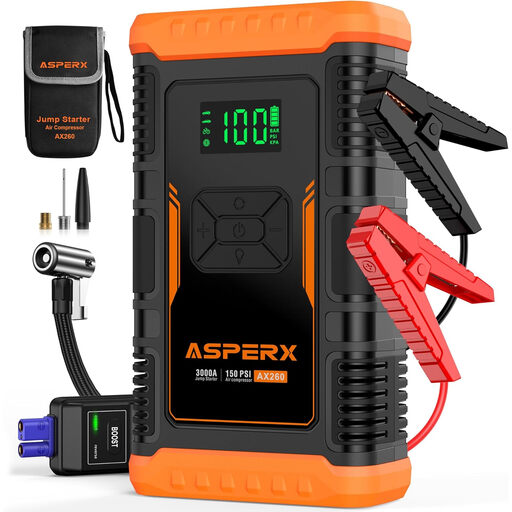
Why This Fits Their Persona: Ideal for the daily driver who wants a compact, reliable all-in-one solution for the glove compartment. Powerful enough for most passenger cars and SUVs, without being unnecessarily large or heavy.
The manufacturer specifies clear engine compatibility (up to 10L petrol/8L diesel), which is more useful than just a peak power rating. The compressor has smart presets and an auto-shutoff, preventing guesswork and overheating.
Good balance between size and power. The compressor has an airflow of 35 L/min and a bright LCD screen for easy operation.
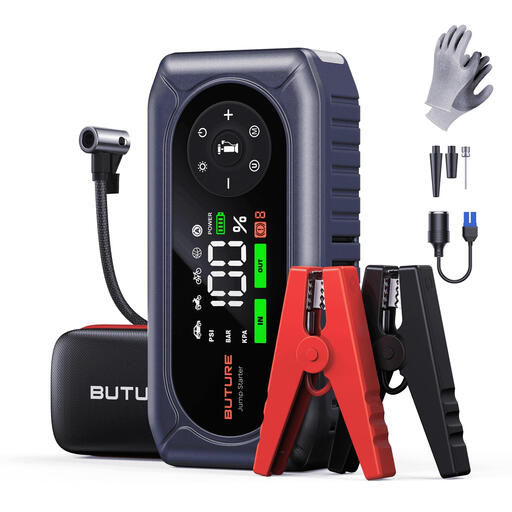
Why This Fits Their Persona: Suitable for owners of larger vehicles like RVs, vans, or heavy-duty SUVs. Its high starting power and robust build make it a reliable partner for camping trips and demanding jobs.
According to the manufacturer, its 'honeycomb' cooling technology reduces heat generation by 30%, which prevents the compressor from overheating during prolonged use. The 10-layer protection system prevents damage from incorrect connections.
Very high starting power (suitable for 9.0L petrol / 8.0L diesel). The 500-lumen, 4-mode LED light, including a red strobe, is a plus for safety in the dark.
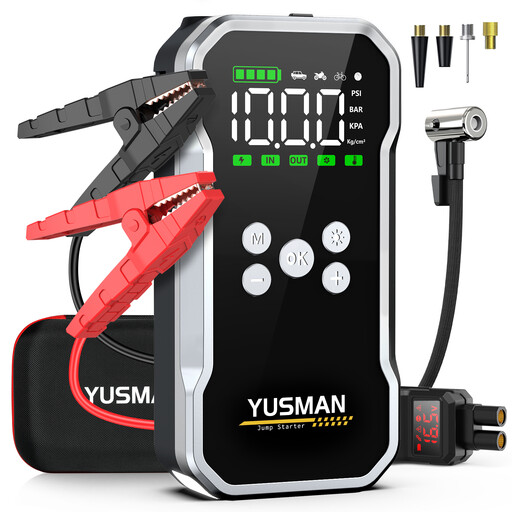
Why This Fits Their Persona: For the user who wants to be prepared for any situation. This model combines an (claimed) extremely high peak power with a fast compressor and various inflation modes, making it suitable for cars, motorcycles, bicycles, and even air mattresses.
The fast compressor (claimed 45 L/min) tackles the pitfall of slow inflation. The 5 different inflation modes with an automatic stop function make the device versatile and user-friendly, reducing the chance of errors.
Highly versatile thanks to the 5 inflation modes and included nozzles. The combination of a powerful jump starter and a fast compressor makes it a complete emergency solution.
We have compiled a complete, up-to-date list of products that meet these strict selection criteria and safety regulations.
It is advisable to fully charge the jump starter after each use. Even when not in use, the battery slowly loses its charge. Most manufacturers recommend charging the device every 2 to 3 months to maximise battery life and ensure it's ready for an emergency.
Yes, modern jump starters are equipped with multiple safety features. Look for models with 'smart' clamps that offer protection against reverse polarity (connecting the clamps incorrectly), short circuits, over-voltage, and overheating. An indicator light or beep will warn you if the clamps are connected incorrectly, preventing damage to the car's electronics and the jump starter itself.
Diesel engines have a higher compression ratio than petrol engines. This means more power (amperage) is needed to start the engine, especially in cold weather. Therefore, a diesel engine requires a more powerful jump starter. Always check the manufacturer's specifications to see if the jump starter is suitable for your vehicle's engine size (in litres) and fuel type. A model that can start a 3.0L diesel engine can typically handle a much larger petrol engine.
