
Vandaag of morgen in huis

Kwaliteit gegarandeerd

Welkomstaanbiedingen ontgrendelen: GRATIS bezorging | Tot 80% korting | Gratis 30 dagen JoyPlus-proefperiode
Download de app
A dead battery or a flat tyre always happens unexpectedly. For the self-reliant car, RV, or boat owner, a jump starter with compressor is an indispensable tool. It offers the freedom to not depend on roadside assistance. But the market is flooded with models that promise the world. In practice, many devices turn out to be unreliable, leaving you stranded on the side of the road anyway.
As a Joybuy Product Recommendation Officer, I'll help you see through the marketing hype. We'll look at the specifications that truly matter, so you can make a well-informed decision. Let's first discuss the most common pitfalls.
To avoid a bad buy, focus on the following three verifiable specifications. These determine whether a portable jump starter is worth its money.
The peak current (peak amperage) is the maximum current the jump starter can deliver for a short burst. This is crucial for starting an engine.
Always check if the manufacturer specifies compatibility in litres (e.g., "suitable for 8.0L gasoline / 6.0L diesel").
Almost every jump starter with air compressor advertises 150 PSI. This is the maximum pressure, but efficiency is determined by the airflow, expressed in litres per minute (L/min).
A model with an auto-stop function, which shuts off at the preset pressure, prevents damage to your tyres and is a practical advantage.
The capacity (mAh) determines the endurance. A larger capacity means more starting attempts or more charges for your devices. Also, pay attention to the charging technology. A USB-C port with Power Delivery (PD) or a USB-A port with Quick Charge (QC 3.0) not only charges your phone faster but also ensures that the jump starter itself recharges more quickly.
Below are some models that score well on the above criteria, matched to specific user profiles.
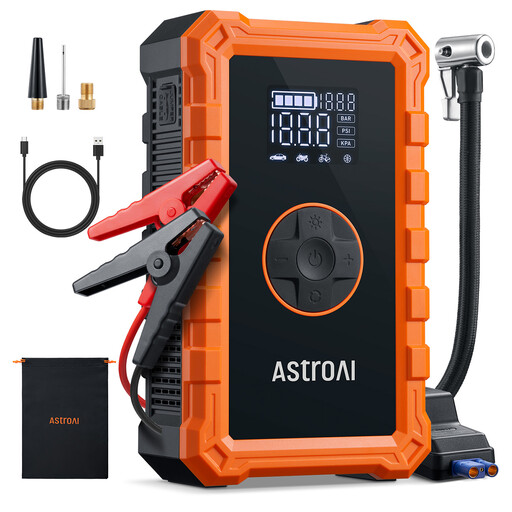
Why This Fits Their Persona: Ideal for drivers of standard gasoline cars or smaller diesels who need a reliable all-in-one emergency solution without overspending. Compact enough for the glove compartment.
The 1500A peak is realistic for the specified engines (up to 6.0L gasoline). The compressor features an auto-stop function and a clear display, sidestepping the pitfall of a useless pump.
Compact and user-friendly design with a large, bright display. The airflow of 25L/Min is sufficient for emergencies.
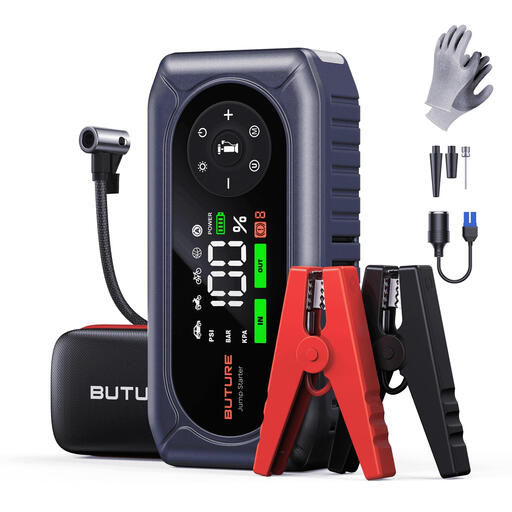
Why This Fits Their Persona: Suited for owners of larger vehicles like SUVs, vans, or RVs with diesel engines. This user needs more starting power and a more robust device for travel and holidays.
The 4500A peak is powerful enough for the specified engines (up to 8.0L diesel). According to the manufacturer, its honeycomb cooling reduces heat buildup, addressing the pitfall of an overheating compressor.
Powerful starting performance for large engines. The 150 PSI compressor has 5 preset modes and a clear LCD screen for easy use.
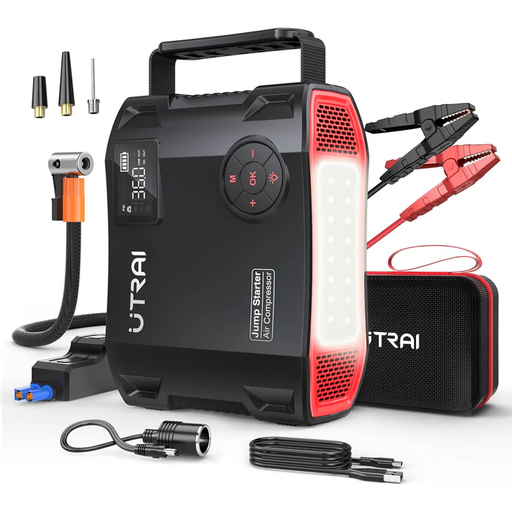
Why This Fits Their Persona: For boat owners, drivers of heavy-duty diesel vehicles, or professionals who need a multifunctional workhorse. This profile requires maximum power, a fast compressor, and the ability to power other 12V devices.
The 6000A peak is suitable for engines up to 10.0L diesel. The compressor delivers a high airflow of 45L/min, avoiding the pitfall of a slow, unusable pump. The large 27000mAh battery is made functional by its 160W DC output.
Extremely high starting power and a fast compressor. The 160W DC output is a unique feature that can power devices like a portable cooler or a car vacuum.
We've compiled a complete, up-to-date list of products that fully meet these strict selection criteria and safety regulations.
Even when not in use, the battery slowly loses its charge. It's advisable to fully charge your jump starter every 3 to 4 months. This ensures the battery remains in good condition and the device is ready when you need it. Always consult the manufacturer's manual for specific recommendations.
No, that's a common mistake. Diesel engines require significantly more starting power than gasoline engines due to their higher compression ratio. Always check that the jump starter with compressor is explicitly rated for your diesel engine's displacement (in litres). A model that's too weak will fail to start the engine and could even be damaged.
The lifespan depends on the quality of the internal lithium-ion battery and how you maintain the device. A good model will last for hundreds of charge cycles. To maximise its lifespan, store the device in a cool, dry place and charge it regularly as described above. Extreme temperatures (both heat and freezing cold) can shorten the battery's life.
