
Vandaag of morgen in huis

Kwaliteit gegarandeerd

Welkomstaanbiedingen ontgrendelen: GRATIS bezorging | Tot 80% korting | Gratis 30 dagen JoyPlus-proefperiode
Download de app
Getting stranded with a dead battery or a flat tyre is a familiar scenario. A jump starter with a compressor seems like the perfect solution: one device for two common problems. However, the market is flooded with models that make lofty promises. Many devices become useless after a few months or underperform when you need them most.
As a Joybuy Product Recommendation Officer, I'll help you see through the marketing jargon. We'll look at the specifications that truly matter, so you can make a purchase you can rely on without overpaying.
Before we get to the recommendations, it's important to recognise the most common pitfalls. These often lead to you ending up with a useless device.
To avoid a bad purchase, focus on three concrete specifications. These determine whether a jump starter with a compressor is worth the money.
Look beyond the peak amps and check what type of engine the jump starter is suitable for. A manufacturer usually indicates the maximum engine displacement (in litres) the starter can handle, for example, "for petrol engines up to 8.0L and diesel engines up to 6.0L". A 12V jump starter is standard for passenger cars, motorcycles, and RVs. Do you have a heavy-duty diesel? Then you'll need a model with a higher, stable starting current.
A good built-in compressor should be able to inflate a car tyre to the correct pressure quickly. Pay attention to two values:
The capacity, expressed in milliampere-hours (mAh), determines how many times you can start a car or how long you can use the jump starter with power bank to charge your phone. A higher capacity is better, but it also makes the device heavier. The built-in safety features are essential. A good portable jump starter should have, at a minimum, protection against short circuits, overheating, and reverse polarity (connecting the clamps incorrectly). A clear display or indicator lights showing the status are indispensable for safe use.
Below is a selection of models tailored to different user profiles. We've looked for a good balance between starting power, compressor performance, and reliability.
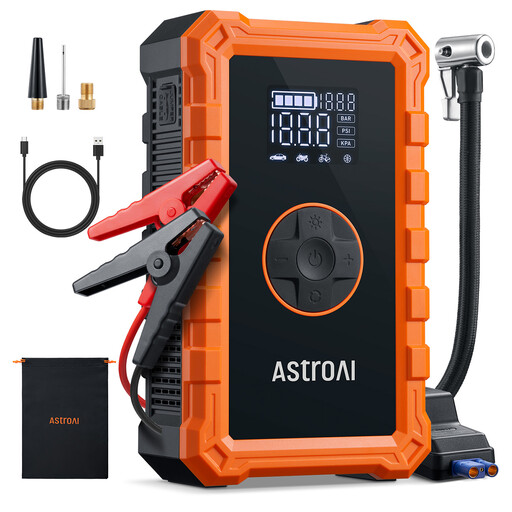
Why This Fits Their Persona: Ideal for drivers of standard petrol or smaller diesel cars who want a reliable and compact device for the trunk. It's a no-nonsense solution for the most common roadside emergencies.
This model avoids the 'weak all-in-one' trap by combining a solid compressor (150 PSI, 25L/min) with sufficient starting power (1500A) for most passenger cars (up to 6.0L petrol/3.0L diesel).
The large 2.4" screen clearly displays the status and tyre pressure. The compressor automatically stops at the set pressure, which increases ease of use.
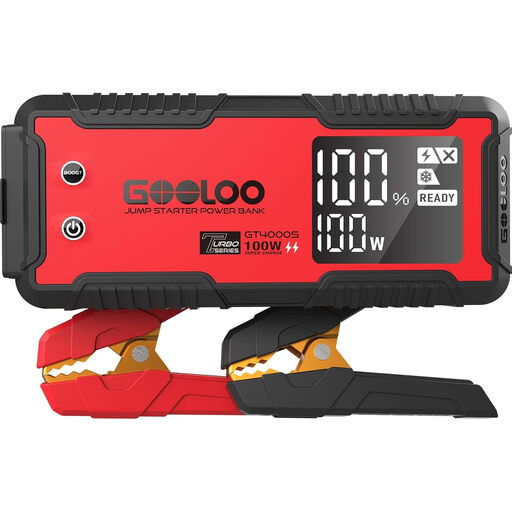
Why This Fits Their Persona: For owners of an SUV, RV, van, or boat. This profile needs serious starting power for large diesel engines and can't rely on a lightweight model. This is a jump starter, not a toy.
This model focuses on one thing: starting power. It bypasses the peak current myth by being genuinely suitable for engines up to 10.0L diesel. This isn't a compromise; it's a specialised tool.
The 100W fast charging feature (both in and out) is a major advantage. According to GOOLOO, the device is fully charged in 1.2 hours and can also charge laptops. Note: this model does not have a built-in compressor.

Why This Fits Their Persona: For those looking for a single powerful device that can do it all: start a heavy-duty engine, quickly inflate a tyre, and serve as a power bank. This is the Swiss Army knife solution for your car.
This model combines a very high peak amperage (4500A) with a full-fledged 150 PSI compressor. It's designed as a powerful 5-in-1 tool without compromising on the core functions (starting and inflating).
Suitable for large engines (up to 9.0L petrol/8.0L diesel). The clear LCD screen and 10-layer protection make it a safe and user-friendly choice for demanding situations.
We have compiled a complete, up-to-date list of products that meet these strict selection criteria and safety regulations.
Most manufacturers recommend fully charging the jump starter every 3 to 6 months, even if you don't use it. This is crucial for keeping the battery in good condition and ensuring it's not dead in an emergency. Always consult the manual for your specific model.
It depends. Many modern jump starters have a "boost" function for batteries with a very low voltage. However, if a battery is completely faulty or has a voltage below 2V, the jump starter may not recognise it and will not activate the starting procedure.
Yes, if used correctly. Quality models are equipped with multiple safety features, such as protection against reverse polarity, short circuits, and overvoltage. These systems protect both the user and the vehicle's sensitive electronics. However, it is important to follow the instructions carefully and remove the clamps immediately after starting the engine.
