
Vandaag of morgen in huis

Kwaliteit gegarandeerd

Welkomstaanbiedingen ontgrendelen: GRATIS bezorging | Tot 80% korting | Gratis 30 dagen JoyPlus-proefperiode
Download de app
A dead battery or a flat tire always happens unexpectedly. A jump starter with a compressor seems like the perfect solution: one device for two common roadside emergencies. But the market is saturated with models that boast impressive specs that often fall short in real-world use. Many car owners make a purchase they later regret.
As a Joybuy Product Recommendation Officer, I see which products are returned daily and why. Before you invest in a car emergency starter, it's crucial to cut through the marketing hype. There are a few persistent pitfalls that can leave you with a useless device, precisely when you need it most.
The 3 Most Common Pitfalls When Buying:
To avoid wasting your money, there are a few technical specifications you must check. These determine whether a jump starter with an air pump will actually perform in an emergency.
The power of a jump starter is expressed in amperes (A). It's crucial to know what power your car needs.
Rule of Thumb: For most gasoline cars in the UK and Europe, a car booster with a peak power of 1500A to 3000A is sufficient. For larger SUVs or diesel engines, it's wise to look at models with 3000A or more. Always check if the manufacturer specifies engine compatibility (e.g., "up to 8.0L gas / 6.0L diesel"). This is a better indicator than peak amps alone.
A good built-in compressor saves you from needing a separate device. Pay attention to two values:
The internal battery determines how many times you can start a car or charge your phone.
Based on these objective criteria, we have selected a number of models that suit different user profiles.
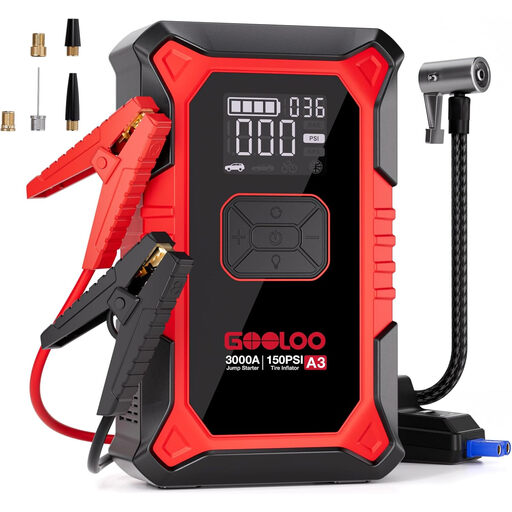
Why This Fits Their Persona: Ideal for the driver of a standard passenger car or small SUV who wants a reliable, no-frills solution. This device offers a great balance between starting power and a functional compressor, without making you pay for extras you'll rarely use.
The specs are clear: 3000A peak power is suitable for most engines (up to 9.0L gas/6.5L diesel, according to GOOLOO). The compressor has an airflow of 35 LPM, which avoids the slow-pump pitfall.
A great balance of starting power and compressor speed. The digital display with an auto-shutoff feature makes tire inflation simple and accurate.
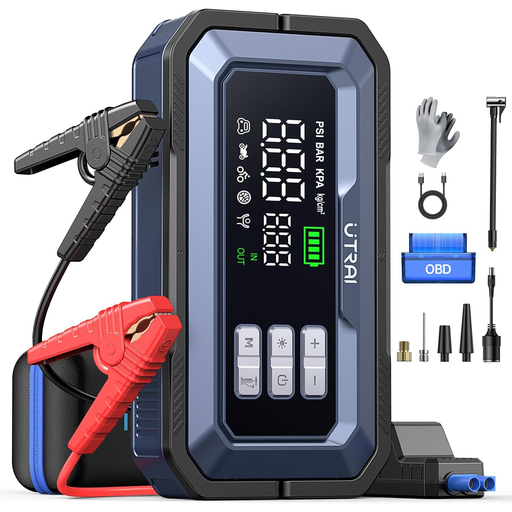
Why This Fits Their Persona: Perfect for the DIY enthusiast, camper, or owner of a van or large diesel vehicle. This model offers extreme power and handy extras like an OBD2 fault code reader and a powerful 160W DC output for other 12V devices.
With a peak power of 7000A and suitability for diesel engines up to 14L, this solves the "peak amps myth" for heavy-duty vehicles. The V0 flame-retardant casing and 10-fold protection system address concerns about durability and safety.
Extremely high starting power and unique extra features like an OBD2 adapter and a 160W DC output. The 2000-lumen work light is also significantly more powerful than most competitors.
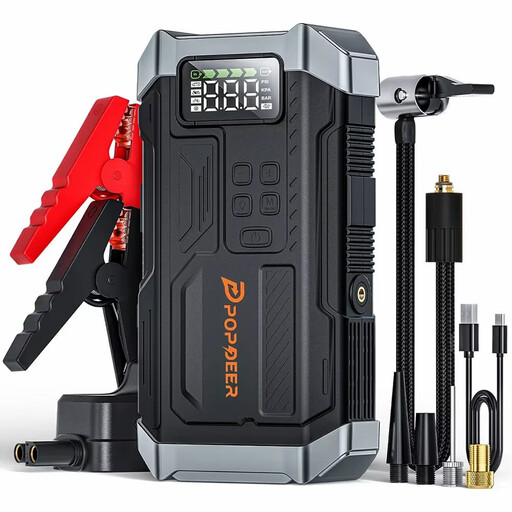
Why This Fits Their Persona: For the family car owner or commuter who wants to be prepared with a powerful and safe device. The 5000A peak power is more than enough for most cars and SUVs, and the focus on safety and cooling provides extra peace of mind.
This model tackles the pitfall of overheating and short lifespan with a honeycomb cooling system. According to POPDEER, this improves heat dissipation and extends the device's life. The auto-shutoff function on the compressor prevents over-inflation.
Strong starting power (5000A) combined with a focus on safety and thermal management. At 35 LPM, the compressor is also impressively fast.
We have compiled a complete, up-to-date list of products that fully meet these strict selection criteria and local safety regulations.
Most manufacturers recommend fully charging the device every 2 to 3 months, even if you haven't used it. This helps keep the battery in good condition and ensures the jump starter is ready for an emergency. Always consult your specific model's user manual for the best maintenance advice.
It depends on the engine size and the outside temperature. A peak power of 2000A might be sufficient for smaller diesel engines (e.g., up to 6.0L, according to some manufacturers), but it's a risk for larger engines or in cold weather. Cold reduces the effectiveness of both the car battery and the jump starter. For an average diesel car in Europe, a model with 3000A or more is a safer choice.
This is generally not recommended. Using functions like the compressor or the jump-start feature while the device is charging can overload the internal battery and electronics. For the safety and longevity of the device, it's better to charge it first and then use it disconnected from the power source.
