For a few shirt collars or quick ironing sessions, a standard steam iron with an easy-to-manoeuvre tip is a sensible choice; also consider the controls and maintenance. A steam generator may suit long ironing sessions with lots of laundry, provided you have space for the separate tank and a suitable ironing board. Always follow the care label for each collar, even if the iron has an automatic temperature setting.
Who is this advice for?
If you quickly iron a few collars
If you iron one or a few shirts in a row, look for a soleplate tip that lets you reach collar points and seams easily, without having to set up a large system. Consumentenbond recommends a steam iron if you do little ironing or have limited storage space.
If you have limited storage space
In a small utility room, it’s not just the size of the iron that matters: you also need room for the water tank and ironing board. Consumentenbond lists limited storage space as a reason to consider a steam iron.
If you have long ironing sessions
When you have a large pile of laundry, tank capacity and how often you need to refill it may matter more than they do for a quick ironing session. Compare the storage space required and check that your ironing board is suitable before choosing a system with a separate tank.
What should you look for when choosing?
Standard steam iron
Suitable for: quick ironing sessions, a few collars and limited storage space.
Bear in mind: you may need to refill a smaller tank more often during longer sessions; the iron may also feel heavier in your hand than the hand unit of a steam generator.
Steam generator
Suitable for: regular, long ironing sessions with lots of laundry or stubborn creases, if you have room for the tank and a suitable ironing board.
Bear in mind: the larger system needs more storage space and may require a different ironing board; if you only iron a collar now and then, you may not need the extra capacity.
For collar details, the shape of the soleplate tip and the controls matter; for long sessions, tank capacity and refilling become more important. Compare continuous steam like for like, and compare a steam boost only with another steam boost.
| What to consider |
What to look for |
Best suited to |
| Collar points and seams |
Look at the shape and reach of the soleplate tip, and check how you control the steam and temperature. |
If I want to work precisely around collar points and seams, I check whether the tip can reach them easily. Around 36% of consumers prioritise precision around collars above all else. |
| Space and quick sessions |
Check how much room the appliance and tank take up, and where you can put them down safely. |
In a small utility room, for quick ironing sessions, I don’t want to store an unnecessarily large system. Around 29% of consumers prioritise space and convenience for short sessions. |
| Steam for large piles of laundry |
Compare continuous steam with continuous steam, and steam boosts with steam boosts; also check that your ironing board is suitable. |
If I have long sessions with lots of laundry, I want to refill less often, so extra capacity may matter. Around 21% of consumers care most about large ironing piles and steam capacity. |
| Fabric care and maintenance |
Read the care label and the instruction manual; follow the descaling instructions for the exact model. |
When I iron different fabrics, I want to know what heat and steam the care label allows and how to maintain the appliance. Around 14% of consumers put fabric care and maintenance first. |
How to avoid common buying mistakes
-
Confusing a high steam boost with continuous steam
Manufacturers list continuous steam and a separate steam boost as different figures. For collars, it also matters whether the soleplate tip can reach the area you want to iron.
Compare the same types of steam specifications and check the soleplate tip on the exact model.
-
Choosing a steam generator when you only iron a collar now and then
A generator takes up more space and may require a different ironing board. You may not need the extra capacity for occasional collar touch-ups.
Choose that extra capacity mainly if you also have long sessions with lots of laundry; check your available space and ironing board first.
Allow for extra storage space and possibly a larger or more suitable ironing board.
-
Assuming an automatic temperature setting makes every garment safe to iron
Temperature technology doesn’t override the care label: some fabrics must not be ironed or steamed.
Read the care label before ironing the collar and follow its instructions on the permitted heat and steam settings.
Brands to consider
Braun
The TexStyle range includes steam irons with model-specific features that may be useful when ironing collar details.
- For the SI 3030, Braun lists a precision tip, manual thermostat, self-cleaning function and 270 ml tank; the SI 7160 has a precision tip and a 300 ml tank.
- These specifications don’t show that the models iron collars better than other irons.
Philips
The Azur DST8070/80 is an example of a model with one automatic temperature setting for ironable fabrics.
- Philips lists 110 g/min continuous steam and a 260 g Turbo Boost for this model.
- Philips’ claim about protection against scorching applies to ironable fabrics. Still check the garment care label, and keep the two steam figures separate.
Tefal
The Puregliss FV8066E0 is an example of a steam iron designed with limescale filtration in mind.
- For the FV8066E0, Tefal lists 50 g/min continuous steam, a 280 g steam boost and a Micro Calc Filter.
- Claims about stain protection and repairability don’t necessarily apply to the entire product range.
Rowenta
The STEAMFORCE DW9240D1 steam iron is worth including in your comparison if steam performance matters as well as collar details.
- Rowenta’s model description mentions a steam boost with the power of a steam generator.
- This is a brand claim, not an independent equivalence test. Assess the soleplate tip, handling and maintenance of the exact model separately.
Irons at Joybuy
This selection includes easy-to-handle steam irons and standard steam irons for quick ironing sessions and garment care.
 No image available
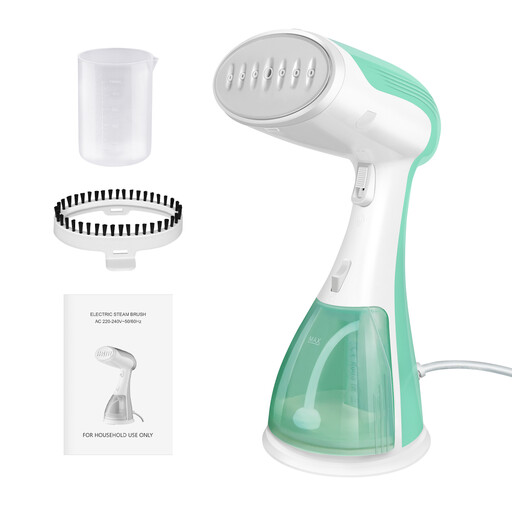
Handheld steam iron, 1500 W
According to its product name, this portable model is designed for use at home and when travelling.
The description lists a 300 ml tank and a steam output of 27 g/min.
View at Joybuy
 No image available
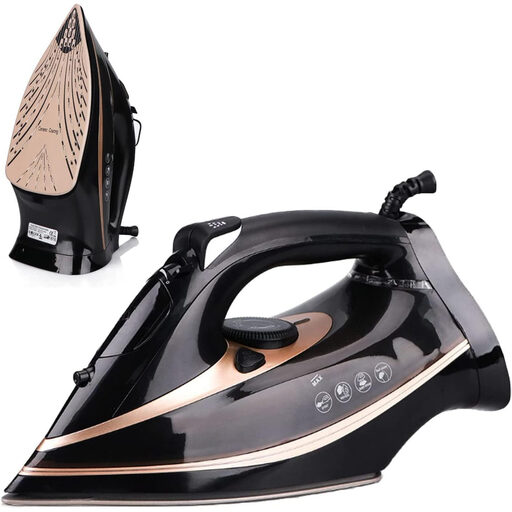
Steam iron, 2600 W, with ceramic soleplate
An option to compare if you’re looking for a standard steam iron for quick ironing sessions.
The description lists 70 g/min continuous steam, a 120 g steam boost and a 300 ml tank.
View at Joybuy
 No image available
Handheld steam iron, 2400 W, with non-stick soleplate
According to its product name, this easy-to-handle model is designed for use at home and when travelling.
The product description lists five temperature settings and a self-cleaning function.
View at Joybuy
 No image available
Xiaomi BHR9034EU handheld steam iron
This model offers both dry ironing and steam ironing.
The product specifications list manual temperature and steam controls, a weight of 0.77 kg and dimensions of 25 × 7,50 × 13,50 cm.
View at Joybuy
 No image available
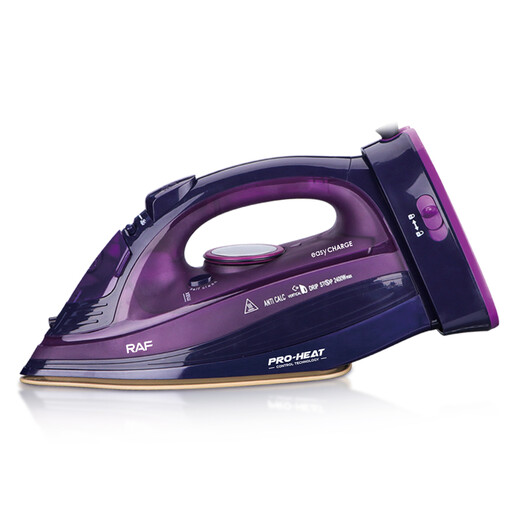
RAF R.1210B Purple cordless steam iron
The product description mentions a precision tip for tricky areas such as collars and between buttons.
The product name lists 2400 W, a 320 ml tank and a steam output of 15–25 g/min.
View at Joybuy
Frequently asked questions
How do I iron a shirt collar without ignoring the fabric care instructions?
First check the care label, and don’t iron the garment if the iron symbol is crossed out. Philips recommends laying the collar flat, ironing the underside first and then the outside; adjust the heat and steam to suit the specific garment.
How do I maintain the steam function?
Follow the maintenance procedure for your model. For example, Philips describes Self Clean and model-specific Quick Calc Release, and recommends descaling regularly; don’t assume these instructions apply to another brand.
Do I need an extended warranty if the iron breaks?
Not automatically. According to the Dutch government, statutory warranty in the Netherlands has no fixed legal time limit; the seller must provide a solution if a product is faulty. An additional paid warranty is mainly worthwhile if its terms genuinely give you extra rights.
Which product marking is relevant when buying in the Netherlands?
Electrical equipment covered by the EU Low Voltage Directive must carry the CE marking when placed on the EU market. EUR-Lex and Business.gov.nl explain that CE is a manufacturer’s declaration of conformity, not an independent quality mark or proof of ironing performance.


