If you have limited storage space and just a few cotton shirts to iron, a standard steam iron is usually the best choice. It’s more compact than a steam generator and has a soleplate for collars and cuffs. If you often iron large piles of laundry, a generator’s larger tank can be useful, provided you have room for the whole appliance. A hybrid model may be handy for quick touch-ups, but check that it gives cotton the finish you want.
Which appliance is right for you?
For ironing with limited cupboard space
You iron cotton shirts and want to be able to put the appliance away easily. Compare the space needed for the whole appliance and any ironing board. The Consumers' Association says a standard steam iron is more suitable than a steam generator when storage space is limited.
For a crisp finish on shirts
You prioritise smooth cotton and precise ironing around the collar and cuffs. The Consumers' Association notes that ordinary cotton is harder to smooth out than lightweight synthetic fabric.
For frequent ironing with limited storage space
You want to refill the water less often during longer ironing sessions, but still need to find room for the tank and the whole appliance. So compare both the tank capacity and the space the complete appliance takes up.
What should you consider when choosing?
Standard steam iron
Best if: you iron a few cotton shirts, have limited storage space and want a soleplate for detailed work.
Bear in mind: the smaller tank may need refilling more often during longer sessions.
Hybrid iron and clothes steamer
Best if: you want to freshen up hanging clothes and sometimes iron horizontally. Tefal describes the Duo Power JF4031E0 as a model with both modes and an included ironing mat.
Bear in mind: the features and any time-saving claims come from the manufacturer; they don’t prove how smooth a cotton shirt will be.
Handheld clothes steamer
Best if: you mainly want to remove light creases from hanging clothes without setting up an ironing board.
Bear in mind: Tefal says vertical steaming doesn’t provide the pressure of horizontal ironing, so don’t assume it will give cotton the same finish.
Steam generator
Best if: you regularly iron lots of shirts or other laundry in one go and have a suitable place to store it.
Bear in mind: the separate tank means you’ll need extra space for the complete appliance.
| What to consider |
What to check before buying |
Who is this important for? |
| Storage space |
Compare the dimensions of the complete appliance and check whether you’ll need an ironing board to use it. |
I want to put the appliance away in a small cupboard after use and have space for the ironing setup I need. Around 34% of consumers put storage space first. |
| A crisp finish on cotton |
Check the soleplate tip, steam settings and care instructions on your shirt; look for test results on cotton where available. |
If I want a precise finish on cotton, collars and cuffs, the ironing results matter more than extra features. Around 33% of consumers prioritise a crisp finish on cotton. |
| Quick touch-ups |
Check whether the appliance can steam vertically and iron horizontally, and whether it includes a mat; decide what kind of finish you need. |
When I’m freshening up one shirt, I don’t want to spend long setting everything up. Around 20% of consumers prioritise quick touch-ups. |
| Long ironing sessions |
Compare the tank capacity, weight and dimensions of the complete appliance; also check that it fits your ironing board. |
When I have a pile of shirts to iron, I want to stop less often to refill the water without overlooking the storage space I’ll need. Around 13% of consumers prioritise long sessions. |
Common buying mistakes
-
Assuming a compact steam generator is the same as a standard iron
A generator still has a separate tank. The Consumers' Association warns that generators can be harder to store and may be too large or heavy for a standard ironing board.
Before buying, measure the space you have for the whole appliance and check that your ironing board is suitable.
-
Choosing a handheld steamer as a replacement just to save space
Vertical steaming without pressure is different from horizontal ironing with a hot soleplate. The Consumers' Association notes that ordinary cotton is harder to smooth out than lightweight synthetic fabric.
Decide in advance how crisp you want the finish on your shirt, collar and cuffs to be. If that’s your priority, choose an appliance with a soleplate.
-
Assuming an anti-scale system means maintenance-free use
An anti-scale system can slow the build-up of limescale, but maintenance is still needed, according to the Consumers' Association.
Check the manual for the specific model to see whether the system needs cleaning or has replaceable parts.
Brands to compare
Philips
Philips offers standard steam irons such as the DST3031/20, as well as steam generators such as the PSG3000/20.
- Philips lists a 300 ml tank for the DST3031/20. For the PSG3000/20, it specifies continuous steam of 120 g/min and a steam boost of 350 g.
- These steam figures are Philips specifications and don’t prove that the generator irons cotton shirts better. The separate tank also takes up extra storage space.
Tefal
Tefal offers standard steam irons and the Duo Power JF4031E0, which combines horizontal ironing and vertical steaming and comes with an ironing mat.
- Tefal lists a 270 ml tank, continuous steam of 40 g/min and five temperature settings for the FV2838E0.
- The Duo Power’s features and time-saving claims come from the manufacturer; they don’t establish an independent result for cotton shirts.
Braun
Braun offers standard steam irons in the TexStyle 3 range. The SI 3055 is one model to compare if a precision tip matters to you.
- Braun’s Dutch catalogue lists a 270 ml tank, a precision tip and automatic shut-off for the SI 3055.
- Check the features of each variant. Braun’s claims about soleplate technology aren’t independent proof that the range smooths cotton more effectively.
Joybuy irons and steamers
This selection includes standard steam irons and a hybrid model for anyone who wants to iron horizontally and steam clothes.
 Image unavailable
2400 W steam iron with non-stick soleplate
A standard steam iron for anyone who wants to iron cotton shirts horizontally without having to store a separate generator base.
Power: 2400 W. The product name specifies a non-stick soleplate.
View at Joybuy
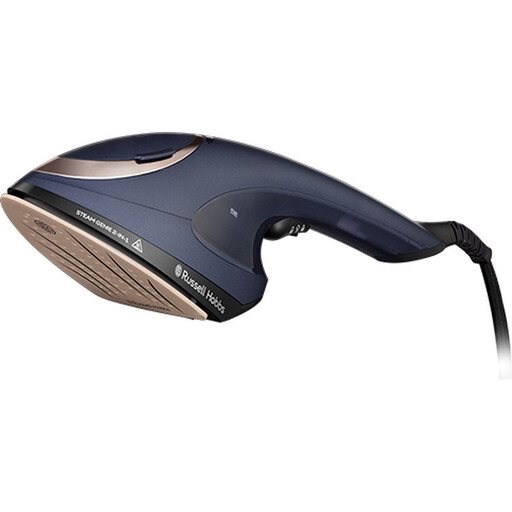 Image unavailable
Russell Hobbs Steam Genie 2in1 (28370-56)
A hybrid option for anyone looking for an ironing function and a steaming function in one appliance.
Model: Steam Genie 2in1 (28370-56).
View at Joybuy
 Image unavailable
Xiaomi Handheld Steam Iron BHR9034EU
A compact option for anyone looking for an iron that, according to the product information, can also steam vertically.
Model: BHR9034EU. The product name specifies dual voltage; check that the stated voltage suits your use.
View at Joybuy
 Image unavailable
Philips 1000 Series DST1030/20 steam iron
A standard steam iron for anyone looking for a soleplate to tackle creases in shirts.
Power: 2000 W. The product name specifies the colour as blue and white.
View at Joybuy
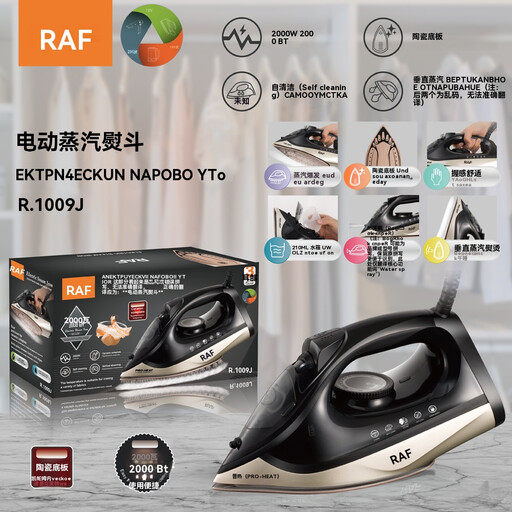 Image unavailable
RAF 2000 W steam iron
A standard steam iron for anyone looking for a soleplate and steam function for shirts.
Power: 2000 W. The product name specifies a ceramic soleplate and a 210 ml water tank.
View at Joybuy
Frequently asked questions
What temperature should you use for a cotton shirt?
Follow the shirt’s care instructions, as the fabric composition or finish may vary. The Consumers' Association warns that too much heat can damage fabric; the ironing symbols may indicate maximum temperatures of 110 °C, 150 °C or 200 °C.
What water should you use, and how can you prevent limescale problems?
Follow your model’s manual for guidance on water and descaling. The Consumers' Association says that steam irons and generators are designed for tap water. Don’t use perfumed ironing water or additives unless the manual specifically allows it.
Do you need a permit to use an electric iron at home in the Netherlands?
EU rules on low-voltage equipment cover the placing of electrical equipment on the market, not permits for normal household use. For equipment within the applicable range of 50 to 1,000 V AC, market operators have obligations, including requirements relating to CE marking and safety information. Check the conformity and mains voltage of the specific product separately.
Who should you contact about a faulty product, and is the warranty always exactly two years?
If a product is faulty, contact the seller. According to the Dutch government, the Netherlands has no fixed statutory warranty period of exactly two years. What you can reasonably expect depends, among other things, on the product, its price and the information provided at the time of sale.


