
Vandaag of morgen in huis

Kwaliteit gegarandeerd

Welkomstaanbiedingen ontgrendelen: GRATIS bezorging | Tot 80% korting | Gratis 30 dagen JoyPlus-proefperiode
Download de app
Imagine coming home after a long day and plugging in your electric car right away. No more searching for an available public charging station, no more unexpected fees. A dedicated home charger offers convenience and full control over your charging costs. However, with so many options on the market, choosing the right charging station for your electric vehicle can be a challenge.
This guide is designed to help you. We'll explain the most important specifications and provide concrete recommendations, so you can make an informed choice that suits your car, your home, and your budget.
Before you buy a wallbox, it's wise to consider a few technical aspects. These factors determine how quickly your car charges and how the station interacts with the rest of your household's electrical system.
The charging power, expressed in kilowatts (kW), determines the charging speed. Most home charging stations offer a power output of 11 kW or 22 kW.
A smart charger offers significant advantages in terms of cost and safety.
In Europe, the Type 2 EV charger connector (also known as the Mennekes plug) is the standard for alternating current (AC) charging. Virtually all modern electric cars and charging stations sold in Europe use this connection, ensuring broad compatibility, so this is not something you typically need to worry about.
Based on functionality and specifications, we have selected a few models that meet the needs of many EV drivers.
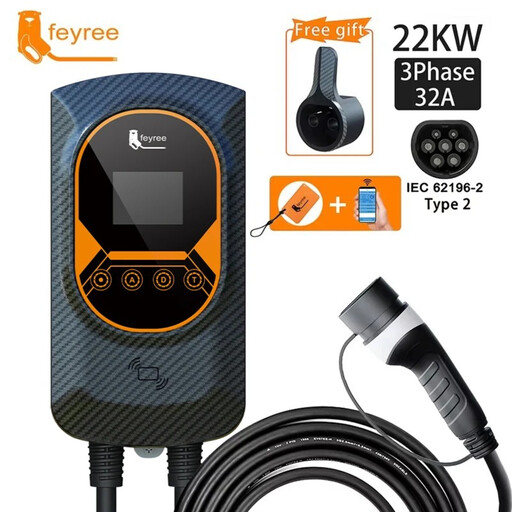
Why it stands out: This model combines a high maximum power output with extensive smart features. Control via the Tuya Smart app makes it easy to manage and schedule charging remotely.
Key Features:
Who is it for? For the EV driver with a 3-phase connection who wants to be future-proof and desires full control via an app. Ideal for those looking to optimise the charging process for cost savings.
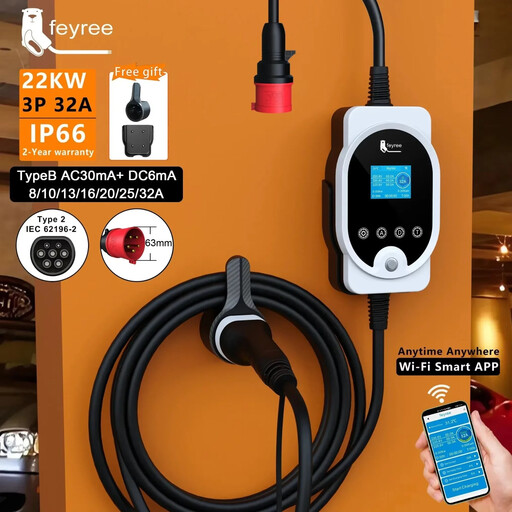
Why it stands out: This is a hybrid solution: a powerful home charging station that can also be taken along as a portable charger. This flexibility is unique and practical for those who charge at multiple locations.
Key Features:
Who is it for? For the EV owner seeking maximum flexibility. Perfect if you want to charge not only at home but also regularly at other locations (like a holiday address or at a relative's house) without relying on public stations.
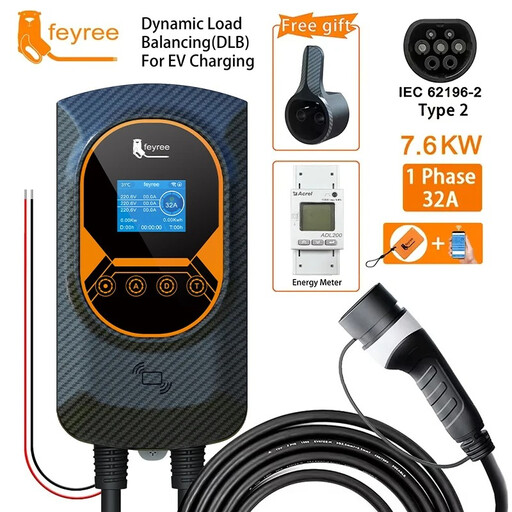
Why it stands out: The built-in Dynamic Load Balancing (DLB) feature is the key characteristic of this charging station. It protects your home's main circuit breaker by automatically adjusting the charging power based on total energy consumption.
Key Features:
Who is it for? Ideal for households with a more limited grid connection or where multiple energy-intensive appliances are often used simultaneously. If preventing power outages is your priority, a charger with DLB is a wise choice.
If these models aren't quite what you're looking for, or if you'd like to compare more options, we understand. Every situation is unique, and the right choice depends on many factors. Explore our full range for more possibilities.
The difference lies in the grid connection and the maximum charging power. A single-phase charger connects to one power line (phase) and typically delivers up to 7.4 kW. A 3-phase charger uses three power lines and can deliver higher power, usually 11 kW or 22 kW, resulting in significantly shorter charging times. The choice depends on your electrical panel and your car's maximum charging capacity.
It's not essential, but it is very convenient. An app allows you to schedule charging sessions during off-peak hours, which directly saves money on your energy bill. Additionally, it provides insight into your consumption and the charging status, contributing to a better user experience.
Dynamic Load Balancing (DLB) is a smart feature that automatically adjusts your car's charging speed based on the total power consumption in your home. If you turn on other high-power appliances, the charger reduces the power to the car to prevent the main circuit breaker from tripping. You primarily need this if your grid connection has limited capacity or if you frequently use heavy appliances (like a heat pump, induction hob, or tumble dryer) at the same time as charging your car.
