
Vandaag of morgen in huis

Kwaliteit gegarandeerd
Download de app
Categorieën

Purchasing a food processor is a significant decision, not one to be taken lightly. The market is vast, and specifications can be confusing. The wrong choice can lead to an unused appliance taking up valuable counter space. The goal is to find a machine that genuinely simplifies your kitchen tasks, whether it's preparing dough, slicing vegetables, or blending smoothies. An all-in-one food processor can combine the functions of several separate appliances, saving you both space and money. This guide will help you make an informed decision based on key product features.
To select the right food processor, it's helpful to base your choice on several objective criteria. These include power, capacity, and the included accessories.
Power, measured in watts, indicates the motor's strength. For light tasks like mixing liquids or whipping cream, a lower wattage is sufficient. For more demanding jobs, such as acting as a dough kneader or grinding hard ingredients, a motor with a higher wattage (e.g., 900W or more) is recommended.
The capacity of the mixing bowl, measured in litres, determines how much you can process at once. A 2-litre bowl is often adequate for a small household, while families or avid bakers will benefit more from a 3.5-litre bowl or larger. Also, consider the material of the bowl and accessories. Stainless steel is durable and won't absorb odours or stains, while plastic is lighter in weight. Check if the components are dishwasher-safe for easy maintenance.
A food processor's versatility is defined by its included accessories. A model that functions as a blender and food processor in one comes equipped with blades for chopping and puréeing as well as a blender jug for liquids. Other useful attachments include:
Below is a selection of models with different specifications, allowing you to make a comparison based on your personal needs.
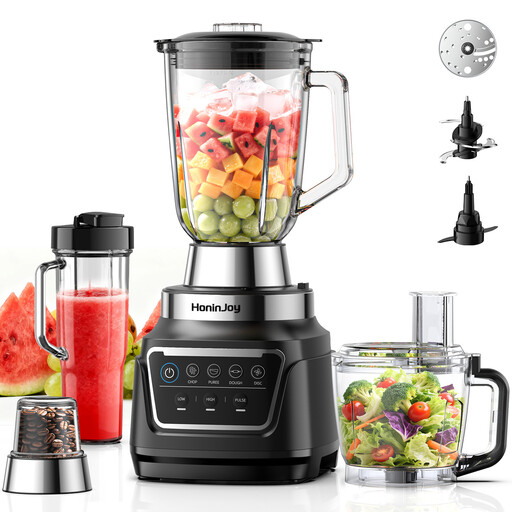
Why We Chose It This model is designed as a complete all-in-one food processor. It combines a powerful motor with an extensive set of accessories, making it suitable for a wide range of tasks, from making smoothies to preparing dough and slicing vegetables.
Key Features
Who It's For For users seeking maximum versatility from a single appliance. The variety of included jugs and cups makes it a practical choice for both family meals and individual portions.
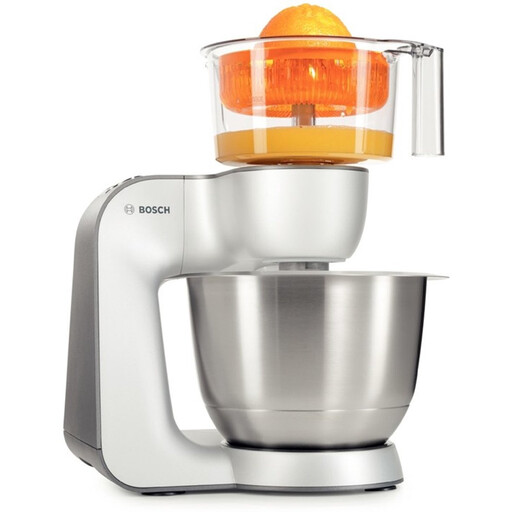
Why We Chose It The Bosch MUM 5 is aimed at users who regularly process large quantities, with a special focus on kneading dough. Its large stainless steel bowl and powerful motor make it a reliable workhorse in the kitchen.
Key Features
Who It's For Ideal for home bakers and larger families. The combination of a large bowl and specialised accessories like the meat mincer and dough kneading function provides functionality for extensive meal preparation.
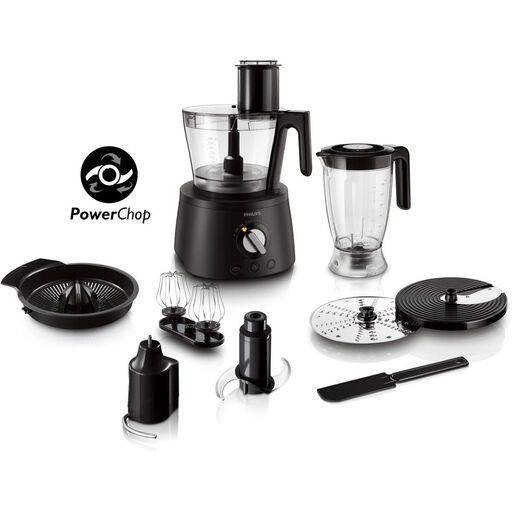
Why We Chose It This food processor with blender from Philips combines high power with user-friendly features. The one-touch auto buttons and large number of speed settings give the user precise control over the final result.
Key Features
Who It's For For the user who wants a powerful yet intuitive machine. The combination of manual control and automatic programs makes the appliance accessible for both beginners and more experienced cooks.
The right choice is a personal one, depending on your cooking style and kitchen space. You might be looking for a more compact model, a machine with a different specific function, or something that fits another budget. The products above are just a sample of what's available.
For a broader overview of models with different specifications and price points, you can browse our full collection. View our full range of Blenders and Kitchen Machines for more models.
The terms are often used interchangeably, but traditionally, there is a key difference. A stand mixer is primarily designed for mixing and kneading with a large bowl and a planetary mixing arm. A food processor is typically focused on chopping, slicing, and puréeing with blades and discs in a sealed bowl. Today, many models are hybrids that function as a blender and food processor in one.
This depends on its intended use. For mixing soups and smoothies, 500-700W is often sufficient. For regularly kneading heavy dough or crushing ice, a motor of 900W or more is recommended for better performance and a longer motor lifespan.
Yes, many food processors are equipped with a special dough hook and have enough power to function as a dough kneading machine. Always check the model's specifications to ensure it is suitable for the type and quantity of dough you plan to make.