
If you’re serving a selection of fillings
You’re looking for rolls that work with several parts of your dinner. If you’re choosing part-baked rolls, you’ll also want to know how much oven space and time you’ll need just before serving.


If you’re serving a selection of fillings at dinner, consider white rolls. If the type of grain and fibre content matter more to you, compare wholemeal and multigrain options. Choose between part-baked rolls and rolls baked in store according to your serving schedule. Check the quantity, preparation instructions and ingredients for each product: ‘medium sliced’ doesn’t, by itself, tell you whether a roll has already been cut open.
You’re looking for rolls that work with several parts of your dinner. If you’re choosing part-baked rolls, you’ll also want to know how much oven space and time you’ll need just before serving.
You want to compare white, wholemeal and multigrain rolls. Check the ingredients and nutritional information per 100 g rather than relying on the name or picture alone.
You’ll want to check whether your chosen rolls are suitable for your guests. Read the latest ingredients and allergen information for that specific variety.
First decide which type of roll you want to serve and how you’ll get them onto the table on time. Then compare the number of rolls in each pack and check the ingredients for the people joining you.
| What to consider | What to check when buying | Who it matters to |
|---|---|---|
| Versatility at the table | Compare the type of roll and count how many are in each pack. | If I’m serving several types of filling, I want to choose rolls that suit my menu. This is the top priority for roughly 40% of consumers. |
| Grain type and fibre | Check which types of flour are used and compare the fibre content per 100 g. | For my dinner, I want to make an informed choice between white, wholemeal and multigrain rolls. Grain type and fibre are the main consideration for around 30% of consumers. |
| Ingredients and allergens | Check the latest information for your chosen variety, including if the packaging or recipe has changed. | If a guest needs to avoid certain ingredients, I want to know what’s in the rolls before I buy them. This check is the top priority for around 20% of consumers. |
| Preparation and storage | Check the preparation instructions and storage information, and make sure the number of rolls suits your party. | With a full oven during dinner, I want to be able to plan when to bake and serve the rolls without making too many. This planning matters most to around 10% of consumers. |
Those words don’t tell you how many rolls you’ll get or whether they’ve already been cut open. A product photo may not make that clear either.
Check the number of rolls and, if necessary, ask whether they’ve been sliced before choosing them for dinner.
The multigrain rolls described by PLUS contain ingredients including wheat and rye. So ‘multigrain’ doesn’t mean a roll is suitable for a guest who needs to avoid gluten.
Ask your guests about any relevant dietary requirements and read the latest ingredients and allergen information for the product you’re actually buying.
Choosing based only on an online description may leave important questions about the pack you’ve selected unanswered. Lidl refers customers to the packaging for the ingredients in its food products.
Check the label on your chosen rolls, especially if ingredients or allergens are important to your decision.
If you want crisp rolls when you serve them, time the baking to fit in with the rest of your dinner. Preparation instructions can vary from product to product.
Read the packaging and plan how many rolls to bake for each serving. Follow the storage advice for any rolls you don’t use; according to the Voedingscentrum, bread gets drier the longer it stays in the freezer.
Albert Heijn lists white and wholemeal rolls in its range.
PLUS describes white and multigrain part-baked rolls in 300 g packs.
Dirk lists a pack of four white part-baked rolls, as well as an individual white roll.
Lidl describes bread baked in its stores.
These white rustic rolls are an option if you’re looking for rolls for dinner and want to be able to count them in advance. Check the packaging for preparation instructions and to see whether the rolls have already been cut open.
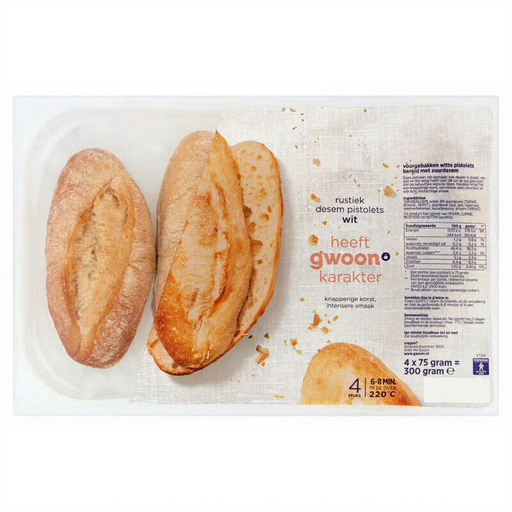 Image unavailable
For dinner with several guests, you can count on four rolls per pack. Before buying, check the packaging for preparation instructions, ingredients and whether the rolls have been sliced.
For PLUS’s white part-baked rolls, PLUS recommends 8–10 minutes in a preheated oven at 220 °C. For other rolls, follow the preparation instructions on their packaging. If you’re baking several batches, allow for the oven space you have available.
No. The name doesn’t mean a roll is gluten-free: the multigrain variety described by PLUS contains wheat and rye. If a guest needs to avoid gluten, check the gluten-free labelling and the packaging for the specific product.
Don’t assume so. PLUS lists iodised salt in the rolls it describes, but you’ll need to check the ingredients list on the latest packaging for the rolls you choose.
Yes. Plan your purchase around the date and storage advice on the packaging. According to the Voedingscentrum, you can freeze bread, but it gets drier the longer it stays in the freezer.