
If you want to blend soup straight in the pan
You’re cooking the beetroot soup in a pan and want to blend it there, without transferring it to another container.


If you’ve already cooked the beetroot soup in a pan, a hand blender lets you blend it without transferring it to another container. If you want to blend it in a separate jug, follow the temperature instructions for the exact model. A soup maker is a good choice if you want to combine heating and blending. For any model, check the permitted capacity and cleaning instructions too.
You’re cooking the beetroot soup in a pan and want to blend it there, without transferring it to another container.
You want to heat and blend with one appliance, and compare the programmes and permitted capacity.
You want to blend soup and other ingredients in a jug, and check that it’s suitable for the temperature of your soup.
When it comes to beetroot soup, your choice mainly depends on where you want to blend it and whether the appliance needs to heat it too.
A good fit if: the soup is already in a suitable pan and you don’t want to transfer it.
Bear in mind: you operate the blender yourself; a hand blender won’t cook the soup.
A good fit if: you want to blend the soup separately and the jug is suitable for the temperature you need, according to the instructions.
Bear in mind: you’ll need to transfer the soup and follow the temperature limit for the exact model.
A good fit if: you want to combine heating and blending in one appliance.
Bear in mind: check the model’s working capacity, preparation and cleaning instructions.
| What to consider | What should you check? | Who is this most important for? |
|---|---|---|
| Blending in the pan | Check whether the blender foot is detachable and read the instructions for using it in your pan. | If I’ve already made the soup in a pan and don’t want to transfer it, I prioritise blending it in that pan; this is the main need for around 36% of consumers. |
| Heating and blending | Check whether the exact model has a hot soup programme and what the minimum and maximum fill levels are. | If you’d rather heat and blend with one appliance, you’ll want to combine these steps; around 29% of consumers prioritise this. |
| Jug temperature | Read the temperature instructions for the full model number; limits don’t automatically apply to other models. | If I want to blend soup in a separate jug, I check that it’s suitable for the temperature; around 21% of consumers put this need first. |
| Cleaning and storage | Compare the components and check which parts can be detached and how they can be cleaned. | If I want to clean or store as few separate parts as possible after lunch, I pay attention to the appliance’s components; around 14% of consumers give this the highest priority. |
Temperature instructions are specific to each model. What’s permitted for one model’s jug doesn’t tell you what’s allowed for another.
Read the instructions for the full model number, and let the soup cool if they say to.
Using the jug at an unsuitable temperature could damage it or its accessories.
A heat-resistant jug and a built-in soup-heating function are two different things. A standard jug blender won’t heat soup by itself.
First decide whether you only want to blend, or whether you also want to heat the soup in the appliance. Then compare models.
If your blender doesn’t have a cooking function, you’ll still need a separate pan, which means more washing up.
Features can vary between models and versions, even when product names look similar.
Compare the full model number and relevant specifications on the product page with the instructions for that version.
The Bosch ErgoMaster MSM6M810 reviewed here is a hand blender for soup that’s already been cooked in a pan.
The MultiQuick 7 MQ7000WH reviewed here is a hand blender for blending soup in a pan.
The models reviewed represent two different options: blending in a jug and heating with a cooking blender.
The Viva Collection SoupMaker HR2203/80 reviewed here is designed for making and blending soup.
The Joybuy products below are hand blenders for soup that you cook in a pan yourself before blending.
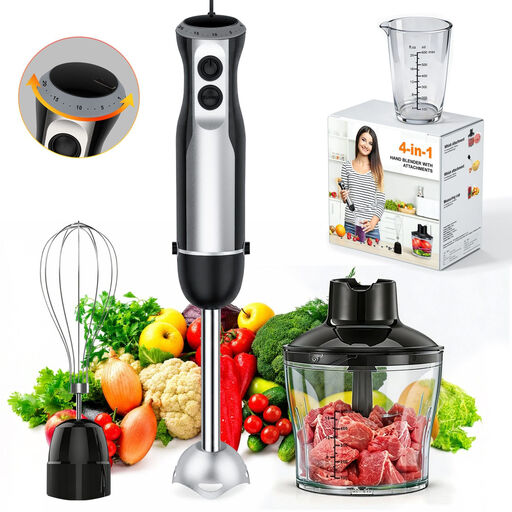 No image available
The product listing includes blending soup among its uses.
The product name lists 20 speeds and a turbo function.
 No image available
The product information lists blending and soup among its uses.
The product information warns against processing boiling liquids; follow the instructions for this model.
 No image available
The product information lists blending soup among its uses.
The product name lists 15,000 rpm, a 700 ml beaker and a 500 ml chopper bowl.
 No image available
The product information lists blending thick soup among its uses.
The product name lists a power rating of 800 W.
 No image available
The product information lists blending soup among its uses.
The product name lists two speeds, a 500 ml chopper bowl and an 800 ml beaker.
No. Follow the temperature instructions for the exact model. Philips advises letting ingredients cool to below 60 °C before using the HR2510/90, HR2511/90 and HR2512/90; this limit doesn’t automatically apply to other models.
According to the Netherlands Food and Consumer Product Safety Authority, CE marking is compulsory for electrical products covered by the relevant rules. This doesn’t confirm whether a particular model actually carries the mark; check the marking and the related product information before you buy.
According to the Dutch government, the seller is your point of contact if there’s a problem with a product. The Netherlands doesn’t have a fixed statutory two-year guarantee period; what you’re entitled to expect depends, among other things, on the product and the purchase information. For online purchases from a business, you’ll often also have a 14-day cooling-off period, subject to legal exceptions.
The Netherlands Nutrition Centre advises covering leftovers and putting them in the fridge or freezer within two hours of cooling. For chilled leftovers, it recommends keeping the fridge at 4 °C and storing them for no more than two days.