
Cook with limited worktop space
You want to juice beetroot without giving up too much permanent worktop space, so you also compare the appliance’s height and the space needed for collection containers.


Choose based on the space you have, how the juicer handles hard vegetables, and how much preparation and cleaning you’re happy to do. A compact centrifugal juicer could suit you if quickly juicing hard vegetables is your priority. A slim slow juicer is worth considering if a small footprint matters more and you don’t mind a slower process. Neither type automatically produces more juice or vitamins.
You want to juice beetroot without giving up too much permanent worktop space, so you also compare the appliance’s height and the space needed for collection containers.
You mostly juice hard vegetables and want to know how much chopping is needed, based on the feed chute and the model-specific instructions.
You want to be able to reach and clean the parts easily after every glass, so you compare the filters, cleaning brushes and dishwasher-safe parts.
Choose this option: if you want to juice hard beetroot quickly and can find a model that fits in your kitchen with all its parts in place.
Bear in mind: the Dutch Consumers’ Association describes centrifugal juicers as fast and suitable for hard vegetables, but often louder too. Check the dimensions of the specific model to make sure it will fit.
Choose this option: if a small footprint matters and you’re happy to juice more slowly. Bosch lists the MESM731M as 152 × 152 mm wide and deep.
Bear in mind: height, the feed chute and space for containers also matter. Kenwood’s stated dimensions, ‘43 x 15 x 20’, have no unit on the product page.
Choose this option: if less chopping matters more than having the smallest possible appliance. Princess lists a tilting 75 mm opening for the 202045.
Bear in mind: a wide opening doesn’t prove that every whole beetroot will fit. Check the instructions for hard vegetables and the storage space required.
| What to consider | What should you check? | Who is this important for? |
|---|---|---|
| Space for use and storage | Compare the width, depth and height with the space available. Also allow room for the feed chute and collection containers. | If I have limited worktop space, I want to know whether the appliance and its parts will fit. Around 31% of consumers prioritise space for the appliance. |
| Handling hard beetroot | Check the manual to see whether raw, hard vegetables are suitable, and what preparation and feeding method the manufacturer recommends. | If you mainly want to juice beetroot, you’ll want to make sure the model you choose is suitable for your ingredients and that you follow its instructions. Around 31% of consumers prioritise handling hard beetroot. |
| Cleaning after juicing | Check which parts can be removed, which the manufacturer says are dishwasher-safe, and how to clean the filter. | If I want to keep washing up to a minimum after each glass, I look for easy-to-reach parts and a filter that’s easy to clean. Around 25% of consumers put cleaning at the top of their list. |
| Quick and easy preparation | Compare the juicing method and feed chute separately. Check claims about speed and noise for the exact model. | If you want to make a glass quickly, consider both the juicing time and any chopping required. Around 13% of consumers prioritise quick or easy preparation. |
Princess gives apples and tomatoes as examples for its 75 mm opening. That doesn’t prove that beetroot of every size and shape will fit without being cut up.
Check the diameter of your ingredients and follow the model-specific instructions for hard vegetables.
An unsuitable feed chute may mean more chopping. Use the appliance according to the instructions to prevent it from getting blocked.
According to the Dutch Consumers’ Association, a slow juicer doesn’t automatically produce more juice. The juicing method alone doesn’t prove that the juice has greater nutritional value.
Choose based on your ingredients, available space and ease of use, rather than a general claim about juice yield or vitamins.
An appliance might not fit in your chosen spot because of its height, feed chute or separate collection containers. For example, Bosch lists the MESM731M as 427 mm high, while Princess includes two collection containers.
Measure the complete set-up, including clearance above the appliance and room to remove its parts.
A tight space can make it harder to fill the appliance and position the collection containers.
On a Bear product page we checked, the title names model YZJ-F01D6, while the specification field lists YZJ-D02F5.
Before treating a product as the model you’ve researched, check the brand, full model number and relevant specifications on the product details page.
The MESM731M is a slow juicer worth comparing if you’re looking for a documented slim footprint.
The Viva HR1832/30 is a compact centrifugal juicer option to compare if you want to juice hard vegetables quickly.
Kenwood describes the PureJuice One JMP400WH as its smallest model. It’s worth comparing if a slim appliance is important to you.
The 202045 Easy Fill is a slow juicer worth comparing if a wide feed chute and less chopping are important to you.
Hurom describes the H310A as a compact model with fewer parts.
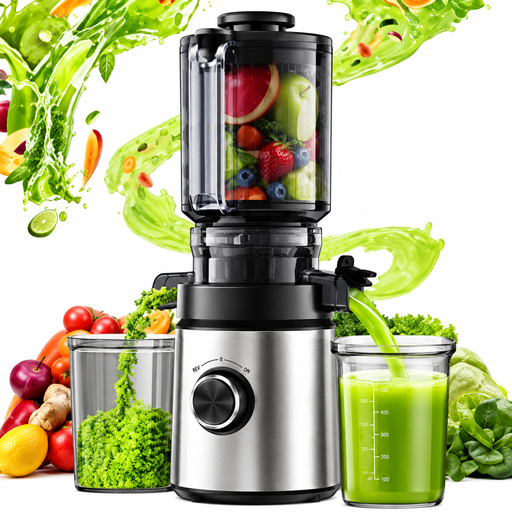
This Joybuy selection focuses on slow juicers with a wide feed chute, for anyone who wants to juice vegetables and fruit and compare the opening with their own preparation method.
 No image available
An option to compare if you’re looking for a slow juicer for vegetables and fruit with a wide feed chute.
The product name lists a 2 l capacity, a 130 mm XL feed chute and two glasses.
 No image available
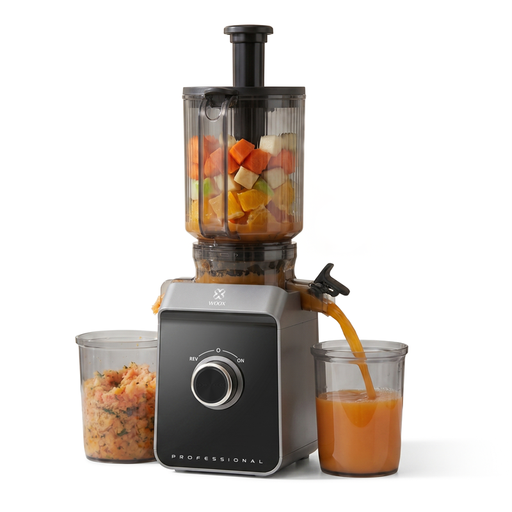
An option to compare if you’re looking for a slow juicer with a wide opening and published dimensions.
Power: 150 W. Dimensions: 189 × 170 × 395 mm. Feed chute: Ø130 mm. The product description lists a 600 ml juice jug and an 836 ml pulp container.
Do not use the appliance for more than 10 minutes at a time; allow it to rest for 20 minutes afterwards.
Yes. The Netherlands Nutrition Centre recommends washing raw vegetables thoroughly under running water and not using soap or bleach. Then cut the beetroot according to your appliance’s instructions.
No, that doesn’t automatically follow from the juicing method. According to the Dutch Consumers’ Association, a slow juicer doesn’t automatically produce more juice. The comparison cited also found no more vitamin C, iron, calcium or magnesium than in juice from a centrifugal juicer.
Check the manual for the exact model. Princess says the detachable parts of the 202045 are dishwasher-safe and includes a filter brush. Bosch lists dishwasher-safe parts for the MESM731M.
For a consumer purchase made online in the Netherlands, you’re generally entitled to a 14-day cooling-off period, starting the day after delivery. If there’s a fault, the Dutch government says the seller must provide a solution. Your statutory guarantee is separate from any manufacturer’s guarantee.
The Netherlands Food and Consumer Product Safety Authority (NVWA) states that electrical products requiring it under the applicable rules must carry a CE mark. According to the NVWA, low-voltage rules apply to electrical equipment within the voltage ranges specified there. Check the documentation for the specific model, rather than relying on a seller’s claim alone.