Brands and models to consider
The features below apply to the product ranges and models mentioned; they are not a general assessment of every appliance made by each brand.
Bosch
The MES4000 is a centrifugal juicer worth comparing if you’re looking for a generous feed chute and two speed settings.
- Bosch lists a ceramic blade, a 1500 ml juice container and dishwasher-safe parts for this model.
- The capacity of the juice container doesn’t tell you how much juice you’ll get from one beetroot. Check the manual to see which parts can go in the dishwasher.
Hurom
The H310A is a slow juicer to consider if you want to process other soft or hard ingredients as well as beetroot.
- Hurom lists three parts to wash for the H310A and gives its dimensions as 16 × 17,2 × 39,5 cm.
- Hurom notes that accessories may vary by country and that the stated motor warranty excludes consumable parts.
Braun
The MultiJuice 7 SJ7000GY is a centrifugal juicer worth comparing if the feed chute and pulp container are important to you.
- Braun lists a 75 mm opening, 1000 W of power and parts that are dishwasher-safe according to the instructions.
- The manufacturer’s claim that it makes a glass of juice in under 15 seconds is not a confirmed juicing time for beetroot.
Philips
The HR1922/21 is a centrifugal juicer to consider if you want to adjust the texture of your juice.
- Philips says FiberBoost offers settings for clearer or thicker juice.
- Juice made by separating out the pulp is not the same as blending the whole beetroot, with all its fibre, into a smoothie.
Joybuy products for beetroot juice
This selection includes a centrifugal juicer for hard beetroot and a slow juicer for anyone who also wants to juice other fruit and vegetables.
 No image available
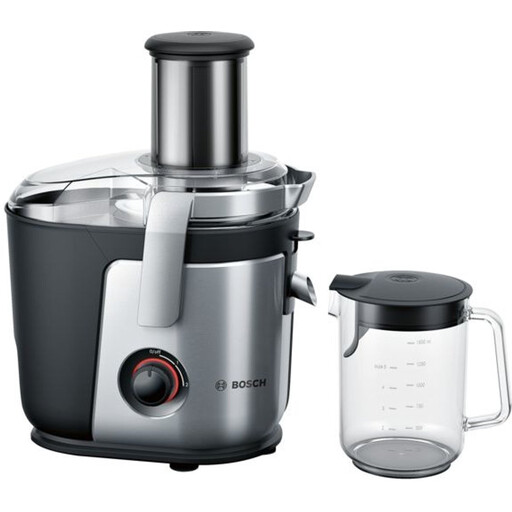
Bosch MES4000 centrifugal juicer
A centrifugal juicer to consider if you mainly want to process hard vegetables and juice them quickly.
The product information lists 1000 W, a ceramic blade, a 1,5 L juice container, two speed settings and an 84 mm feed chute. The removable parts are described as dishwasher-safe.
Before buying, check the CE marking and manual for this model. According to the Netherlands Food and Consumer Product Safety Authority, CE marking is mandatory for electrical appliances covered by the relevant regulations.
View at Joybuy
 No image available
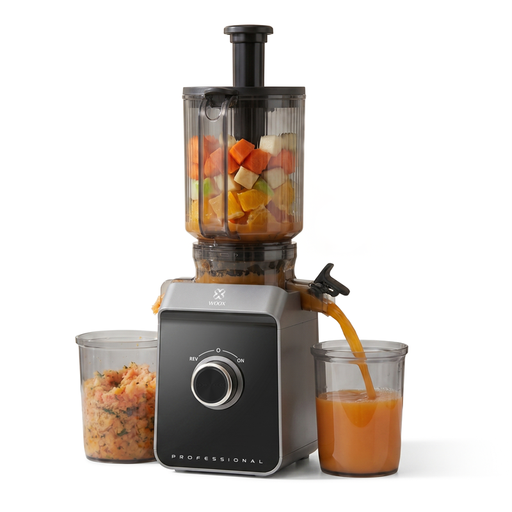
WOOX MX0289 slow juicer
A slow juicer to consider if you want to juice other fruit and vegetables as well as beetroot, and don’t mind a longer preparation time.
The product information lists 150 W, a 600 ml juice jug and an 836 ml pulp container. It also says to use the appliance for no more than 10 minutes at a time, then let it rest for 20 minutes.
Before buying, check the CE marking and manual for this model. According to the Netherlands Food and Consumer Product Safety Authority, CE marking is mandatory for electrical appliances covered by the relevant regulations.
View at Joybuy
Frequently asked questions
Should I choose a slow juicer because it makes healthier beetroot juice?
No, not for that reason alone. The Dutch Consumers’ Association says the comparative evidence it cites does not support claims that slow juicers produce juice with more vitamins or minerals than centrifugal juicers. If you want the fibre from the whole beetroot in your drink, a blender is a better fit. The Netherlands Nutrition Centre recommends eating vegetables rather than drinking them where possible.
How should I prepare raw beetroot?
Wash the beetroot under running water and brush off any soil, even if you plan to peel it afterwards. Follow the manual for the right size of pieces and how to feed the beetroot into the machine.
Can I make fresh beetroot juice ahead of time for my lunch break?
If possible, make it close to when you plan to drink it. The storage time for an opened shop-bought product does not automatically apply to freshly made, unpasteurised juice.
What are my rights if my online-bought juicer is disappointing or develops a fault?
For a standard online purchase as a consumer, you generally have a statutory 14-day cooling-off period after delivery, according to ACM ConsuWijzer. This is separate from your rights against the seller if the appliance does not perform as you could reasonably expect under normal use. A commercial manufacturer’s warranty does not replace your statutory rights.
What safety marking must an electric juicer have in the Netherlands?
An electric juicer covered by the relevant Dutch regulations for electrical equipment must have CE marking. The Netherlands Food and Consumer Product Safety Authority explains that the low-voltage rules apply to nominal AC voltages from 50 V to 1000 V. Check the marking on the specific model. CE marking is not proof that a product has been independently tested.


