
Workshop host preparing portions for a group
You want to know in advance how much hummus you can make in each batch, so you can plan realistic portions for your participants.


A food processor with a chopping blade is a good choice if you want to chop, slice or grate ingredients as well as make beetroot hummus during your workshop. For a simple, smaller batch of hummus, a hand blender may be enough. First, plan how much you’ll make in each batch and check the usable processing capacity, included attachments and cleaning instructions. The bowl’s total capacity doesn’t automatically tell you how much thick hummus you can make at once.
You want to know in advance how much hummus you can make in each batch, so you can plan realistic portions for your participants.
You’re making a smaller quantity and want to purée the beetroot and chickpeas to taste. A hand blender may also be an option.
You want to clean the parts between batches and, if you serve food to customers, take account of the relevant hygiene and allergen rules.
Choose this option: if you want to chop, slice or grate as well as purée. The Netherlands Nutrition Centre lists a food processor as an option for making hummus.
Bear in mind: extra attachments mean more cleaning. Check the processing capacity for your recipe.
Choose this option: if you’re making a simple batch of hummus and don’t need slicing or grating discs. The Netherlands Nutrition Centre lists a hand blender alongside a food processor.
Bear in mind: check that your chosen blender and beaker are suitable for the amount you’re making in each batch.
Choose this option: if small portions and straightforward chopping and puréeing are your priorities.
Bear in mind: a smaller bowl may mean making several batches. Check that the instructions allow thick mixtures.
| What to consider | What should you check? | Who is this important for? |
|---|---|---|
| Quantity per batch | Work out the ingredients for each batch and compare them with the processing capacity for the exact model and recipe. For the black Magimix CS 3200XL with citrus press, Magimix lists a total capacity of 2,6 l and a processing capacity of 1 l. | When I’m cooking for a group, I want to know in advance how much hummus will fit in the bowl in each batch. Around 36% of consumers prioritise the quantity per batch. |
| Puréeing and food preparation | Check whether the model includes a chopping blade and whether any discs are suitable for other workshop recipes. Distinguish between the functions of the processor bowl and those of any blender jug. | If I also want to chop or slice ingredients, I look for the right attachments. If I’m only making hummus, extra accessories are less important. Around 29% of consumers prioritise puréeing and other food preparation tasks. |
| Cleaning between batches | Check which parts can be taken apart and are dishwasher-safe according to the instructions. A claim that parts are dishwasher-safe doesn’t replace the need for a good cleaning routine or steps to prevent cross-contact. | If I’m preparing food for several groups or recipes, I want to be able to clean food-contact parts thoroughly. Around 21% of consumers prioritise cleaning between batches. |
| Worktop space and equipment | Measure the available worktop and storage space, then compare it with the dimensions and accessories of the exact model. Choose attachments that suit the tasks involved in your workshop. | If I’m cooking on a shared worktop, I want an appliance and accessory set that fit the space. Around 14% of consumers prioritise space and the equipment they need. |
Total capacity and processing capacity can differ. For the black Magimix CS 3200XL with citrus press, Magimix lists 2,6 l and 1 l respectively. Figures for liquids or total capacity don’t automatically tell you how much thick hummus you can make.
Plan your recipe batch by batch and check the instructions for the exact model and thick mixtures.
A lower permitted quantity per batch may mean extra processing rounds and more cleaning.
Slicing and grating discs are most useful if participants will use those functions too. The Netherlands Nutrition Centre lists both a food processor and a hand blender for making hummus.
First, decide which food preparation tasks participants will actually use the appliance for.
A claim may apply to certain accessories, but it doesn’t remove the need for suitable cleaning or, where relevant, consideration of allergens.
Check the instructions for each part and plan how you’ll manage ingredients and allergens. The NVWA sets out hygiene and allergen requirements for situations where those rules apply.
The MultiTalent 3 MCM3501M is a food processor with a chopping blade and discs, for anyone who wants to prepare vegetables as well as make hummus.
The black CS 3200XL with citrus press has multiple bowls, making it a good option if you want to organise different preparations.
The PurEase FP 3132 BK combines puréeing, chopping and slicing with a separate blender jug.
The MultiPro Compact FDP31.170GY has a blade and slicing/grating disc, and is designed for compact storage.
This selection includes food processors and compact choppers for making hummus and other chopping or slicing tasks. Don’t assume the stated bowl capacity is the same as the amount of thick hummus you can process in each batch.
 Image unavailable
A good option if you want to chop, slice or grate ingredients as well as make hummus.
The product name lists 800 W and a 2,3 l bowl. Check the processing capacity for your hummus recipe.
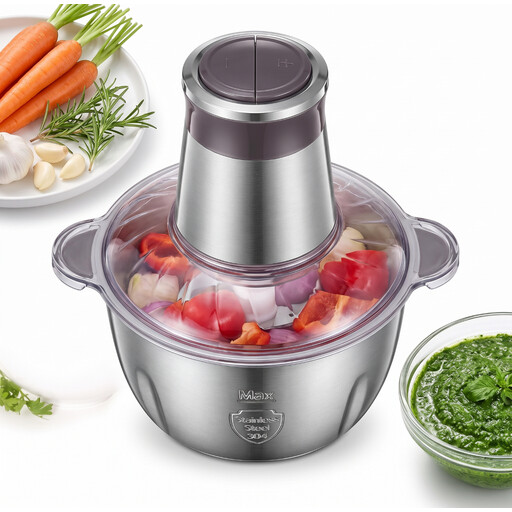 Image unavailable
A compact chopper option if you mainly want to chop and purée, as well as prepare vegetables.
The product name lists 350 W, a 2,5 l bowl, two speeds and three blades. Check the instructions before using it with thick mixtures.
 Image unavailable
The two bowl sizes may be useful if you’re making separate preparations in different quantities.
The product details list two glass bowls of 2 l and 0,6 l and a power rating of 300 W. The bowls and lids are not heat-resistant; avoid temperature differences of more than 50 °C.
 Image unavailable
An option if you want to purée cooked ingredients and stack the bowls for storage.
The product name lists 350 W and three stainless steel bowls of 2,5 l, 2,2 l and 1,8 l. The description says to pulse for no more than 30 seconds per cycle.
 Image unavailable
An option for dips and purées if you can cut the ingredients into smaller pieces beforehand.
The product name lists a 2 l glass bowl, 300 W power, two speeds and stainless steel blades. The description recommends cutting ingredients into 2 cm cubes and not running the motor for more than 30 seconds at a time.
Yes. The Netherlands Nutrition Centre lists both a food processor and a hand blender for making hummus. Check that your chosen appliance and beaker are suitable for the quantity you’re making, according to the instructions. The recipe information doesn’t compare performance when making large batches for workshops.
You can’t tell from the total bowl capacity alone. Magimix Netherlands lists a total capacity of 2,6 l and a processing capacity of 1 l for the black CS 3200XL with citrus press. Check the permitted quantity for the exact model and your recipe.
Unplug the appliance and follow the cleaning instructions for the specific model, including those for the bowl, lid and blade. Check whether each part is dishwasher-safe. For businesses preparing food, the NVWA highlights the importance of a clean and hygienic working environment.
If you sell or supply food to customers, the NVWA says you must inform them about any allergens present. So check the tahini and other ingredients. A workshop for private individuals only is not automatically considered to fall into this category.
For businesses that sell food or drink to customers, the NVWA sets out rules for preparing and storing it safely and hygienically in line with HACCP. Whether these rules apply to your workshop depends on how you organise it and provide the food.