What should you look for when buying?
Start by estimating the number of orders during a single interval. Then assess the space available, the type of milk service you want and the running costs.
Compact domestic automatic coffee machine
A good fit if: you mainly make coffee for a small group and the actual demand is within the capabilities of your chosen model. Philips says the EP1220/00 can make two cups of coffee at once.
The trade-off: making two cups at once does not tell you how many orders you can fulfil over an entire interval. A traditional milk frother also requires an extra step.
Professional automatic coffee machine
A good fit if: you regularly serve lots of visitors and have room for a larger machine and its cleaning routine. WMF recommends a maximum of 80 cups per day for the Peak 50.
The trade-off: daily capacity does not indicate how many drinks can be served during an interval. Ask about output for your interval length and drink mix, and check that the machine’s dimensions and daily cleaning routine will work in your space.
Narrow, one-cup machine
A good fit if: a narrow footprint and black coffee for a small group matter more than serving multiple cups at once. JURA gives the ENA 4 a width of 27,1 cm.
The trade-off: the ENA 4 has a 1,1 l water reservoir and makes one cup at a time, so it may not be the obvious choice for a busy interval queue.
| What to consider |
What to check before buying |
Who is this important for? |
| Output during the interval |
WMF recommends a maximum of 80 cups per day for the Peak 50; Philips says the EP1220/00 can make two cups of coffee at once. Ask about output for your interval length and drink mix. |
If I need to handle lots of orders during a short interval, I want to know how many cups the machine can make in that time. Around 36% of consumers prioritise output during the interval. |
| Size and access |
Measure the width, depth and height, and leave room for filling and cleaning. JURA lists the ENA 4 at 27,1 × 32,3 × 44,5 cm (w × h × d); Siemens lists the EQ300 TF301E09 at 383 × 251 × 433 mm (h × w × d), with front access. |
When preparation space is tight, I also need access to reservoirs and maintenance components. Around 29% of consumers put available workspace first. |
| Milk drinks and cleaning |
Compare the milk option on the exact version and check the cleaning instructions and how milk should be stored. |
If I want to serve cappuccinos, I need to be able to organise the extra preparation and cleaning. Around 21% of consumers prioritise milk service and the associated maintenance. |
| Running costs and servicing |
Consider the purchase price and coffee costs together. For regular use, ask about service terms for your intended setting. The Consumers’ Association highlights both purchase and coffee costs. |
If the machine will be used often, I want to factor in the costs and service terms for that level of use, rather than looking at the purchase price alone. Around 14% of consumers put total running costs first. |
Bean-to-cup machines at Joybuy
This selection features automatic bean-to-cup machines with functions that may suit a small coffee service, such as making two cups at once and a choice of milk options. These features do not indicate the machine’s total output during a theatre interval.
 No image available
Philips 1200 Series EP1220/00, matt black
For a small service, Philips’ function for making two cups of coffee at once may be useful. It is not a measure of total output during an interval.
The classic milk frother requires an extra step for milk drinks.
View at Joybuy
 No image available
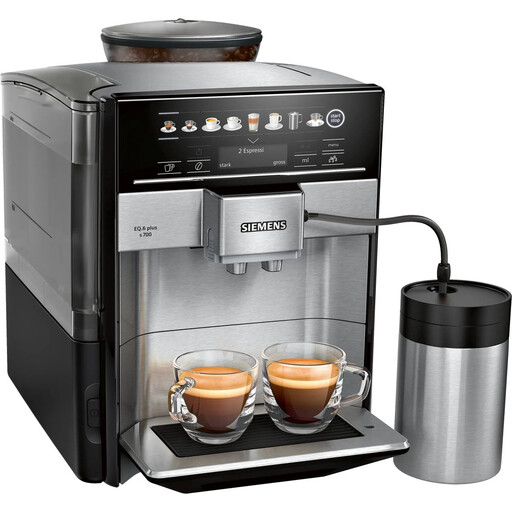
Siemens TE657M03DE EQ.6 Plus s700
The product information lists coffee and milk specialities and the ability to make two cups at once via the touchscreen. Check whether this suits the orders you expect during your interval.
Making two cups at once is not a measure of output over a full theatre interval.
View at Joybuy
 No image available
Philips 5500 Series EP5547/90 LatteGo
If you want to serve milk drinks as well as coffee, the listed LatteGo system may be useful. Check that its cleaning routine suits your planned service.
The product information lists the ability to make two cups at once and clean the milk system in a dishwasher or under the tap. This does not tell you how many orders the machine can handle during a single interval.
View at Joybuy
 No image available
De'Longhi ECAM290.61.SB Magnifica Evo
For a small service offering milk drinks, the product information lists an automatic milk system. Check which cleaning routine and milk storage arrangements are right for your use.
The product information lists the ability to make two cups at once and a 1,8 l water reservoir. The two-cup function is not a measure of output during an interval.
View at Joybuy
Frequently asked questions
Are 80 cups per day enough for a theatre interval?
Not necessarily. WMF recommends a maximum capacity of 80 cups per day for the Peak 50, not for a single short peak period. Compare the expected number of orders and drink mix with the machine’s output over the time available during your interval.
What should you check before installing a machine in a small space?
Measure the whole installation area and check that you can access the machine for filling and cleaning. WMF lists the Peak 50’s dimensions as 325 × 473 × 571 mm, including the power cable; other models have different dimensions.
How do you keep a machine with a milk system clean when serving visitors?
Follow the cleaning instructions for the exact model and ensure milk is prepared and stored safely. WMF describes Click+Clean as part of the Peak 50’s daily routine; the NVWA requires food to be handled safely and hygienically when it is sold.
What warranty applies to a purchase?
For consumer purchases in the Netherlands, you have a legal right to a product that is fit for purpose; the Dutch government does not specify a fixed statutory warranty period. A manufacturer’s or extended warranty is in addition to this. If a theatre organisation is buying the machine, check the business terms and conditions separately.
What rules apply if the theatre sells coffee to visitors?
According to the NVWA, you must register if you sell food several times a year; registration is not required if you sell it once a year. For repeated sales, a food safety plan or suitable hygiene code is mandatory. For non-prepacked products, customers must be able to get information about allergens present, such as milk, before buying.


