Who is this guide for?

Study group with a small worktop

You want freshly brewed coffee from beans without the machine or access to its tanks getting in the way of your workspace. Compare the overall dimensions and check how easy it is to reach the different parts in your setup. The product specifications for De’Longhi and JURA show why width alone isn’t enough.

Host serving several rounds of coffee

You make several cups in a row and want to know how often you’ll need to refill the water tank, and whether your chosen drink can be made into two cups at once. Consumentenbond highlights the two-cup function as a point of comparison; the capacity of a specific model’s tank is just a capacity, not a guaranteed number of cups.

Group of cappuccino drinkers

You’re weighing up frothing milk yourself against automatic milk preparation, and factoring in the cleaning afterwards. Philips says to rinse the LatteGo system after every use; De’Longhi describes the ECAM22.110.W as having a traditional milk frother.

What should you look for?

Mainly black coffee

A good fit if: the group mainly drinks espresso or coffee and is unlikely to use an automatic milk system much.

The trade-off: JURA describes the ENA 4 EB as a one-cup machine without automatic milk drinks; bear in mind its stated 1,1-litre tank capacity when making coffee for a group.

Frothing milk yourself now and then

A good fit if: you usually make black coffee but want to froth milk yourself for some drinks.

The trade-off: De’Longhi lists a traditional milk frother and a 1,8-litre water tank for the Magnifica S ECAM22.110.W; frothing milk involves a few steps for each drink.

Making milk-based drinks regularly

A good fit if: several people in the group often want cappuccinos or other milk-based drinks without frothing milk themselves for every cup.

The trade-off: Philips lists automatic LatteGo preparation for the EP2333/40 and recommends rinsing the system after every use. Siemens lists automatic cappuccino and latte macchiato preparation for the EQ300 TF301E09.

What to consider What to look for Who should consider it?
Positioning and access Measure the width, depth and height; also check there’s enough room to fill or remove the tanks and drip tray. If I have limited worktop space, I want to be able to position the machine and still reach its parts. Around 33% of consumers in this situation would make positioning their top priority.
Making several cups Compare the tank capacity and check whether the exact model can make your chosen drink into two cups at once. When serving coffee, I want to minimise interruptions to refill the tank. For around 27% of consumers, making several cups would be the main priority.
Black coffee or milk-based drinks Check whether each model makes milk-based drinks automatically, lets you froth milk by hand or doesn’t specify this. If the group often drinks cappuccino, I want to know how much effort milk preparation takes. Around 20% of consumers would see milk-based drinks as their main consideration.
Purchase and maintenance Compare the care instructions and products needed for the exact model; also think about which features you’ll actually use. I want to fit the after-use routine and maintenance into my schedule, as well as the initial purchase. For around 20% of consumers, cost and maintenance would be their main concern.

Common buying mistakes

  • Focusing on width alone

    A narrow machine can still take up a lot of depth. You’ll also need room to access the tanks and other parts.

    Measure the available width, depth and height, and check how you’ll fill and clean the machine in your setup.

    An awkward position can take up workspace or make refilling and cleaning difficult.

  • Assuming tank capacity equals a fixed number of cups

    The stated capacity doesn’t guarantee a particular number of cups: your chosen drink size and rinsing both affect water use.

    Compare tank capacities, but don’t plan a coffee round around a fixed number of cups per tank.

    If you’re serving several rounds in a row, you may need to refill more often than you expect.

  • Assuming automatic milk preparation needs no maintenance

    An automatic milk system still needs cleaning. Philips recommends rinsing LatteGo after every use.

    Choose automatic milk preparation if your group will use the feature regularly, and follow the instructions for the exact model.

    Cleaning takes time; also follow the model-specific instructions for maintenance products.

  • Relying on an extended warranty as your only protection

    In the Netherlands, statutory rights apply alongside any manufacturer’s warranty or additional cover.

    ACM ConsuWijzer provides consumers with advice about warranties. If a product develops a fault too soon under normal use, contact the seller first and compare any additional cover with the statutory rights you already have.

    Additional cover may overlap with protection you already have.

Brands to consider

De’Longhi

The Magnifica S ECAM22.110.W is an option for black coffee, with the option to froth milk yourself.

  • For this version, De’Longhi lists a width of 230 mm, a 1,8-litre water tank and a 250-gram bean hopper.
  • The traditional milk frother isn’t automatic; these specifications don’t necessarily apply to other Magnifica versions.

JURA

The ENA 4 EB is aimed at people who mainly drink black coffee and want a fully automatic machine that makes one cup at a time.

  • JURA lists dimensions of 27,1 × 32,3 × 44,5 cm and a 1,1-litre water tank.
  • The listed coffee specialities are black; the tank capacity is worth considering if you’re making several rounds of coffee.

Philips

The 2300 Series EP2333/40 is an option if automatic milk preparation is important to you.

  • Philips describes this model as having automatic LatteGo milk preparation.
  • Philips recommends rinsing LatteGo after every use, so the cleaning routine is part of your decision.

Siemens

According to Siemens, the EQ300 TF301E09 combines automatic milk drinks with front access for maintenance.

  • Siemens lists one-touch cappuccino and latte macchiato preparation, as well as a removable brewing unit.
  • The stated dimensions are 383 × 251 × 433 mm (H × W × D); check that the depth and front access suit your setup.

Krups

The Arabica EA8170 is another model to compare for espresso or lungo with adjustable preparation settings.

  • Krups lists an LCD screen and three grind settings for this model.
  • ‘Compact’ is the manufacturer’s description and doesn’t prove that this model will fit better than other machines; compare the space needed for the exact model.

Bean-to-cup machines at Joybuy

These Joybuy bean-to-cup machines are options for a study group: compare the space they need, how they prepare milk and their options for making several cups.
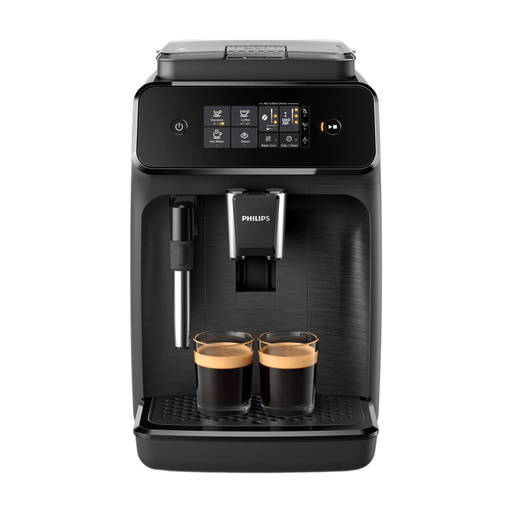
Philips 1200 Series EP1220/00 fully automatic espresso machine

Philips 1200 Series EP1220/00

An option if you want coffee made from beans and would like to froth milk yourself now and then.

The product listing at Joybuy gives dimensions of 37,10 × 43,30 × 24,60 cm and says the brewing unit is removable. According to the product description, the machine has a classic Pannarello steam wand; milk is frothed by hand.

View product at Joybuy
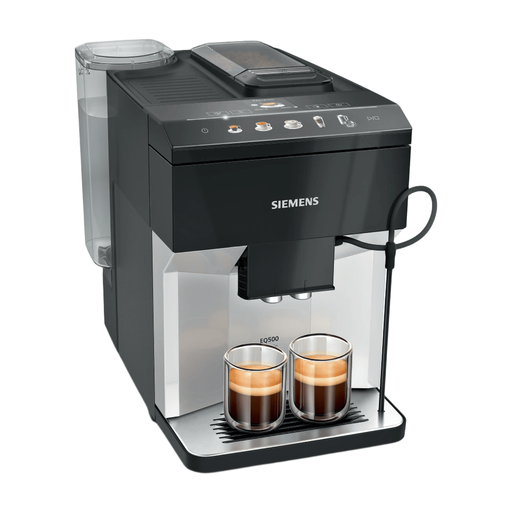
Siemens EQ500 TP511R01 fully automatic espresso machine

Siemens EQ500 TP511R01

An option if the group enjoys coffee and milk-based drinks, and you want a removable brewing unit.

The product listing at Joybuy gives dimensions of 37,30 × 44,80 × 26,50 cm and says the brewing unit is removable. The product description mentions oneTouch preparation of drinks including latte and cappuccino, as well as daily rinsing of the milk system.

View product at Joybuy
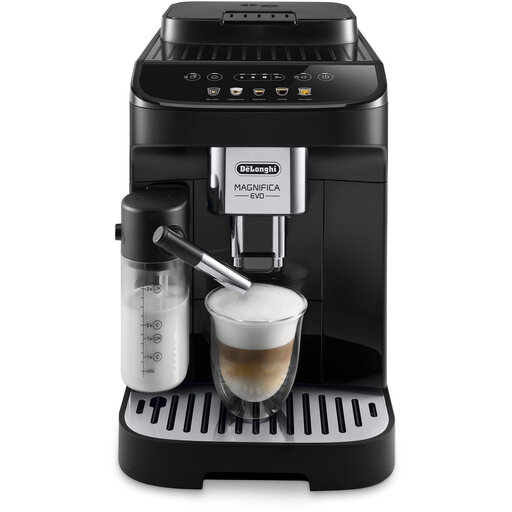
De’Longhi Magnifica Evo ECAM290.61.B fully automatic coffee machine

De’Longhi Magnifica Evo ECAM290.61.B

An option if you want to compare automatic milk preparation and a larger water capacity for serving several rounds of coffee.

The product listing at Joybuy gives dimensions of 36 × 44 × 24 cm, a 1,8-litre water tank and a 250-gram bean hopper. The description mentions automatic LatteCrema Hot preparation and an integrated milk container.

View product at Joybuy

Philips 5500 Series EP5547/90 LatteGo coffee machine

Philips 5500 Series EP5547/90

An option if you want automatic milk preparation and settings for several users.

The product listing at Joybuy mentions 20 coffee varieties, 12 grind settings and two user profiles. The description mentions automatic milk preparation with LatteGo and dishwasher-safe LatteGo parts.

View product at Joybuy
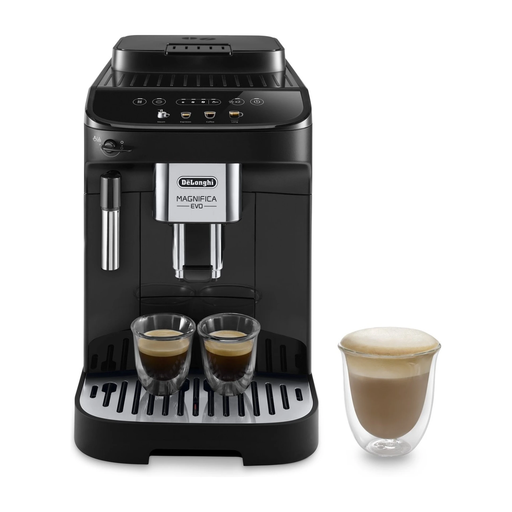
De’Longhi Magnifica Evo ECAM290.21

De’Longhi Magnifica Evo ECAM290.21

An option if you want to make several espressos or lungos at once and only froth milk yourself now and then.

The product listing at Joybuy gives dimensions of 44 × 24 × 36 cm, a 1,8-litre water tank and a 250-gram bean hopper. The product description mentions making two espressos or lungos at once, a manual steam wand and a removable brewing unit.

View product at Joybuy

Frequently asked questions

Will a narrow coffee machine always fit under a kitchen cupboard?

No. A narrow width doesn’t tell you everything about the space the machine needs. JURA lists the ENA 4 EB as 44,5 cm deep, while Siemens gives the EQ300 TF301E09 a depth of 433 mm; also measure the height and the space you need to access the tanks.

How often should I clean a milk system?

Follow the instructions for the exact model. Philips recommends rinsing LatteGo after every use and says to rinse the brewing unit weekly, among other steps. This is the manufacturer’s advice for the products described, not a general cleaning schedule for all machines.

Are bean-to-cup machines cheaper per cup than pod machines?

Consumentenbond says coffee made from beans costs less than coffee made with capsules, but fully automatic machines have a higher purchase price. Whether your overall costs are lower depends on factors including how much you use the machine and its purchase price.

Who should I contact if the machine breaks down too soon?

In the Netherlands, contact the seller first. According to ACM ConsuWijzer, the seller is responsible for providing a solution if a product doesn’t meet what you could reasonably expect under normal use; a manufacturer’s warranty doesn’t replace that right.

What should I look for in an electric coffee machine for the Dutch market?

Check the product information and the machine for the required CE marking. The Dutch government says that electronic devices placed on the market in the EU must have a CE marking.
