
Host with limited worktop space
Wants to fit in a bean-to-cup machine and keep it topped up and clean without getting in the way of cooking.


Start by measuring the available width and depth, but also check that you can reach the water tank, bean hopper and brewing unit. Then decide whether you want to make two black coffees at once, serve milk drinks at the touch of a button or froth milk yourself. These options vary by model, and milk functions mean extra cleaning. The specifications from Melitta, Siemens, De’Longhi, Philips and JURA help you compare features, but they do not prove which machine is fastest or makes the best-tasting coffee.
Wants to fit in a bean-to-cup machine and keep it topped up and clean without getting in the way of cooking.
Looks for the option to make two cups at once and easy access to water and beans during the evening.
Wants to weigh up whether a milk drink at the touch of a button or frothing milk by hand is a better fit, including the cleaning involved.
First, measure the space and allow room to fill and clean the machine. Then choose the drink options that suit your guests.
| What to consider | What should you look for? | Who is it for? |
|---|---|---|
| Positioning and access | Measure the width and depth, and check that you can reach the tank and parts that need cleaning. Melitta lists the Solo as 20 cm wide; Siemens gives the TF301E19 dimensions as 383 × 251 × 433 mm (h × w × d). | If my worktop is already full, I want to know in advance whether I can also refill and clean the machine; around 36% of consumers say positioning is their main reason for buying. |
| Serving several guests | Check whether each drink can be made two cups at a time. Melitta lists this function for espresso and café crème on the Solo; two black coffees does not automatically mean two cappuccinos. | When I’m making coffee for several guests, I look at what the machine can actually prepare in one go; around 29% of consumers prioritise serving several guests. |
| Milk drinks | Compare automatic milk drink options with a traditional milk frother, and check how the milk system needs to be cleaned. Philips describes the EP2220/10 as having a classic milk frother; Siemens and De’Longhi list one-touch milk drink options on the models in question. | If my guests want cappuccino or latte macchiato, I want to know in advance how many steps and how much cleaning are involved; around 21% of consumers prioritise milk drinks. |
| Cleaning and maintenance | Check the model’s manual for how to clean the brewing unit, drip tray and any milk components. Philips recommends cleaning the milk circuit to prevent milk from drying on it. | When I want to keep cleaning to a minimum after an evening with guests, I check the maintenance steps for the model I’ve chosen; around 14% of consumers say maintenance is their main reason for buying. |
Depth and the space needed to reach components also determine whether a machine is practical on a small worktop.
Measure the full space available and check how to refill and clean the exact model.
Melitta specifies the Solo’s function for espresso and café crème; this does not mean the model can also make two milk drinks at once.
Check which drinks the model can make at the same time, rather than relying on the term ‘two-cup function’ alone.
Automatic preparation does not remove the need to clean the milk circuit. Philips notes that milk residue can dry on it.
Follow the cleaning steps for the exact model and check which parts need to be cleaned after use.
The Solo is designed for a narrow space and for making espresso or café crème.
The EQ300 TF301E19 combines specified dimensions with one-touch milk drink options.
The Magnifica Start ECAM220.80.SB EX:1 is an option if automatic milk drinks are important to you.
The EP2220/10 from the 2200 series suits anyone who prefers to froth milk themselves.
The ENA 4 (EB, article number 15501) is designed for espresso and black coffee, making one cup per operation.
This selection focuses on fully automatic bean-to-cup machines with milk drink options for guests. They vary in how they work, how many cups they can make at once and how much maintenance they need.
 No image available
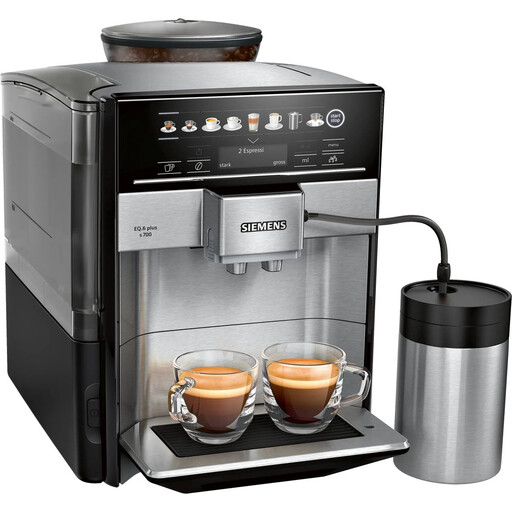
An option if guests want cappuccinos at the same time: the product description says it can make two cappuccinos simultaneously.
The description lists OneTouch DoubleCup for coffee and milk specialities, and automatic steam cleaning of the milk system.
 No image available
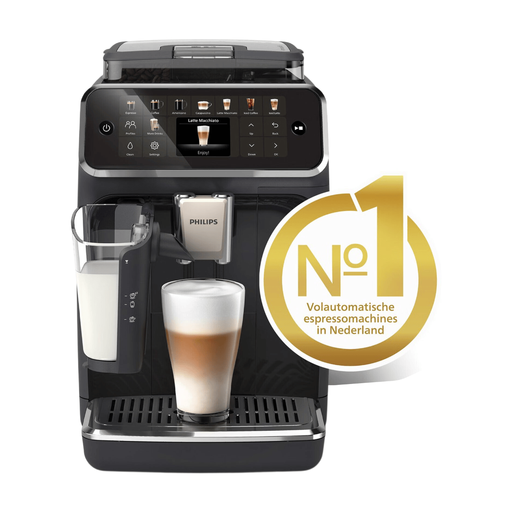
An option if guests want a choice of hot and cold coffees; the product description lists recipes including cappuccino, latte and iced coffee.
The description lists 20 recipes, 12 grind settings, a 1,8 l water tank and a ceramic grinder.
 No image available
An option if guests want automatic milk drinks; the product description says it can make two milk specialities at once.
The description lists two interchangeable bean hoppers and a hot water function.
 No image available
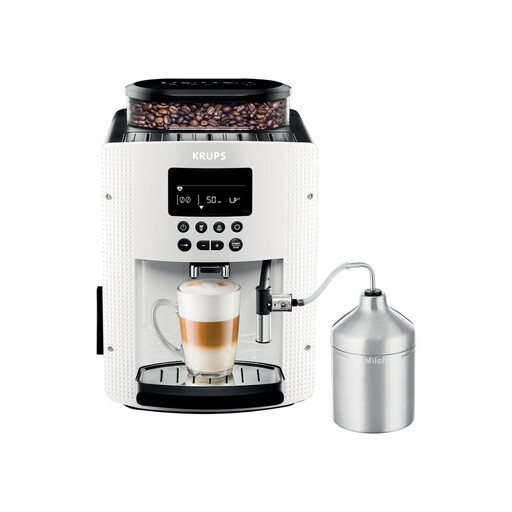
An option if some guests want espresso while others prefer cappuccino or latte; the product description lists the option to make two espressos at once and an Auto Cappuccino set for cappuccino and latte.
The description lists adjustable grind and temperature settings, and a removable water tank. The machine and milk system need to be cleaned by hand.
Measure not only the available width, but also the depth and height, and check that you can reach the tank and parts that need cleaning. Compare the available space with the dimensions of the exact model. For example, Siemens gives the TF301E19 dimensions as 383 × 251 × 433 mm, in the order height × width × depth.
Yes. Follow the manual for the model you’ve chosen. Philips recommends cleaning the milk circuit to prevent milk from drying on it; an automatic cleaning function on another model does not replace the instructions for that specific model.
According to ACM ConsuWijzer, if a product breaks down sooner than you could reasonably expect, the seller must put it right free of charge, for example by repairing or replacing it. This legal right is separate from any manufacturer’s warranty; in the Netherlands, there is no single fixed statutory warranty period for every appliance.
Electrical appliances must meet product safety requirements. The Netherlands Food and Consumer Product Safety Authority refers to the Low Voltage Directive for electrical equipment with a rated AC voltage between 50 V and 1.000 V. The Netherlands Enterprise Agency lists electrical appliances as a product group for which the relevant CE rules must be checked. According to the European Union, a CE marking is the manufacturer’s declaration that the product meets the applicable product requirements, not an independent taste or quality test.
According to ACM ConsuWijzer, online consumer purchases generally come with a statutory 14-day cancellation period, which ends 14 days after delivery, subject to legal exceptions. Check how unboxing, trying out and returning the machine are handled in your situation.