
Hosting several coffee drinkers
When you have guests, you make cups one after another and don’t want to keep topping up the water or beans. So consider both the hopper capacity and the steps needed between cups.


When making coffee for several guests, the capacity of the water and bean hoppers, the steps needed between cups and the available worktop space are all important starting points. The Dutch Consumers’ Association recommends choosing a machine based on the number of cups and the drinks you want. Automatic milk preparation can make brewing easier, but it also means extra cleaning. Before choosing a particular model, check the full model code and the CE marking on the machine being offered.
When you have guests, you make cups one after another and don’t want to keep topping up the water or beans. So consider both the hopper capacity and the steps needed between cups.
You share the machine with others and want to agree who will clean the drip tray, coffee grounds container, brew group and any milk components.
You need to find a spot for the machine in a small shared kitchen while still being able to reach the hoppers and other parts. Measure the available space before you choose.
Start with the drinks your guests usually want, then work out how much space, refilling and cleaning will be practical for your group.
| What to consider | What should you check? | Who is this important for? |
|---|---|---|
| Making cups one after another | Compare the water and bean hopper capacities with the size of your group. Check whether the specific drink and model can make two cups at once. | If I’m serving several guests, I want to know how often I’ll need to refill the machine and what steps are involved. Around 28% of consumers prioritise making drinks for a group one after another. |
| Sharing the cleaning | Check how to access the drip tray, coffee grounds container and brew group, and what cleaning the milk components require. | In a shared kitchen, I want to agree in advance who will take care of the daily cleaning. Around 22% of consumers consider shared maintenance the most important factor. |
| Worktop space | Measure the space available, as well as the room needed to reach the hoppers and other removable parts. | If the worktop is small, I want to be able to position and use the machine without making refilling awkward. Around 17% of consumers choose mainly according to the kitchen space available. |
| Black coffee or milk-based drinks | Check whether the exact model makes the drinks you want and whether it has a steam wand or an automatic milk system. | I want to know whether guests regularly ask for cappuccinos and how much extra cleaning the chosen milk option involves. Around 17% of consumers prioritise the milk-based drinks the machine can make. |
| Running costs and faults | Check what maintenance products are needed and agree with your housemates how to share ongoing running costs. | If I share the machine with others, I want to agree how to divide maintenance costs and know who will keep the proof of purchase. Around 16% of consumers focus mainly on overall costs. |
The stated water or bean hopper capacity doesn’t tell you how long it takes to make the drinks you want in succession.
Count black coffees and milk-based drinks separately, and check which programmes are available for the full model code and what steps are needed between cups.
Making more drinks one after another may mean spending extra time refilling and emptying the machine.
Parts that come into contact with milk need cleaning. An automatic programme doesn’t take care of every cleaning step for you.
Read the instructions for the specific version and agree who will clean the milk components after use. The Dutch Consumers’ Association recommends removing milk residue daily and cleaning a steam wand immediately after use.
Milk-based drinks mean regular cleaning; also check which cleaning products the model requires.
Drinks and maintenance requirements can vary between model codes.
Compare the full model code and check which drinks and milk functions are listed for the specific version.
A guarantee offered by the manufacturer is not the same as your legal rights against the retailer. ACM ConsuWijzer explains the difference between guarantees.
Keep your proof of purchase and contact the retailer if you think the product may not conform to the contract.
The Essential EA81M8 may suit a group that mainly drinks black coffee. KRUPS lists a 1.7 l water tank and a 260 g bean hopper for this model.
The Magnifica Evo ECAM290.61.SB is an option if guests regularly ask for coffee with milk. De'Longhi lists cappuccino and MyLatte as drink options.
The EP2220/10 from the 2200 Series may suit you if you’re looking for a bean-to-cup machine with a steam wand for manual use.
The ENA 4 is a compact, one-cup bean-to-cup machine for anyone who mainly wants black coffee. For version 15501, JURA lists a 1.1 l water tank, a 125 g bean hopper and dimensions of 27,1 × 32,3 × 44,5 cm.
These models offer different ways to make coffee from beans, including manual frothing and automatic milk preparation. Check the CE marking on each specific product listing: the NVWA states that it is compulsory for electric coffee machines, but the marking is not the same as a mandatory independent product inspection.
 No image available
An option if you want coffee from beans and prefer to froth milk manually.
The product description lists 12 grind settings and a removable brew group. You froth milk manually using the Pannarello steam wand.
 No image available
This version is suited to anyone looking for coffee from beans and automatic milk preparation.
The product description lists 12 grind settings, two user profiles and dishwasher-safe LatteGo parts. The milk-contact parts, drip tray and coffee grounds container still need cleaning.
 No image available
An automatic milk option for groups where cappuccino or other coffee with milk is a regular favourite.
The product description lists a 1.8 l water tank, a 250 g bean hopper and the ability to make two espressos or lungos at once. According to the description, this does not apply to cappuccino. The milk-contact parts, drip tray and coffee grounds container also need cleaning.
 No image available
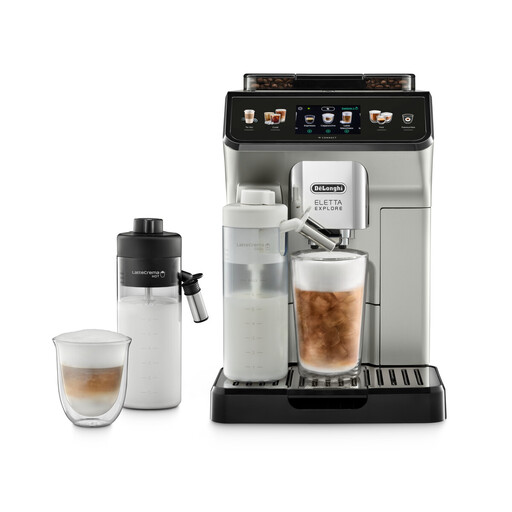
An option to compare if your group wants a variety of coffees and milk-based drinks, and making two cups at once could come in handy.
The product details list 50 programmes, automatic milk preparation, a 1.8 l water tank and the ability to make two cups at once. They don’t specify which drinks this two-cup feature applies to. Removable parts and automatic cleaning don’t make the machine maintenance-free.
Don’t assume so: a bean-to-cup machine makes coffee according to the programme you select. Check whether the specific model can make two cups at once for each drink, and how many steps and refills your group will need.
Clean the milk-contact parts according to the instructions for the specific version. The Dutch Consumers’ Association recommends removing milk residue daily and cleaning a steam wand immediately after use; also follow the instructions for the drip tray and coffee grounds container.
If a consumer has bought the machine, the retailer is the point of contact for your legal guarantee if the product doesn’t perform as you could reasonably expect under normal use. Keep your proof of purchase and agree with your housemates who will look after the purchase details.
Yes. The NVWA states that CE marking is compulsory for electrical products. It is a legal requirement for placing a product on the market, but it is not the same as a mandatory independent product inspection. Check the marking on the specific product listing.
The Fire Service advises students not to plug extension leads into one another and not to overload a multi-socket adaptor with too many appliances. Also check the instructions and electrical connections for your set-up.