
A family that drinks both regular and decaf coffee
You want to make different types of coffee at the same breakfast. How you switch beans or add pre-ground coffee determines how many steps are involved.


For a family that occasionally makes decaf lattes while others drink regular coffee, pre-ground decaf can be practical, provided the machine you choose supports your preferred latte recipe in that mode. If your family often switches between whole beans, compare the switching steps and the potential for beans to mix. Also consider whether cleaning the milk system fits your breakfast routine, and check the CE marking on the specific model.
You want to make different types of coffee at the same breakfast. How you switch beans or add pre-ground coffee determines how many steps are involved.
You often make milk-based drinks and want to know how much cleaning the milk system needs after use.
You make several cups in a row and pay attention to the controls, refilling and the steps needed between drinks. A drink option on the display does not, by itself, tell you how many milk-based drinks can be made at once.
A good fit if: you want to make decaf occasionally without removing the regular beans from the hopper.
Bear in mind: you add the decaf separately and need to check whether your preferred latte recipe is available in this mode.
A good fit if: family members regularly switch between regular and decaf beans, and the machine lets you select either type.
Bear in mind: Melitta warns that a small amount of the different beans may mix when you switch.
A good fit if: you want to store different types of whole beans separately and swap hoppers.
Bear in mind: for the Rivelia EXAM440.55.G, De'Longhi describes a step to empty the grinder before switching.
| What to consider | What should you check? | Who is this important for? |
|---|---|---|
| Decaf and regular coffee | Check the steps for switching beans and whether your preferred latte recipe works with pre-ground coffee. | If I want to make decaf and regular coffee during the same breakfast, I focus on how the coffee is added and how you switch between types. Around 33% of consumers put this at the top of their buying list. |
| Cleaning the milk system | Check which parts need rinsing after each use and which can go in the dishwasher, according to the manual. | If I have little time for cleaning after breakfast, I want to know in advance what the milk system requires. Around 27% of consumers give cleaning the milk parts top priority. |
| Making several drinks | Check the water tank and whether your preferred milk-based drinks can actually be made at the same time. | If I make coffee for several family members one after another, I want to know what steps I need to take between drinks. Around 20% of consumers focus mainly on serving several drinks at breakfast. |
| Maintenance and running costs | Read the maintenance instructions and check whether your chosen model needs filters or other consumables. | If I also want to understand the recurring tasks involved after purchase, I check the maintenance instructions for the exact model. Around 20% of consumers prioritise maintenance and running costs. |
Melitta says that a small amount of different beans may mix when you switch. This may matter if you want to keep them strictly separate.
Consider the switching process for the exact machine, rather than relying on the number of bean compartments alone.
Parts that come into contact with milk need cleaning. The steps vary by system; Philips recommends rinsing LatteGo after each use or washing its two parts in the dishwasher after each use.
Before buying, read the cleaning instructions for the exact model and decide whether they fit your after-breakfast routine.
The Rivelia EXAM440.55.G is worth considering for households that want to switch between whole beans and make hot milk-based drinks.
The Barista TS Smart is worth a look if you want to store two types of beans in a dual-chamber hopper.
The 5500 LatteGo EP5541/50 is worth considering if you want to combine milk-based drinks with a pre-ground coffee function.
This selection features fully automatic machines with milk-based drink functions. For each model, check whether pre-ground decaf works with your preferred latte recipe, and check the CE marking on the specific model before deciding.
 No image available
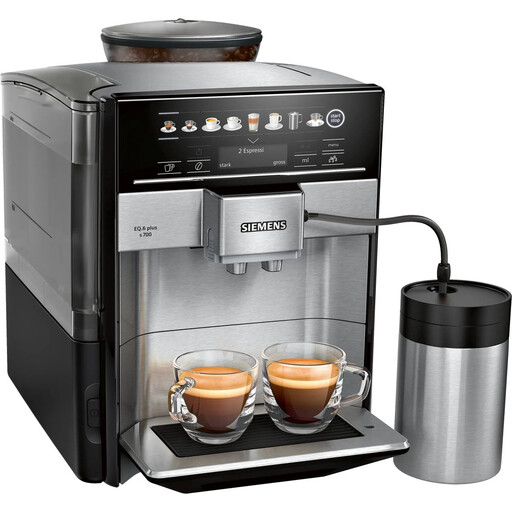
Worth considering if you want to make milk-based drinks during a family breakfast.
The product description lists two cappuccinos at once and automatic cleaning of the milk system after each drink.
 No image available
An option if you want a milk system and need to take cleaning the milk parts into account.
The product description lists latte macchiato, two user profiles, 12 adjustable grinder settings and LatteGo parts that are dishwasher-safe.
 No image available
Worth considering if you want to make milk-based drinks and have the option to use pre-ground coffee.
The product description lists a LatteCrema Hot milk system, latte macchiato, a hopper for beans and an inlet for ground coffee, a removable milk container and 13 grinder settings.
 No image available
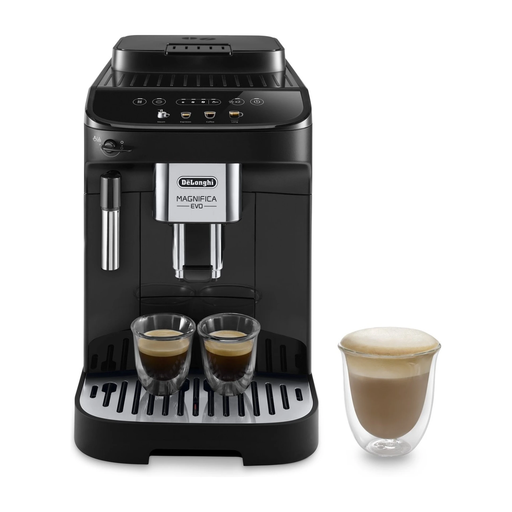
An option if you want to froth milk yourself and are happy to include the extra steps involved with the steam wand in your routine.
The product description lists a hopper for beans and an inlet for ground coffee, a manual steam wand and a removable brew unit. The steam wand needs to be cleaned and purged after use.
 No image available
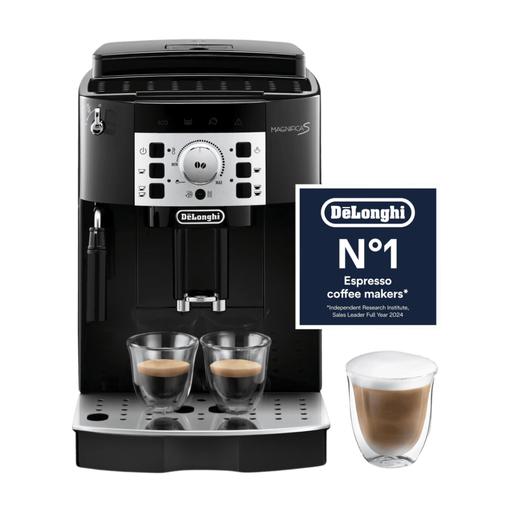
An option if you want to froth milk yourself and be able to use both whole beans and ground coffee.
The product description lists a steam wand for milk froth, adjustable coffee strength and grinder settings, and a removable brew unit. The steam wand needs cleaning and purging after use.
No. A pre-ground coffee function does not, by itself, prove that the latte recipe is available in that mode. Check the combination in the manual for the exact model; Philips says the extra-shot function does not work with pre-ground coffee on the EP5541/50.
Follow the cleaning instructions for parts that come into contact with milk. Philips recommends rinsing LatteGo after each use or washing its two parts in the dishwasher after each use; the Dutch Consumers' Association also recommends removing milk residue daily.
No. According to the Netherlands Authority for Consumers and Markets' ConsuWijzer service, your statutory guarantee applies alongside a manufacturer's or seller's guarantee, and your entitlement depends on what you could reasonably expect from the product.
According to the Dutch Government, electrical appliances placed on the market in the EU must have a CE marking. Check the marking on the specific model before deciding.
No. The Netherlands Nutrition Centre says a 125 ml cup of decaf contains around 3 mg of caffeine; this is not a measurement of a latte made with any of these machines. The Netherlands Nutrition Centre also advises pregnant and breastfeeding women to drink no more than two cups of decaffeinated coffee a day.