Who is this choice relevant for?

A host with limited cupboard space

You want a machine that fits and is still easy to reach when you need to top up the water and beans or clean its parts. Melitta lists the Solo as 20 cm wide; be sure to check its other dimensions and how much access it needs too.

A host serving guests one after another

You’re looking at reservoir capacity and whether the machine can make two cups at once, but you don’t want to mistake those specifications for a guaranteed serving time. Philips lists two servings and a 1,8 l water reservoir for the EP1220/00; JURA describes the ENA 4 as a one-cup machine.

A host whose guests love milk-based drinks

You’re weighing up the cappuccino or latte macchiato features you want against the controls, maintenance and space the machine takes up. De’Longhi describes the ECAM220.20.W as having a traditional milk frother; Siemens lists automatic milk-based drinks for the EQ300 TF305EF9.

What should you look for when choosing?

Start with the space available and access to the machine’s parts. Then compare how many cups you want to make at once and which drinks your guests prefer. If you’re considering milk-based drinks, check the cleaning requirements for the specific model in advance too.

What to consider What should you check? Who is this most relevant for?
Space and access Measure the width, height and depth; check that you can reach the reservoirs and other parts. If I have limited cupboard space, I need to be able to fit the machine in and reach it to fill and clean it. Around 36% of consumers give the right size and ease of access top priority.
Serving guests Compare the reservoir capacity and the number of suitable servings the machine can make at once. When guests order one after another, I want to know how often I’ll need to top up the machine and whether it can make two cups at once. Around 29% of consumers prioritise serving guests in succession.
Milk-based drinks Check which drinks are prepared automatically and what steps and cleaning are involved. If several book club members want a cappuccino or latte macchiato, I need to weigh convenience against the maintenance required for the milk system. Around 21% of consumers give their preferred milk-based drinks top priority.
Cleaning Read the maintenance instructions for the brewing unit and any milk-system parts on the specific model. After a get-together, I want to know how many parts I’ll need to clean and whether they’re easy to reach. Around 14% of consumers put easy maintenance above other considerations.

Common pitfalls

  • Focusing only on the width

    A slim machine could still be too deep or too tall, or difficult to reach when you need to fill and clean it.

    Measure the full space and check the dimensions and access requirements for the specific model before choosing.

  • Assuming a two-cup function means it can serve a group

    The function tells you how many suitable servings the machine can make at once, not how many guests will get coffee within a certain time.

    Compare the reservoir capacity too, and take guests’ drink choices and the need to top up the machine during the get-together into account.

  • Choosing a milk function without considering maintenance

    A milk function doesn’t remove the need to clean the milk-system parts. Philips recommends cleaning the classic milk frother on its espresso machines every day.

    Check the manual to see which parts need cleaning on the model you’re considering.

  • Confusing the manufacturer’s warranty with all your statutory rights

    A manufacturer’s warranty doesn’t automatically cover the full extent of your rights against the seller. ACM ConsuWijzer explains that consumers may have rights against the seller if a product, when used normally, doesn’t do what they’re entitled to expect.

    Consider any additional warranty separately from your statutory rights, and contact the seller for a solution if you have a problem.

Brands to consider

Melitta

The Solo is worth considering if you’re looking for a slim machine mainly for black coffee.

  • Melitta lists the Solo as 20 cm wide and says it can make two espressos or café crèmes at once.
  • This model isn’t for you if you want automatic milk-based drinks; check the other dimensions and access requirements too.

Philips

The 1200 EP1220/00 model reviewed combines a two-serving function with a classic milk system.

  • Philips specifies a 1,8 l water reservoir and dimensions of 246 × 371 × 433 mm for this model.
  • The milk frother requires manual operation and daily cleaning, according to Philips. These details apply to the EP1220/00, not every Philips model.

De’Longhi

The Magnifica Start ECAM220.20.W is worth considering if you’d like to froth milk yourself from time to time.

  • De’Longhi lists a 1,8 l water reservoir, a 250 g bean container and a traditional milk frother for this model.
  • Milk is frothed manually. Other Magnifica Start models may have a different milk system.

Siemens

The EQ300 TF305EF9 is worth considering if book club members regularly want automatic milk-based drinks.

  • Siemens lists one-touch cappuccino and latte macchiato preparation, dimensions of 383 × 251 × 433 mm and a 1,4 l water reservoir for this model.
  • The dimensions and features are specific to this model; automatic preparation doesn’t mean there’s no cleaning to do.

JURA

The ENA 4 is a one-cup option if you mainly serve black coffee and orders are more spread out.

  • JURA specifies a 1,1 l water reservoir, a 125 g bean container and dimensions of 27,1 × 32,3 × 44,5 cm for the ENA 4.
  • Its one-cup design and reservoir capacity may mean more frequent top-ups when guests order one after another; no serving time for a group is specified.

Coffee machines at Joybuy

This model is worth considering if you want to make coffee and milk-based specialities for two cups at a time during a get-together.
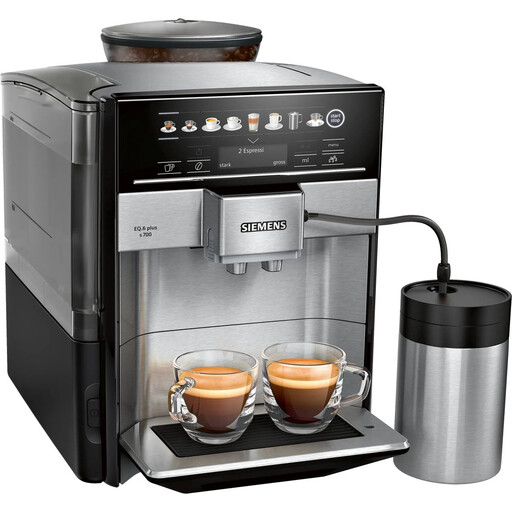
Siemens TE657M03DE EQ.6 Plus s700

Siemens TE657M03DE EQ.6 Plus s700

A good fit if you want to make coffee and milk-based specialities for two cups at a time.

The product description lists OneTouch DoubleCup, a 1,7 l water reservoir and automatic steam cleaning after every drink.

Joybuy

Frequently asked questions

Can you keep a bean-to-cup coffee machine in a cupboard?

It depends on the machine’s dimensions and the access you need to fill and clean it. Compare the measurements of the specific model with your setup, and follow the manual for use and maintenance.

Does making two cups at once mean the whole book club will get coffee quickly?

No, a two-cup function doesn’t tell you how quickly a whole group can be served. The number of guests, their choice of drinks and any topping up or cleaning during the get-together also play a part.

What should you clean after using the machine?

Follow the manual for your chosen model. Philips recommends rinsing the brewing unit of its espresso machines weekly with lukewarm water and cleaning the classic milk frother every day, among other things. Check the instructions for other brands separately.

Do I need an additional warranty to have rights in the Netherlands?

No, an additional warranty is not the same as your statutory rights against the seller. According to ACM ConsuWijzer, the seller must resolve a valid problem free of charge if a product used normally doesn’t do what you were entitled to expect. There is no single fixed warranty period for every appliance.

What safety rules apply to electrical appliances in the Netherlands?

According to the Netherlands Food and Consumer Product Safety Authority, electrical equipment with a rated AC voltage between 50 V and 1.000 V is subject to the applicable requirements of the Low Voltage Directive, with the relevant exceptions. Check the product information and instructions for the specific appliance; this general rule does not confirm that an individual item complies.
