Which set-up is right for you?

Maker who takes close-up photos

If you want to show individual beads, clasps and finishing details clearly, focus on the magnification and compatibility of the lens you use. Canon Netherlands and Nikon Netherlands give magnification specifications for specific macro lenses; these do not automatically apply to a standard lens.

Maker working with changing studio light

If lamps and reflections change in your shared workspace, a consistent, diffused lighting set-up is important for keeping your photos more consistent. Bonjourfoto describes diffused light as a way to reduce reflections on jewellery; Canon Netherlands explains white balance settings.

Maker with limited workspace

If you want to put your camera away after use, compare the complete set-up and the close-up capabilities of your current phone or a compact camera. Apple Support describes macro photography only for supported iPhone models; Sony gives different focusing distances for wide-angle and telephoto on the RX100 VII.

What should you look for?

Phone you already own

When: If you want to take photos quickly and your own device captures the necessary details sharply.

Trade-off: Macro is not available on every phone model; Apple describes the feature for supported iPhones.

Compact camera

When: If you want to use a separate camera without changing lenses, and the close-up you need is within the range of your chosen zoom setting.

Trade-off: For the Sony RX100 VII, the stated focusing range is approximately 8 cm at wide angle and approximately 100 cm at telephoto, measured from the front of the lens.

Mirrorless camera with a macro lens

When: If you regularly want to capture beads, clasps or finishing details at a large size and have room for a camera, lens and lighting.

Trade-off: Macro magnification depends on the specific lens; Canon states a maximum of 1:2 for the RF 35mm F1.8 Macro, while Nikon states 1:1 for the Z MC 50mm f/2.8. Depth of field can be shallow in close-ups.

What to consider What to look for when buying Who is this important for?
Capturing fine details sharply Check the magnification ratio, focusing distance and lens mount for the exact combination. If I want to show the texture of beads or the finish on a clasp, I want to know whether my lens can capture those details large enough. Around 33% of this group of consumers put detail first.
Managing reflections and colour Check that there is room for diffused lighting and that you can repeat your lighting and white balance settings. When the light and reflections in my shared workspace change, I want a consistent set-up for a cohesive series of photos. Around 27% of this group of consumers prioritise controllable lighting.
Working compactly and packing away Compare how much space the complete set-up takes up and test close-ups at your preferred zoom setting. If I need to clear my workspace afterwards, I want to manage as few separate components as possible. Around 20% of this group of consumers are looking for a compact set-up that is quick to pack away.
Total set-up cost Check which lens is actually included and whether you will also need macro equipment, lighting or a tripod. I want to know in advance what I need besides the camera body to take the photos I want. Around 20% of this group of consumers focus on the total cost of the set-up.

Common buying mistakes

  • Assuming a camera kit is a macro set-up

    The magnification Canon and Nikon state for a macro lens applies to that specific lens, not automatically to a kit's standard lens.

    Check what is included in the kit, the lens mount and the magnification ratio of the lens you are actually buying.

    Brands and systems to consider

    Canon

    EOS R mirrorless cameras offer a route to detailed photos using interchangeable RF lenses.

    • Canon Netherlands specifies support for RF and RF-S lenses on the EOS R50. According to Canon, the separate RF 35mm F1.8 Macro offers a maximum magnification of 1:2.
    • That magnification applies to the specific macro lens and not automatically to an R50 kit lens.

    Nikon

    Z system cameras can be paired with Z macro lenses.

    • Nikon Netherlands specifies a maximum reproduction ratio of 1:1 for the Z MC 50mm f/2.8.
    • For the Z DX MC 35mm f/1.7, Nikon states an actual maximum ratio of 0.67×. The quoted 1:1 refers to the 35mm/FX-format equivalent.

    Sony

    The RX100 VII has a built-in zoom lens, so you do not need to change separate lenses.

    • Sony Netherlands gives a focusing range for the RX100 VII starting at approximately 8 cm at wide angle.
    • At telephoto, the stated range is approximately 100 cm from the front of the lens. So test your preferred zoom setting and framing for bead photos.

    Panasonic

    LUMIX G cameras use the Micro Four Thirds system, with macro lenses as a possible addition.

    • Panasonic Netherlands describes the G100D as a Micro Four Thirds camera and the H-HS030 as a 30mm F2.8 macro lens.
    • Check the current availability of the H-HS030 before planning to include this lens in your set-up.

    Apple

    An iPhone that supports the feature could be a close-up option if you already own one.

    • Apple Support describes macro photography on supported models, with automatic switching to the ultra-wide camera at distances as close as 2 cm.
    • This feature is not automatically available on all iPhones; check the focus and framing on your own device.

Cameras on Joybuy

These Joybuy products are camera options to compare for photography and use in a shared studio. For close-ups of beads, check the focusing distance, magnification options and any need for diffused light for each model; the product name alone does not confirm that it is suitable for macro photography.
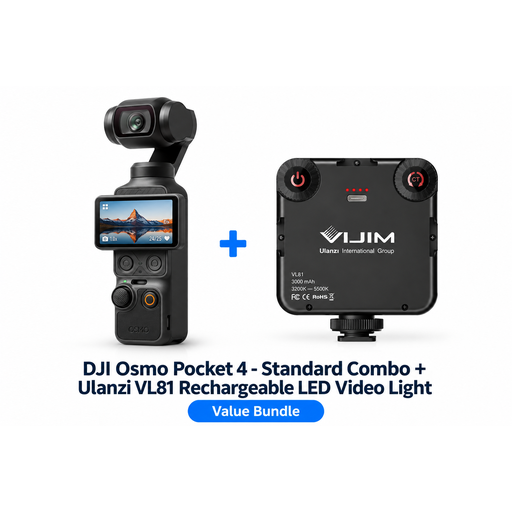
DJI Osmo Pocket 4 Standard Combo with Ulanzi VL81 Rechargeable LED Video Light

DJI Osmo Pocket 4 Standard Combo with Ulanzi VL81 LED Video Light

This bundle is worth considering if you are looking for a portable camera set-up with lighting included; check separately that the camera can focus sharply enough for the close-ups of beads you want to take.

The product information lists a 1-inch CMOS sensor, 4K/240fps video and 2× lossless zoom. The description mentions an LED light with adjustable colour temperature.

Joybuy

DJI Osmo Pocket 4 Standard Combo

DJI Osmo Pocket 4 Standard Combo

Consider this pocket-sized model if you want to compare compact cameras; check whether its close-up capabilities suit your chosen framing for small beads.

The product name lists a 1-inch CMOS sensor, 4K/240fps video and 2× lossless zoom.

Joybuy

DJI Osmo Pocket 3

DJI Osmo Pocket 3

This pocket-sized model is worth comparing if you want a camera you can put away after use; test separately whether it can take the close-ups you need.

The product name lists a 1-inch CMOS sensor and 4K/120fps video. The product description gives a weight of 179 g and autofocus for stationary subjects.

Joybuy

Songdian Pocket Camera, pink

Songdian Pocket Camera 4K 44MP, pink

Compare this pocket camera if you are looking for a compact model; the stated zoom specification alone does not show whether a small bead will appear clearly in the frame.

The product name lists 4K, 44MP and 16× zoom. The product description mentions autofocus.

Joybuy
Sony ZV-E10 with 16–50mm zoom lens, black

Sony ZV-E10 with 16–50mm zoom lens, black

This camera with a 16–50mm zoom lens is an option to compare if you are considering a camera-and-lens set-up; check separately whether the lens can focus close enough for your beads.

The product description lists a 24.2 MP APS-C sensor, 4K video and Product Showcase Setting. According to the description, an adapter and charger are not included.

Joybuy

Frequently asked questions

Do you need a macro lens to photograph beads?

Not always: first test whether your current camera or a supported phone can capture the smallest details sharply enough. With a mirrorless camera, magnification depends on the lens you use; the macro capabilities of one separate lens do not automatically apply to another lens in a kit.

How do you set up a temporary shooting area in a shared studio?

Use diffused light and keep the position of the bracelet, camera and lighting as consistent as possible between shots. Check for reflections before taking a series of photos; a light tent can help block lamps and reflections from the surroundings, but it takes up workspace.

What can you do if the whole bracelet is not in focus?

Depth of field can be shallow in close-ups, so not every part will be in focus at the same time. Adjust the settings or framing and check the result; with a stationary subject, focus stacking can combine several shots taken at different focus points, but this takes extra time to shoot and edit.

What warranty and cooling-off period apply to purchases in the Netherlands?

When you buy as a consumer, a product must meet what you can reasonably expect from it; ACM ConsuWijzer describes this as the statutory guarantee. For an online consumer purchase, you generally have a 14-day cooling-off period after delivery, subject to legal exceptions. If you are buying mainly for business use in your studio, do not automatically assume that the same consumer protections apply.

Can I edit photos of bracelets for online sales?

Product listings must not mislead consumers. Make sure any changes to the colour or details do not give a false impression of the bracelet you are selling; this rule does not determine which camera you should use.
