
Smaller groups looking to avoid leftovers
For two to four people, you can buy loose rolls to match the number of guests. If you choose a pack of part-baked rolls, think ahead about how you’ll store any that are left over.


For a small barbecue, buying rolls loose lets you control the quantity; a pack of four is handy if you can store any leftover rolls according to the pack instructions. Then choose the type of roll to suit your filling and check the label: white, multigrain and sourdough don’t tell you enough on their own about fibre, allergens or how the rolls should be prepared.
For two to four people, you can buy loose rolls to match the number of guests. If you choose a pack of part-baked rolls, think ahead about how you’ll store any that are left over.
If you’re serving vegetables, a burger or another filling, your choice of white, multigrain or sourdough rolls may depend on your taste and what you’re putting in them. With part-baked rolls, also check whether you’ll have time to prepare them.
If you’re keeping an eye on fibre, salt or allergens, the nutritional information for the exact product is more useful than labels such as ‘multigrain’, ‘spelt’ or ‘sourdough’ alone. If iodine is a consideration, check whether the label lists iodised salt.
First, decide how many rolls you need and whether you want to keep any leftovers. Then compare the fillings, preparation instructions and ingredients of the products you’re considering for your barbecue.
| What to consider | What to check when buying | Who is this most important for? |
|---|---|---|
| Quantity and leftovers | Whether the rolls are sold loose or how many come in a pack; storage instructions for rolls you won’t use straight away. | For a barbecue for two to four people, I don’t want to have more bread left over than necessary. Around 42% of consumers would say avoiding leftovers is their main concern when shopping. |
| Fillings and preparation | The size of the roll and, for part-baked rolls, the preparation instructions on the pack. | If I want to fill the rolls generously, the size needs to be right and I want to know when to bake them. Around 33% of consumers would say this matters most to them. |
| Ingredients and nutritional information | Fibre per 100 g, ingredients and allergens; check for iodised salt if it matters to your choice. | When choosing between different grains, I want to see what’s actually in the roll. Around 25% of consumers would say this product information is their top priority. |
These words don’t tell you how much fibre a roll contains or which allergens it includes. PLUS lists 56% wholemeal wheat flour and 7 g of fibre per 100 g for its multigrain rolls; these figures apply to that variety, not all multigrain rolls.
Compare the ingredients, allergens and nutritional information for the exact roll. Don’t assume a spelt roll is gluten-free.
According to the Voedingscentrum, using baker’s salt is not compulsory. So you can’t tell which salt has been used just from the name of a roll.
If it matters to your choice, look for ‘iodised salt’ or ‘baker’s salt’ in the ingredients. For a loose roll, ask for product information if needed.
If there are two of you, you may have rolls left over. How you can store them depends in part on the packaging and whether it has been opened.
Buy loose rolls if you want to match the quantity exactly, or follow the pack’s storage instructions for any you won’t use straight away.
Baking times and temperatures vary by product. Jumbo gives a baking time of 10–12 minutes at 200 °C for its multiseed rolls; don’t automatically use those instructions for another product.
Read the instructions on your pack before the barbecue and bear in mind how much oven space you’ll need for other side dishes.
These brands offer different ways to buy rolls and different varieties. Always compare the specific product and the information on its packaging.
For anyone wanting to buy fresh rolls loose to suit a smaller group.
For anyone looking for part-baked rolls in a pack of four.
For anyone looking for a loose white roll in store.
For anyone looking to buy a loose white roll.
For anyone wanting to compare part-baked rolls in different grain and sourdough varieties.
For anyone wanting to compare loose rolls with a pack of four.
This pack of four is a good option for a small group looking for white sourdough rolls. Before the barbecue, check the packaging to see whether the rolls need baking.
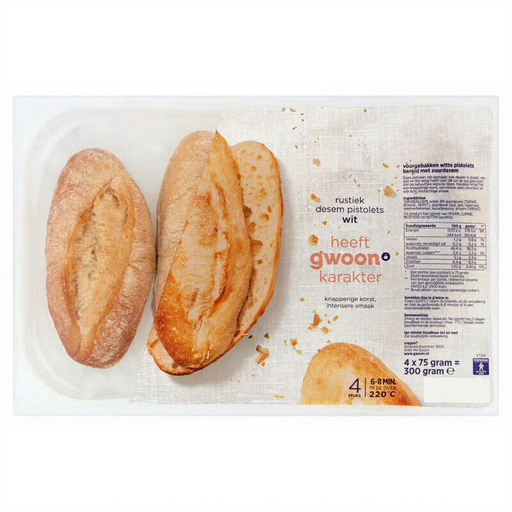 Image unavailable
A pack of four for anyone wanting to plan the number of rolls for a small barbecue.
Joybuy lists ingredients including wheat flour, 8% sourdough with wheat and spelt, and iodised salt.
Check the packaging for preparation and storage instructions, and nutritional information per 100 g or per serving.
No, don’t use that term to work out how many rolls to buy. The Voedingscentrum classifies small rolls as small bread; the supermarket products shown are sold loose and in packs of four. Choose based on the number of people eating and what you’ll do with any leftovers.
No, you can’t assume that: according to the Voedingscentrum, baker’s salt is not compulsory in bread. Check the ingredients for the specific product to see whether it lists ‘iodised salt’ or ‘baker’s salt’.
No, spelt is not a gluten-free alternative. PLUS’s sourdough spelt rolls list wheat and spelt as ingredients; check the allergen information on the packaging for each product.
Once opened, follow the instructions on the packaging first. For opened part-baked rolls, the Voedingscentrum gives general storage guidance of 2–4 days in the fridge or 1–3 months in the freezer. Also check the date on your product: ‘best before’ relates to quality, while ‘use by’ relates to safety.
Follow the time and temperature on the packaging for your rolls. For example, Jumbo gives a baking time of 10–12 minutes at 200 °C for its multiseed rolls; those settings won’t necessarily apply to other varieties.