
If you want to share bread
You’re looking for bread to serve in pieces alongside dips and grilled food. Topped focaccia and tear-and-share baguettes are options; check that the flavours and toppings work with the rest of your meal.


Choose a topped focaccia when you want the bread itself to add flavour to your BBQ spread; opt for ciabatta or a baguette if you want to leave room for dips and your own toppings. Also check the grain type, allergens and preparation method: a ‘multi-grain’ name doesn’t automatically mean the bread is wholemeal, and par-baked bread needs oven space just before serving.
You’re looking for bread to serve in pieces alongside dips and grilled food. Topped focaccia and tear-and-share baguettes are options; check that the flavours and toppings work with the rest of your meal.
You want herb butter, sauces or your own toppings to take centre stage. Relatively plain ciabatta or a baguette gives you more scope than bread with distinctive toppings.
You compare ingredients, fibre and allergens, especially if bread makes up a larger part of your meal. The Netherlands Nutrition Centre says white bread contains fewer nutrients than wholemeal and brown bread.
First decide whether you want the bread itself to add flavour or to go with a range of dips. Then check the nutrition information and when it needs to be baked.
| What to consider | What to check when buying | Who it matters to |
|---|---|---|
| Bread to share | Check the shape of the bread and the ingredients used for flavour, such as vegetables, herbs or cheese. | If the bread is already flavourful, I don’t need to put out as many toppings for the sharing table. Around 31% of consumers prioritise flavourful bread that’s easy to share. |
| A base for dips | Compare ciabatta and baguettes by their ingredients and whether they’re sold fresh or ready to bake. | When there are several sauces on the table, I want bread that doesn’t dictate a particular flavour. For around 31% of consumers, having the freedom to choose dips and toppings is their main concern. |
| Nutrition information | Check whether the bread is described as wholemeal, brown or multi-grain, and read the ingredients and nutritional values. | If bread makes up a larger part of my meal, I want to consider the grain type and fibre content. This is a priority for around 23% of consumers. |
| Baking and storage | Read the baking instructions and storage advice on the packaging. | I want to serve warm bread without needing the oven for other side dishes at the same time. Around 15% of consumers give this timing the highest priority. |
The term doesn’t tell you whether a bread will go with your dips and dishes. Topped focaccia serves a different purpose from plain ciabatta.
Choose based on the type of bread, its toppings and how you plan to serve it: focaccia to share as it is, for example, or a baguette for your own toppings.
Bread can contain relevant ingredients even if its name doesn’t clearly mention allergens. For example, a focaccia listed by PLUS contains wheat and milk.
Check the latest ingredients and allergen information on the packaging. For unpackaged bread, ask about allergens.
The option to use iodised baker’s salt doesn’t tell you what’s in any particular loaf.
If you want to know which salt was used in a specific bread, check the ingredients list.
Par-baked bread takes time and oven space. For example, PLUS gives a baking time of 8–10 minutes at around 180 °C for a specific focaccia; those instructions don’t automatically apply to other varieties.
Follow the instructions for your bread and plan when to bake it around serving time.
Albert Heijn offers ciabatta, baguettes and sourdough varieties, among other options.
Jumbo offers focaccia alongside other savoury breads, including flatbread and pinsa.
Lidl describes a focaccia topped with peppers, red onion, cheese and mozzarella.
ALDI lists a 300 g Cucina par-baked focaccia with peppers and olives.
PLUS groups ciabatta, baguettes and focaccia under BBQ bread, among other options.
Dirk offers par-baked bread such as ciabatta, baguettes and wholemeal baguettes.
This ciabattina is a good choice if you want bread to serve with dips or your own toppings. Compare the listed ingredients and preparation instructions with what you plan to serve.
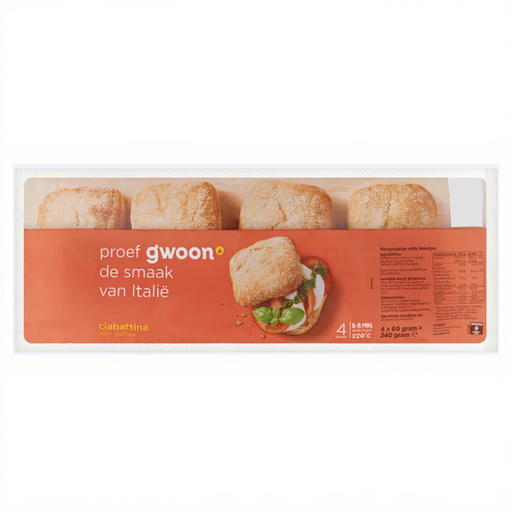 No image available
A ciabattina to serve with dips or your own toppings.
The product information lists olive oil and wheat sourdough. The bread contains wheat; if you have allergies, check the latest packaging for information, including any warnings about possible traces of sesame, lupin, mustard and nuts.
If you’d like to serve it warm, follow the baking instructions on the packaging.
Choose focaccia if you want to share bread with its own flavours, and ciabatta if you’re serving guests a range of dips or toppings. Check the ingredients for both; if you’re buying a par-baked variety, the preparation instructions matter too.
No, don’t assume that any particular bread does. According to the Netherlands Food and Consumer Product Safety Authority, iodine compounds may be present in bread, bread substitutes and other bakery products through baker’s salt containing no more than 65 mg of iodine per kg of salt. Check the ingredients list to find out what applies to your bread.
For packaged bread, read the latest ingredients and allergen information, even if the product name doesn’t mention any allergens. The Netherlands Food and Consumer Product Safety Authority says allergens must be listed on the label; if you’re buying unpackaged bread, ask for the information about that product before you buy.
First, follow the storage instructions for the product. For opened par-baked bread, the Netherlands Nutrition Centre gives general storage advice of 2–4 days in the fridge or 1–3 months in the freezer; freezing may make the bread drier.