
Vandaag of morgen in huis

Kwaliteit gegarandeerd

Welkomstaanbiedingen ontgrendelen: GRATIS bezorging | Tot 80% korting | Gratis 30 dagen JoyPlus-proefperiode
Download de app
Bathroom scales may seem like a simple product, but there are big differences between models. Do you just want to check your weight, or would you also like to track trends in body fat, muscle mass and water? And would a Bluetooth connection be useful, or would you stop using the app after a few weeks?
Checking a few technical details before you buy can help you avoid a poor purchase. Below, we cover the main pitfalls, specifications and some suitable options for different households.
Smart bathroom scales can show BMI, body fat, muscle mass, water percentage and other readings as well as weight. These features often use bioelectrical impedance analysis (BIA). The results can vary depending on factors such as fluid intake, skin contact, the time of day and your posture.
It’s best to use these figures to track trends under similar conditions. Don’t treat them as a medical diagnosis. According to the product information for several models, body analysis features are intended for monitoring and as a guide at home.
Bathroom scales can be unstable on a thick rug, carpet or uneven tiles. This can affect the reading and increase the risk of slipping. Place your scales on a hard, flat, dry surface and, if possible, keep them in the same place.
Glass platforms also need care. Don’t use the scales with wet feet, and stop using them immediately if the glass is cracked.
Before buying, check:
Scales with an app are most useful if you want to look back at your readings regularly. For a quick daily weigh-in, a clear LCD or LED display is often enough.
Start by checking the maximum capacity. 180 kg scales are suitable for a wide range of users, while some models support up to 200 kg. Never exceed the stated limit.
The measurement increment may be listed as 0.05 kg or 0.1 kg. This is the step size shown on the display; it doesn’t automatically guarantee that every reading will be exact in all conditions. For comparable results, weigh yourself at the same time, on the same surface and in a balanced stance.
Digital scales with step-on or tap-on activation are easy to use. Check that the display is easy to read, especially in a bathroom with limited lighting. An automatic shut-off feature helps save battery power.
Also check the battery type. Some models use two or three AAA batteries, while the RENPHO Elis Solar 2 uses solar cells, according to its product description. Batteries aren’t included with some models.
Body analysis scales or body fat scales usually use metal contact points and BIA technology. To use this feature, you’ll generally need to stand barefoot, with dry feet, on the designated areas.
Bluetooth scales can send data to an app. For example, the Xiaomi S400 lists Bluetooth Low Energy 5.0 and support for the Mi Health app on Android 8.0 or iOS 12 and later. The stated readings are manufacturer product claims. Use them to help track changes, not as a substitute for professional advice. According to the safety information, users with a pacemaker, defibrillator or other electronic implant should avoid the BIA function and use the scales for weight measurement only.
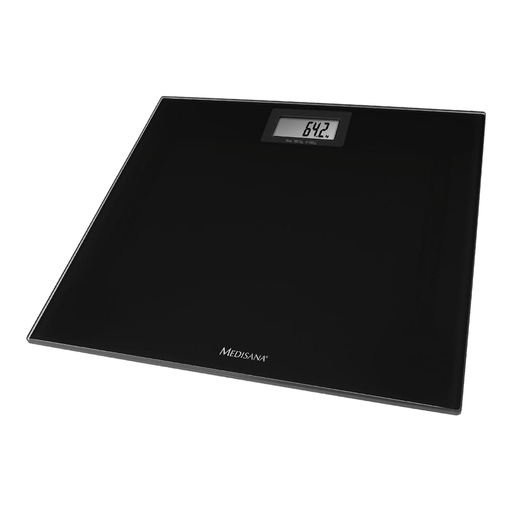
Why it suits this type of user: For anyone who just wants to check their weight each day, without an app or complicated set-up.
There’s no need to rely on an app; the LCD screen shows your reading straight away. Just make sure you place the scales on a hard, flat surface.
Step-on and tap-on activation, a choice of kg, lb and stone, automatic shut-off after 10 seconds and a stated capacity of 180 kg.
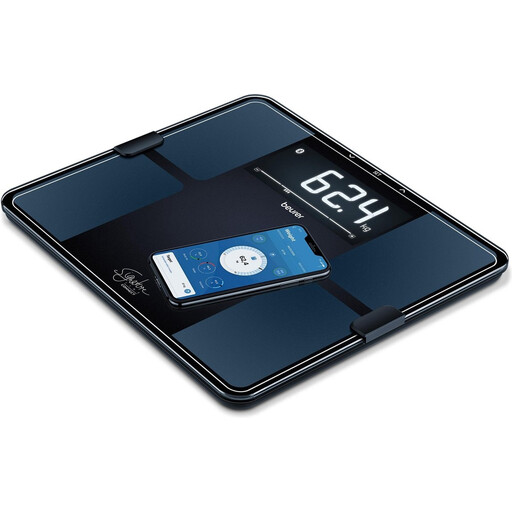
Why it suits this type of user: For households that value support for multiple users, app syncing and a higher capacity.
The product information lists eight user profiles and automatic recognition, helping to keep household members’ data separate.
Stated capacity of 200 kg, Bluetooth data transfer to HealthManager Pro, an illuminated display with 45 mm digits and several body composition readings.
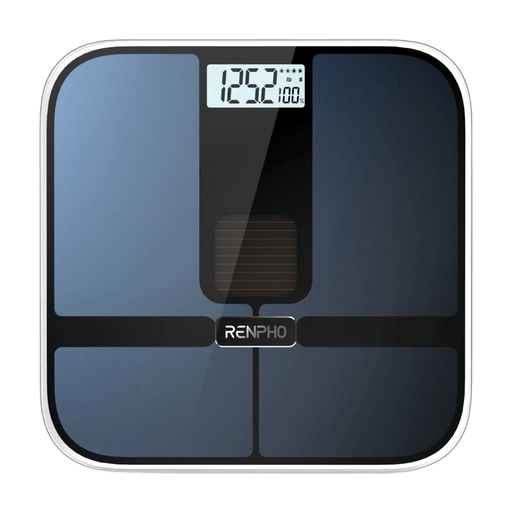
Why it suits this type of user: For users who want to combine body analysis and Bluetooth with less reliance on disposable batteries.
The app and Bluetooth features are clearly designed for keeping track of readings. The product description also mentions automatic user recognition.
According to the product information, 13 measurements are available, including body fat, muscle mass, water percentage and BMI. The scales use solar cells.
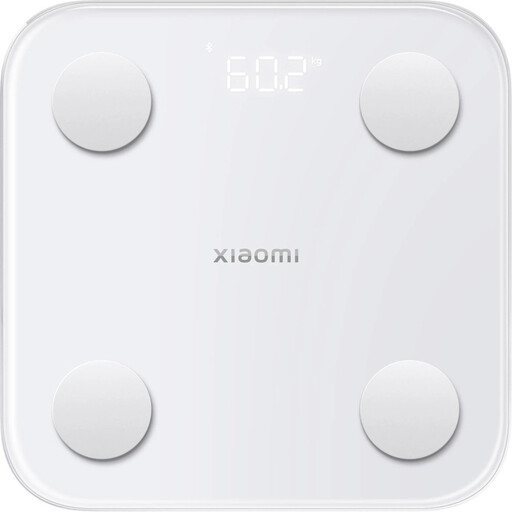
Why it suits this type of user: For tech-minded users who want to collect and review readings in a familiar app.
Compatibility with Android 8.0 and iOS 12 or later is listed, so you can check this before buying.
Bluetooth Low Energy 5.0, a range of 0.1 to 150 kg and a reinforced glass platform measuring 300 × 300 mm.
We’ve put together a complete, up-to-date list of products that meet these strict selection criteria and the current European safety regulations.
Place the scales on a hard, flat, dry floor, not on carpet or a bath mat. Use them in the same place each time. If possible, weigh yourself at a consistent time, such as in the morning after using the toilet, and stand still with your weight evenly distributed across both feet.
Their lifespan depends on how they’re used, the batteries, exposure to moisture and any damage to the glass or sensors. Keep the platform dry, clean it with a soft cloth and don’t drop the scales. If the model won’t be used for a long time, remove the batteries if the instruction manual recommends it.
As well as the purchase price, factor in the cost of batteries and, if applicable, using an app. Check whether batteries are included and what type of connection is required. With a basic model without Bluetooth, ongoing costs are usually limited to replacement batteries.
