
Cleaning edges and grout
If you’re tackling dirt around the tap, along the basin or between tiles after moving house, you’ll benefit most from a brush head that fits into these tight spaces.


Start with a mild cleaning product and a soft brush, especially if you’re not sure how the tiled surface has been finished. An electric brush is most useful for dirt in grout and around the basin. Choose a small head for narrow edges, and test it on an inconspicuous area first if the finish is unfamiliar or polished.
If you’re tackling dirt around the tap, along the basin or between tiles after moving house, you’ll benefit most from a brush head that fits into these tight spaces.
If you’re not sure whether the surface is polished or otherwise delicate, you’ll want to avoid scratching or damaging the finish before using a stiff brush or strong cleaning product.
If you mainly want to scrub an open area of tiles, compare the brush-head width and battery pack. Bear in mind that a wide head won’t necessarily fit into narrow grout lines.
Best for: edges, corners around taps and short sections of grout where precise reach matters.
Trade-off: a small head requires more passes over a larger tiled area.
Best for: a relatively clear, larger tiled area. RYOBI lists a 15 cm round head for the R18CPS-0.
Trade-off: the wide head may be less suited to narrow grout lines and obstacles; this model is sold without a battery.
Best for: an unfamiliar finish or dirt that comes away with water or a suitable mild cleaning product and a soft cloth or brush.
Trade-off: stubborn, localised dirt may still need targeted scrubbing; don’t start with a stiff brush head or harsh cleaning product.
| What to consider | What should you look for? | Who is this important for? |
|---|---|---|
| Cleaning open tiled areas | Measure the space around the basin and compare it with the head diameter of the exact model. | If I mainly want to clean a larger, open area, I look at how much surface the head can reach; around 36% of consumers say cleaning flat surfaces is their main need. |
| Reaching grout and edges | Check the shape of the head and whether the detail brush you want is actually included in the set. | If there’s dirt around the tap or between tiles, I want a brush that fits into the narrow space; around 29% of consumers give grout and edges top priority. |
| Protecting the finish | Find out what the tiles and grout are made of, and test a soft brush head with a suitable cleaning product on an inconspicuous area first. | If I don’t know what the finish is, I want to test carefully first to avoid scratches; around 21% of consumers put protecting the finish first. |
| Wet use and battery | Read the instructions for the device, battery and charger separately, and check which battery is supplied with the model. | By a basin, I want to know how to use and charge the brush, and whether the set includes a suitable battery; around 14% of consumers make this their main buying consideration. |
A wide head may not fit well around the tap or into narrow grout lines. A larger diameter alone says nothing about how well it will clean those areas.
Measure the available space and check which heads are included with the exact set. You may need a separate detail brush for grout and the edges around taps.
A brush’s water-resistance rating doesn’t automatically apply to its battery, cable or charger. The Netherlands Fire Service highlights the risks of batteries and chargers becoming damaged or coming into contact with moisture.
Follow the instructions for the device, battery and charger, and don’t use a damaged charging cable or charger.
RYOBI states that the R18CPS-0 is sold without a battery, while a battery and charging cable are listed for the RSCR4-120G.
Check the full model code and what’s included in the box. You may need to buy a suitable battery separately for the R18CPS-0.
Atlas Concorde warns that stiff brushes can scratch polished porcelain. The right care depends on the tile material and finish.
Find out what the tiles and grout are made of. Start with a soft cleaning tool and a suitable mild product on an inconspicuous area.
Bosch describes the UniversalBrush as suitable for tiles, grout and tight spaces around taps.
RYOBI offers several models; check the head size and whether a battery is included for each model rather than relying on the brand name alone.
Dremel describes detail brushes in its Versa range for small surfaces, grout and awkward corners.
This selection includes electric brushes for bathroom tiles and grout, as well as a larger, patio-focused brush for more spacious areas. Its weight and extension tube make it less suitable for detailed cleaning around the basin.
 No image available
The product description lists bathroom tiles, basins and grout as suitable uses; the telescopic handle is designed for high and low areas.
The set is described as including 7 interchangeable heads, 2 speeds, a rechargeable battery and an LED charging status indicator.
 No image available
The product description lists tiles, bathrooms and tight spaces as suitable uses; check whether the included heads fit the space around your tap.
The description mentions 7 brush heads and an LCD screen. It also says the main unit must not be submerged; follow the instructions for wet use.
 No image available
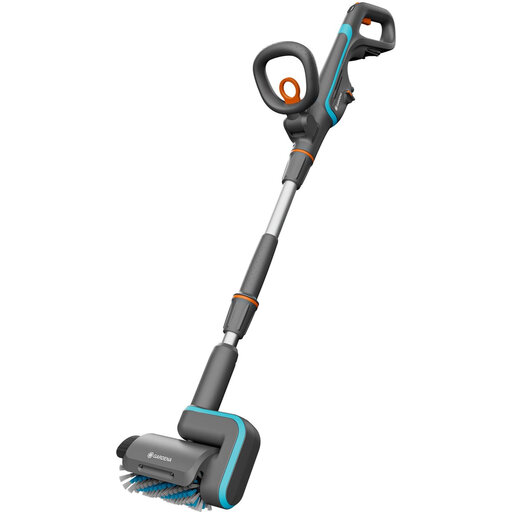
This model is described as a patio cleaner; its telescopic extension tube and stated weight of 4 kg make it less practical for precise scrubbing around basin edges.
The description lists a roller brush and three water-flow settings. The battery and charger are not included.
Not until you know what the finish is and how it should be cared for. Atlas Concorde specifically warns against using stiff brushes on polished porcelain; Marazzi recommends starting with water or a pH-neutral liquid cleaner and a gentle cleaning tool for many glazed ceramic and porcelain tiles. Test on an inconspicuous area first.
Follow the instructions for the exact model and keep the charger away from water. Bosch lists IPX5 splash protection for the UniversalBrush and RYOBI lists IPX7 for the RSCR4-120G; these ratings don’t mean the charger is water-resistant. The Netherlands Fire Service advises following the instructions for batteries and chargers, and not using damaged ones.
No, never mix bleach with other cleaning products. Wherezitwatin, a Dutch government information service, warns against doing so. Also follow the product label and the care advice for your grout.