If you only scan individual bank statements occasionally and want to put the scanner away afterwards, a mobile sheet-fed scanner is a good fit. If you regularly scan stacks of double-sided statements, a compact model with an automatic document feeder is more practical. A flatbed scanner is an alternative for fragile or heavily folded documents, but you’ll need to place each one by hand. Always check how much space the paper takes up while scanning, and make sure both sides are captured.
Which type of scanner suits you?
Scanning at a small desk
You want to digitise individual statements and put the scanner away afterwards. Compare how much space the device takes up in use, not just its dimensions when stored. Canon says the CanoScan LiDE 400 can be used or stored vertically, while Epson describes the ES-50 as space-saving.
Scanning stacks regularly
You process several statements, which may be double-sided, and want to feed fewer sheets in by hand. Check whether the model has an automatic document feeder (ADF) and scans both sides. Brother and Canon both list a 20-sheet ADF for the ADS-1300 and imageFORMULA R10 respectively.
Creating a well-organised digital archive
You want to be able to find scans again and store bank details carefully, or you have documents you’d rather not feed through a scanner. Choose a suitable place to store them, and check that scans are legible and complete. The Dutch Tax and Customs Administration advises individuals to keep relevant supporting documents; the Dutch Data Protection Authority distinguishes between personal or household use and processing on behalf of an organisation.
What should you look for when choosing?
Mobile scanner for individual sheets
A good fit if: you mainly scan individual statements and want to put the device away afterwards.
The trade-off: continuous feeding is not the same as an automatic feeder for a stack. Also check how double-sided documents are handled.
Compact model with ADF and duplex scanning
A good fit if: you regularly scan several double-sided statements in a row. Brother lists a 20-sheet ADF and duplex scanning for the ADS-1300; Canon also lists a 20-sheet ADF and single-pass scanning of both sides for the R10.
The trade-off: measure the space needed for paper input and output, and check that your statements are suitable for feeding through the scanner.
Flatbed scanner
A good fit if: individual statements are fragile or heavily folded and you’d rather place them on a flatbed one at a time.
The trade-off: you’ll need to place each sheet by hand and make room to position the document and open the lid.
| What to consider |
What should you look for? |
Who should pay particular attention? |
| Desk space |
Measure the available work surface and check where paper enters and exits during scanning. |
If every bit of desk space matters, I want to know how much room the scanner and paper path will take up. Around 36% of consumers say desk space is their top priority. |
| Stacks and double-sided sheets |
Check the ADF capacity and whether both sides are scanned in a single pass. |
If I regularly process several suitable statements, I want to spend less time feeding in and turning over sheets by hand. Around 29% of consumers prioritise handling stacks. |
| Private, easy-to-search archiving |
Check where files are stored and which file formats are available; manage access and backups yourself. |
If I want to find bank details again later, I pay attention to where they’re stored and whether the files have clear names. Around 21% of consumers put archiving and privacy first. |
| Fragile or difficult-to-handle paper |
Assess the condition of the paper and check which media types a sheet-fed scanner can handle. |
If a statement is fragile or heavily folded, I want to avoid feeding it through a scanner that isn’t suitable. Around 14% of consumers make careful scanning their top priority. |
Common pitfalls
-
Comparing only the scanner’s stored dimensions
The space needed for paper while scanning may differ from the space taken up by the device itself. Brother says the DS-940DW has a U-shaped paper path that doesn’t need extra space behind the scanner.
Measure the full paper path and allow for any input or output trays that open on your desk.
-
Confusing continuous feeding with an automatic document feeder
Epson describes the ES-50 as having continuous feeding; Brother explicitly lists a 20-sheet ADF for the ADS-1300. These descriptions don’t mean the same thing.
Look for a stated ADF capacity if you want to load a stack.
-
Assuming a scan always replaces the paper original
For business records, the Dutch Tax and Customs Administration says information must be kept in its original form, whether digitally or on paper. Different rules apply to individuals and business records.
Decide whether your statements are personal or business documents, and check the rules that apply before destroying any originals.
Brands worth comparing
Brother
The DS-940DW is designed for limited desk space, while the ADS-1300 adds automatic feeding for stacks.
- Brother lists a space-saving U-shaped paper path for the DS-940DW. For the ADS-1300, it specifies a 20-sheet ADF and duplex scanning.
- These features apply to the models mentioned, not every scanner from the brand. Measure your space and check which type of feeder suits your paper.
Epson
The WorkForce ES-50 is a USB-powered sheet-fed scanner; according to Epson, the ES-60W adds Wi-Fi and a battery.
- Epson describes the ES-50 as space-saving and lists PDF output. For the ES-60W, it highlights wireless use.
- The continuous feeding listed for the ES-50 is not a specified ADF for stacks. Check whether you need extra portability and how double-sided statements are handled.
Canon
The imageFORMULA R10 is a compact ADF scanner for double-sided sheets; the CanoScan LiDE 400 is a flatbed scanner for individual documents.
- Canon lists a 20-sheet ADF and single-pass duplex scanning for the R10. For the LiDE 400, Canon mentions vertical scanning or storage.
- With the LiDE 400, you place documents on the flatbed by hand. A product description alone won’t tell you which scanner is best for the way you’ll use it.
Plustek
The ePhoto Z300 is mainly recommended for photos and occasional document scanning.
- Plustek lists A4 support and OCR software for this model.
- The stated dimensions are 453,5 × 286 × 98 mm. Measure the space you have available; there’s no comparative performance test for bank statements to base your choice on.
Joybuy products for scanning documents
This selection includes Epson handheld and sheet-fed models for digitising individual documents and statements. Compare the scanner type with the amount of paper you process and the space you have available while scanning.
 No image available
Epson DS-C330 ADF + Sheet-Fed Scanner, 600 × 600 DPI, A4, Black/White
An A4 sheet-fed scanner to consider if you want to scan documents through a feeder; check how much space you’ll need for paper while it’s in use.
Resolution: 600 × 600 DPI. Format: A4.
View at Joybuy
 No image available
Epson DS-770 II Sheet-Fed Scanner, 600 × 600 DPI, A4, White
An A4 sheet-fed model to consider if you want to scan documents through a feeder; check the space required and paper requirements.
Resolution: 600 × 600 DPI. Format: A4.
View at Joybuy
 No image available
Epson WorkForce DS-70 Handheld Scanner, 600 × 600 DPI, A4, White
An A4 handheld scanner to compare if you scan individual documents; check that manual feeding suits the way you’ll use it.
Resolution: 600 × 600 DPI. Format: A4.
View at Joybuy
 No image available
Epson WorkForce DS-80W Handheld Scanner, 600 × 600 DPI, A4, White
An A4 handheld scanner to compare for individual documents; check that the feeder and operation are suitable for your statements.
Resolution: 600 × 600 DPI. Format: A4.
View at Joybuy
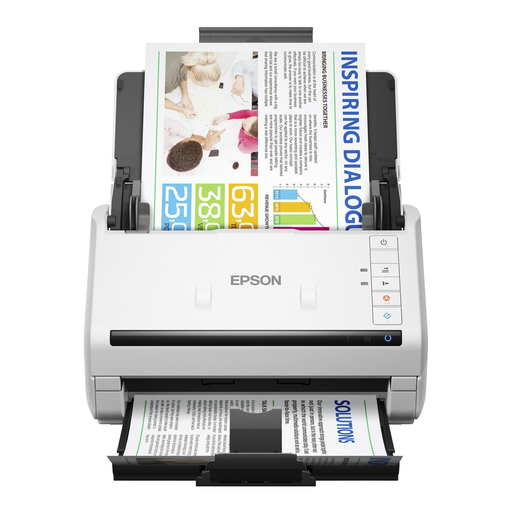 No image available
Epson WorkForce DS-530 II Sheet-Fed Scanner, 600 × 600 DPI, A4, Black/White
An A4 sheet-fed model to compare for documents scanned through a feeder; check which paper types it can handle.
Resolution: 600 × 600 DPI. Format: A4.
View at Joybuy
Frequently asked questions
Do I need an ADF for double-sided bank statements?
Not necessarily. An ADF is most useful if you want to feed several suitable individual sheets through one after another. Also check whether the scanner captures both sides in a single pass; Canon explicitly lists this feature for the imageFORMULA R10.
How do I start creating a digital archive I can check?
Start with a test scan and check that both the front and back are legible and complete. Then choose a clearly named storage folder and file name. Brother describes saving scans to a folder of your choice with the ADS-1300, but you’ll still need to check each scan.
Do I have to keep personal bank statements in the Netherlands for a set number of years?
According to the Dutch Tax and Customs Administration, individuals don’t have to keep books or records and aren’t subject to a tax retention requirement. However, it advises keeping supporting documents that may be relevant to your tax return. Don’t automatically apply business retention periods to personal statements.
Can I throw away business bank statements after scanning them?
Don’t assume that you can. The Dutch Tax and Customs Administration says information in business records must be kept in its original form, whether digitally or on paper. Check which rules apply to your records before destroying any originals.
Does keeping bank statements for personal use fall under the GDPR?
The Dutch Data Protection Authority says that processing carried out purely for personal or household use falls outside the GDPR. This doesn’t automatically apply when you process statements on behalf of a business or organisation.


