What should you look for when choosing?
OLED, including WOLED and QD-OLED
A good fit when: picture quality from various seating positions and dark scenes are priorities. Consumentenbond notes that OLED generally offers a wider viewing angle and deeper blacks.
Keep in mind: reflections vary depending on the screen and your surroundings. The risk of burn-in is also a consideration if you display static images for long periods.
LCD with an IPS panel
A good fit when: you’re considering an LCD TV and the exact model has a wide viewing angle. RTINGS.com explains that IPS panels generally perform better than VA panels when viewed from an angle.
Keep in mind: a wide viewing angle doesn’t guarantee the same contrast as every other panel type. Check both features on the specific model you’re considering.
VA LCD or mini-LED with viewing-angle enhancement
A good fit when: you sit relatively straight in front of the screen from your main seat, or the viewing angle of the specific model remains wide enough from your side seats. RTINGS.com often lists mini-LED as an option for bright rooms.
Keep in mind: a label such as mini-LED or QLED doesn’t prove that a TV has a wide viewing angle. Check the panel technology or a measurement for the exact model.
Start by checking picture quality from the seat furthest to the side. Then assess motion and reflections, and choose a screen size that suits your viewing distance and recording source.
| What to consider |
What should you check? |
Who is this important to? |
| Picture from the side |
Compare the horizontal viewing angle of the exact model and view the screen from the seat furthest to the side. |
When I watch from the side sofa, I want colour and contrast to remain usable without having to sit directly in front of the screen. Around 39% of consumers give picture quality from the side top priority. |
| Motion in the recording |
Compare a familiar scene with motion processing switched off and set to a low level. Also check the playback source and frame rate. |
For dance movements and camera pans, I want to be able to choose between smoothness and a natural-looking picture. Around 23% of consumers put motion handling at the top of their list. |
| Reflections and ambient light |
View the model in similar lighting conditions, checking reflections and dark stage scenes separately. |
If there are windows or lamps next to my seat, I want reflections to stay from overpowering dark scenes. For around 23% of consumers, visibility in ambient light is their main concern. |
| Screen size and recording source |
Measure the distance from the seats that matter and check the resolution and playback method of your recordings. |
I want the screen size to suit my viewing distance and my recordings to play on the TV. Around 15% of consumers give screen size and source compatibility top priority. |
Brands to compare as a guide
Always compare the full model code and screen size. A product range’s features don’t necessarily tell you how a specific model will perform from your seats.
LG
The OLED C6 range is worth considering if you want to compare OLED TVs in different sizes. The OLED48C67LA is a 48-inch model for the Dutch market.
- LG describes the OLED48C67LA as a 4K OLED TV.
- Check the viewing angle and brightness of the exact model. A manufacturer’s claim isn’t an independent comparison with other models.
Philips
According to Philips Netherlands, the 55OLED760/12 combines a 55-inch OLED screen with Ambilight.
- The screen size and Ambilight give you separate features to consider in your comparison.
- Assess motion handling with your own recording. A description of smooth motion isn’t an independent test result.
Sony
The BRAVIA 8 II range is a QD-OLED option to compare with other OLED models.
- Sony lists QD-OLED as the panel technology for the BRAVIA 8 II.
- The panel name alone doesn’t tell you how your recordings will be processed or what viewing angle to expect from the model you choose.
Samsung
The Dutch product page lists the S90F as a 55-inch OLED TV.
- The screen technology and size give you a specific model to compare with other 55-inch OLED TVs.
- Check the full model code and screen size before making assumptions about panel variants or viewing angles.
Joybuy TVs to compare
These Joybuy models are OLED TVs in a range of screen sizes. Consider them if you have seats positioned at an angle, but check the viewing angle of the exact model and choose a size that suits your viewing distance.
 Image unavailable
LG OLED65C68LA, 65 inch, OLED evo, 4K
This OLED model is worth considering if you want to assess picture quality from side seats. Check the viewing angle of this exact model.
Screen size: 65 inch. Panel: OLED evo. Resolution: 4K.
View at Joybuy
Image unavailable
LG OLED55C68LA, 55 inch, OLED evo, 4K
Compare this OLED model from the seat furthest to the side in your viewing area. The panel name alone doesn’t determine the viewing angle of this model.
Screen size: 55 inch. Panel: OLED evo. Resolution: 4K.
View at Joybuy
 Image unavailable
LG OLED48G69LS, 48 inch, OLED evo, 4K
This 48-inch OLED model is worth comparing with your own seating distance and side seats in mind. Assess the picture quality of this specific model.
Screen size: 48 inch. Panel: OLED evo. Resolution: 4K.
View at Joybuy
 Image unavailable
Samsung S85F Series GQ55S85FAU, 55 inch, OLED, 4K
Assess this OLED model from the seats you use and compare the viewing angle of the exact model.
Screen size: 55 inch. Panel: OLED. Resolution: 4K.
View at Joybuy
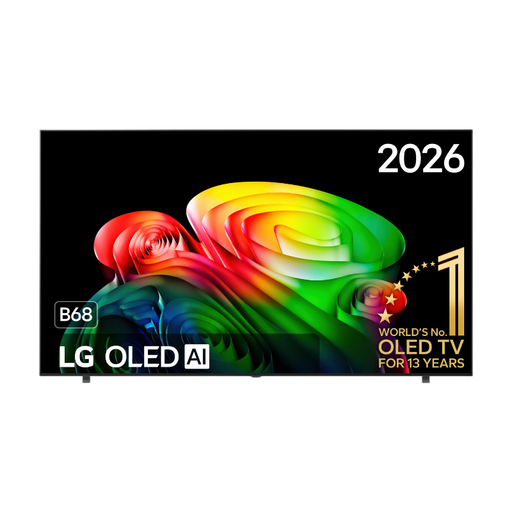 Image unavailable
LG OLED77B68LA, 77 inch, OLED, 4K
With this larger OLED model, check both the viewing angle from the side seats and the available space and viewing distance.
Screen size: 77 inch. Panel: OLED. Resolution: 4K.
View at Joybuy
Frequently asked questions
Does 120 Hz automatically make a ballet recording look smooth?
No. The recording’s frame rate and camera movements still matter. Motion interpolation can reduce judder, but it can also cause artefacts or make the picture look unnatural. RTINGS.com discusses this trade-off; compare settings using the same recording.
How do you choose a screen size when there are several seats?
Measure the viewing distance from the seats you use and check that the screen is comfortable to watch from the side seats too. Consumentenbond suggests around 2.4 times the screen diagonal as a guide to a comfortable viewing distance, based on its own research.
What should you consider when placing or wall-mounting a TV?
Before mounting, check the weight, compatible bracket, wall, and the position of windows and lamps. LG’s general mounting guidance warns that the wall type and installation environment may impose limitations. Also consult the manual for the exact model.
What if your TV, bought online, disappoints you when viewed from the side sofa?
For a typical online consumer purchase, ACM ConsuWijzer says you have a statutory cooling-off period that ends 14 days after delivery. Check the applicable exceptions and the conditions for trying and returning the product. This is separate from your rights if the product is faulty.
Does a TV in the Netherlands always come with exactly two years’ statutory guarantee?
No. ACM ConsuWijzer explains that statutory guarantee rights depend on what you could reasonably expect from the product; they aren’t simply the same as a fixed manufacturer’s warranty period. If a fault develops during normal use, contact the retailer for an appropriate solution.
Should you check a TV’s energy label?
Yes. The Dutch Government explains that the energy label for household appliances is mandatory and provides information about energy consumption. When comparing specific models, check their product information too, not just the screen technology.


