
Beginner learning melody and chords
You want to learn to play a ballad step by step and value touch response, learning features and a clear, easy-to-follow keyboard layout.


For learning a pop ballad with melody, chords and built-in accompaniment, a touch-sensitive keyboard is a good fit. If your main aim is to practise piano technique, it’s worth comparing digital pianos with weighted keys too. Choose the number of keys to suit your arrangement and measure the space available. Also check the headphone socket and which accessories are included with the exact model variant.
You want to learn to play a ballad step by step and value touch response, learning features and a clear, easy-to-follow keyboard layout.
You want to accompany yourself while singing or playing, using built-in styles without needing a computer.
Your main aim is to practise piano technique and work out whether a digital piano will fit in your spare room.
Choose this if: you have limited space and want to practise melody and chords; Yamaha lists the PSR-E383 as having 61 touch-sensitive keys, learning features and accompaniment styles.
Keep in mind: check that the lowest and highest notes in your arrangement fall within the keyboard’s range. Touch response is not the same as a weighted piano action.
Choose this if: a part for both hands doesn’t fit comfortably on 61 keys, but you still want keyboard accompaniment; according to Yamaha, the PSR-EW320 has 76 touch-sensitive keys.
Keep in mind: according to Yamaha, the PSR-EW320 is 1.148 mm wide and does not have a weighted hammer action.
Choose this if: your pop ballad is mainly a reason to learn piano and develop your piano technique; Casio describes the CDP-S110 as having a scaled hammer action.
Keep in mind: compare the space needed to set it up and its range with your room and sheet music.
| What to consider | What should you check? | Who is this important for? |
|---|---|---|
| Expression and learning | Check the touch response and practice features of the exact model. | If I’m learning a ballad step by step, I want to be able to play softly and forcefully, and practise in a clear, straightforward way. Around 36% of consumers put expression and ease of learning first. |
| Space and quiet practice | Measure the available width and check the type of headphone socket. | I want to practise at home without filling the spare room with equipment, and use a suitable pair of headphones if needed. Space and quiet practice are the top purchase priority for around 29% of consumers. |
| Chords and accompaniment | Check that the model has the accompaniment styles and chord controls you want. | If I’m singing or playing the melody, I want to be able to add chords or accompaniment without a computer. Accompaniment is the top priority for around 21% of consumers. |
| Key range and piano action | Compare the highest and lowest notes in your arrangement with the keyboard’s range; consider weighted keys separately from touch sensitivity. | If both hands need a wider range or I want to learn piano technique, I want to consider more keys or weighted keys. Around 14% of consumers put key range and piano action first. |
Touch sensitivity lets the instrument respond to how you play, but it doesn’t mean the keys have a weighted piano action.
First decide whether you want to learn keyboard accompaniment or focus mainly on piano technique. Then compare the actions of the different models.
A 76-key keyboard offers a wider range than a compact one, but Yamaha lists the PSR-EW320 as being 1.148 mm wide. Both your sheet music and the space available in the room can set limits.
Check the highest and lowest notes in your arrangement and measure the space where the instrument will go.
What’s included varies by model and variant. Casio lists an SP-3 pedal with the CDP-S110, while Korg says the EK-50 comes with an adapter.
Check what’s included with the exact variant and which connections it has before ordering accessories.
If a suitable pedal or adapter isn’t included with the variant you choose, you may need to buy one separately.
The PSR-E383 and PSR-EW320 offer keyboard features for anyone wanting to practise a ballad with melody, chords or accompaniment.
The CT-S300 is a compact keyboard option; the CDP-S110 is an alternative for anyone looking for a digital piano with a hammer action.
The EK-50 is designed for players who want to use automatic, chord-controlled accompaniment styles.
The GO:KEYS 3 and GO:KEYS 5 are options for creating or adapting chord patterns.
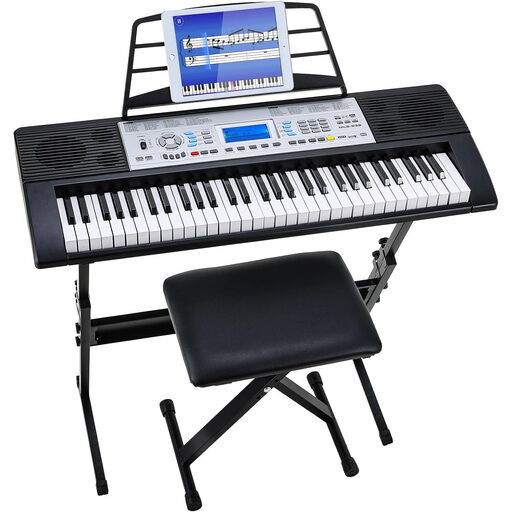
The Joybuy selection shown is a 61-key keyboard set for anyone wanting to practise a ballad on keyboard at home. If your main aim is to learn piano technique, you could also compare digital pianos with weighted keys.
 No image available
A 61-key set for anyone wanting to practise a ballad on keyboard at home; check that its range suits the notes in your arrangement.
The product name lists 500 sounds, two speakers, an LCD screen, a stand and a stool.
Not if you mainly want to learn with keyboard sounds and automatic accompaniment. Compare the highest and lowest notes in your arrangement with the available range. If your main aim is piano technique, a digital piano with weighted keys may be a better fit.
Check the headphone socket on your chosen model and use suitable headphones or an adapter. Yamaha lists a standard stereo headphone socket for the PSR-EW320; Korg lists a 3,5 mm stereo socket for the EK-50. Headphones won’t eliminate the mechanical sound of the keys.
It varies by model and variant. Casio lists an included SP-3 pedal with the CDP-S110, while Korg lists an included adapter with the EK-50. Check what’s included with the variant you want to buy.
According to the Dutch government, when you buy from a business at a distance, you generally have 14 days to change your mind, although there are exceptions. The same guidance says this does not apply to purchases from a private individual.
According to the Dutch government, products don’t have a fixed statutory warranty period, but they must be of satisfactory quality. If there’s a fault, the seller is your point of contact; an additional warranty doesn’t replace your statutory rights.