
Vandaag of morgen in huis

Kwaliteit gegarandeerd

Welkomstaanbiedingen ontgrendelen: GRATIS bezorging | Tot 80% korting | Gratis 30 dagen JoyPlus-proefperiode
Download de app
A baby night light may seem like a simple purchase, but the differences between models can be significant. Some lights are mainly decorative, while others are designed for night feeds, nappy changes or automatically lighting a dark hallway. So don’t focus solely on the design or the number of light colours.
Many parents encounter three common pitfalls:
A dimmable night light gives you more control than a lamp with just one brightness level. A low setting is often enough for a nursery or night feed. For changing a nappy or preparing a bottle, a slightly brighter setting may be more useful.
Also consider the colour temperature, measured in Kelvin (K):
A low brightness level does not automatically mean that the lamp is suitable for every situation. Also check the light output in lumens (lm). A 20 to 30-lumen lamp is very different from a 210-lumen table lamp.
A rechargeable baby night light means you won’t need to replace batteries regularly. When choosing one, check:
A portable night light is useful if you want to move it between the nursery, bedroom and travel cot. However, a lamp with a built-in battery is not automatically maintenance-free. Battery life may decrease over time, and an integrated battery or LED is often not replaceable.
A touch night light is easy to operate when you don’t want to search for a switch. A model with several brightness settings or a memory function can simplify your nighttime routine.
A night light with a motion sensor is particularly useful in a hallway, bathroom or beside the bed. Check the technical specifications: some sensors only work when the ambient light falls below, for example, 20 lux and have a range of 3 to 5 metres.
Always place a lamp securely and out of the child’s reach. Indoor models, such as a lamp with IP20, are not intended for damp areas or contact with water. Also follow the manufacturer’s instructions regarding charging, cleaning and supervision.
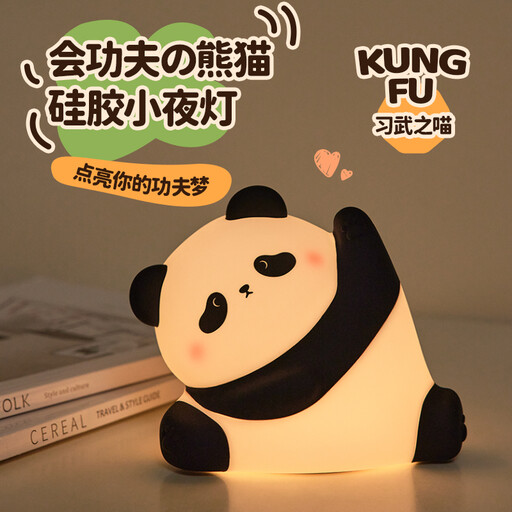
Why it suits this profile: This compact panda design is intended for the nursery, bedside table and use during night feeds. It remains easy to operate thanks to touch control.
The lamp has three dimming levels and a 1200 mAh rechargeable battery. This means you don’t have to settle for one fixed brightness level that may be too bright.
ABS, PP and food-grade silicone according to the product description; three light settings, USB charging and no installation required.
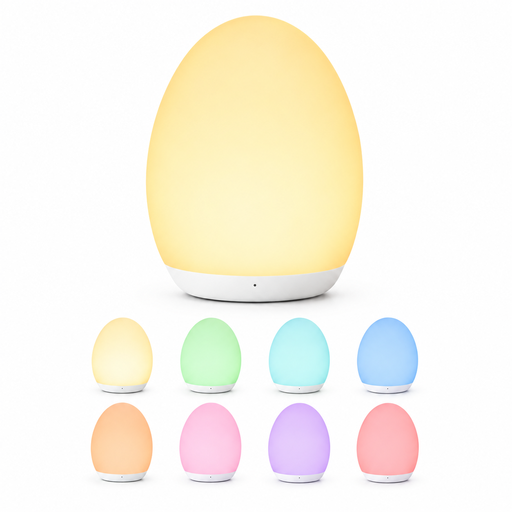
Why it suits this profile: Suitable for parents who want to use one portable night light for night feeds, nappy changes, bedtime and travel.
The product information distinguishes between approximately 7 hours at maximum brightness and up to 100 hours on the lowest setting. This helps prevent the battery claim from being misinterpreted.
2000mAh battery, dimmable warm light, eight colour modes, touch control, memory function and a one-hour timer.
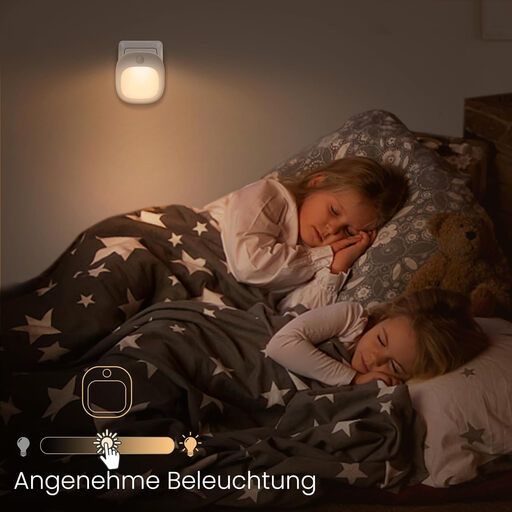
Why it suits this profile: Practical for anyone who wants to illuminate several areas, such as the nursery, landing, bedroom or bathroom.
According to the product specifications, the motion sensor switches on in low ambient light and detects movement from 3 to 5 metres away. The lamp can also remain on continuously.
Set of two, continuously dimmable with a memory function, 1 W LED and a brightness of 20 lumens.
Why it suits this profile: A practical choice for adults and families looking for a compact lamp for the bedroom, hallway or toilet, without relying on a socket.
The battery can be charged via USB and the lamp offers five brightness levels. However, check whether up to 10 hours of use in sensor mode suits your routine.
Three colour temperatures, five dimming levels, 500mAh battery, USB charging and motion detection with a range of 3 to 5 metres.
We’ve put together a complete, up-to-date list of products that fully meet these strict selection criteria and the applicable European safety regulations.
A night light is not essential, but it can be useful for night feeds, nappy changes or checking on a sleeping child. Choose a low light setting and position the lamp so that the light does not shine directly into their eyes. An LED night light generally uses little energy, but always check the stated wattage and battery life.
This depends on the battery capacity, brightness and usage mode. A claim such as “up to 100 hours” may only apply to the lowest setting. At maximum brightness, battery life is often considerably shorter. Also check whether the battery is replaceable and which USB power supply the manufacturer recommends.
Place the model on a stable surface or follow the supplied instructions, for example along a route to the nursery or on a landing. Bear the sensor range in mind and make sure curtains or other objects do not block the sensor. Use a lamp that is suitable for the room in question and keep electrical components away from moisture.
