
Vandaag of morgen in huis

Kwaliteit gegarandeerd

Welkomstaanbiedingen ontgrendelen: GRATIS bezorging | Tot 80% korting | Gratis 30 dagen JoyPlus-proefperiode
Download de app
A baby monitor with camera can help you keep an eye on your baby or toddler from another room. However, video baby monitors vary considerably in connection, range, image quality and alerts. What’s more, a high resolution or long range stated on the packaging does not necessarily reflect everyday use in a typical home.
Be particularly aware of the following potential pitfalls:
A baby monitor without Wi-Fi usually connects directly to a parent unit. This is useful if you mainly want to monitor your baby at home and do not want to use an account, app or cloud storage. For example, the VAVA VA-IH006 PRO uses a direct 2.4GHz connection and, according to the product information, does not require an app or cloud service.
A Wi-Fi baby monitor is more suitable if you want to check in via your smartphone while away from home. In that case, check:
A camera with an app is not automatically a fully fledged baby monitor. Some indoor cameras are primarily designed for general surveillance and do not have a parent unit, temperature sensor or dedicated baby features.
A baby monitor with night vision usually uses infrared to display images in low-light or dark conditions. Don’t just focus on 1080p, 2K or 4MP. The following are also important:
A large screen is useful when viewing the camera from a distance. For mobile use, a stable app may be more important than a larger display. A camera that can be rotated remotely is practical when your child moves around the room, but this feature often uses more power.
Check whether the camera needs to remain connected to mains power. With several models, the camera itself requires a fixed power connection, while only the parent unit has a rechargeable battery.
When it comes to motion detection and crying alerts, pay attention to the available settings. A baby monitor with motion detection can send an alert when movement is detected in a defined area. This is a helpful feature, not a guarantee that every situation will be recognised correctly.
A baby monitor with a temperature sensor provides an indication of the temperature around the camera. Use this information as a reference rather than as a medical measurement. Two-way communication is useful for letting your voice be heard from another room, but check whether the volume and microphone sensitivity can be adjusted.
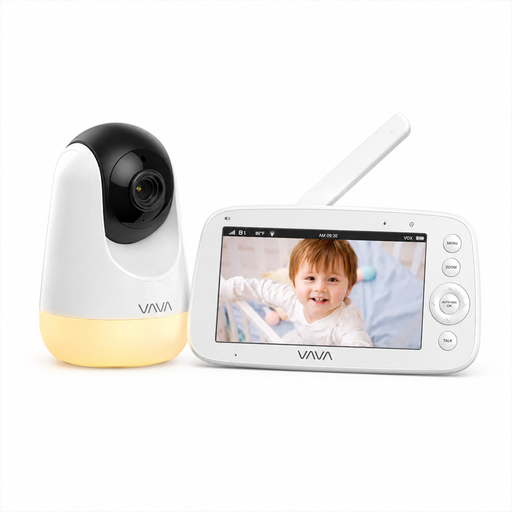
Why it suits this profile: A direct connection without an app or account keeps installation straightforward for use at home.
According to the product information, the stated range is up to 300 metres in open space; indoors, it may be lower. The direct connection means it does not rely on the internet.
5-inch 720p screen, infrared night vision, two-way communication, temperature information and up to 24 hours of audio mode.
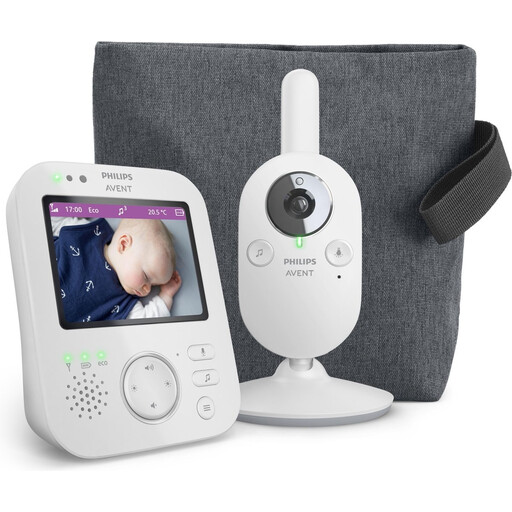
Why it suits this profile: Ideal for parents who value a separate parent unit, zoom functionality and a connection that does not require a smartphone app.
The product specifications state a range of up to 50 metres indoors and up to 300 metres outdoors. This clearly distinguishes between indoor and outdoor range.
Colour screen, 2x digital zoom, VOX mode, infrared night vision, ECO mode and two-way communication.
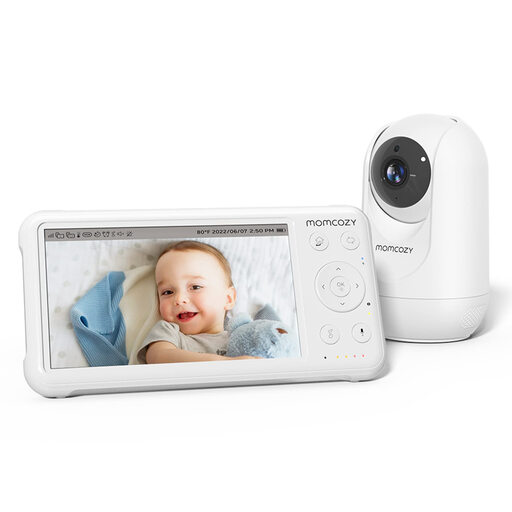
Why it suits this profile: Useful for families who want to monitor several rooms or are looking for features such as pan and tilt, temperature information and sleep sounds.
The range is stated as up to 960 ft in open space. Do not treat this as a guarantee of the same distance through Dutch walls and between floors.
1080p screen, PTZ control, temperature sensor, night vision, two-way communication and support for up to four cameras.
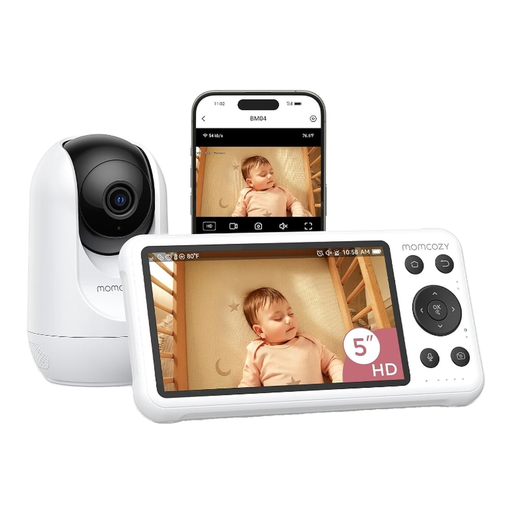
Why it suits this profile: A combination of a separate monitor and smartphone app suits parents who want to view the video both at home and while out and about.
The dual-mode setup provides a parent unit for use at home and Wi-Fi access through the app. Secure your network with a strong password and check the privacy settings.
5-inch 1080p display, motion and crying detection, night vision, two-way communication and local recording.
We’ve put together a complete, up-to-date list of products that fully meet these strict selection criteria and the applicable European safety regulations.
No. A baby monitor without Wi-Fi often uses a direct connection between the camera and parent unit. Wi-Fi is particularly useful for access through a baby monitor with an app when you are away from home. Choose the connection based on how you intend to use it, rather than simply on the number of features.
This varies by model and usage. A screen that stays on continuously uses more power than VOX or audio mode. Therefore, check the battery life separately for video and audio-only use. With some models, the camera only works when connected to mains power.
Place the camera securely and out of your child’s reach. Keep cords away from the cot and do not place the camera on or directly next to the bed. Always follow the installation instructions. Night vision, motion detection and temperature measurements are useful aids, but they do not replace adult supervision.
