
Vandaag of morgen in huis

Kwaliteit gegarandeerd

Welkomstaanbiedingen ontgrendelen: GRATIS bezorging | Tot 80% korting | Gratis 30 dagen JoyPlus-proefperiode
Download de app
A baby walker can help your child practise standing, pushing and walking. However, not every model will suit every toddler or home. A baby walker should be suited to your child’s motor skills, the space available and the way they like to play. Marketing often focuses on music, lights and lots of activities, while practical features such as wheel resistance and stability get less attention.
Use this buying guide to compare a wooden baby walker, an activity push-along walker and a baby walker with music and lights, based on verifiable product specifications.
An activity baby walker may look appealing, with its buttons, blocks, gears and sounds. However, children sometimes focus mainly on the activity panel and make less use of the walking function. Check whether the panel can be removed, or whether the walker is still enjoyable to use without lights and music.
A low price or light weight is not automatically practical. If the wheels turn too freely, your child may move forwards faster than they can keep up. Look for a wide base, a sturdy handle and wheel settings that let you limit the speed. A triangular frame or rubber wheel rims can also be useful, but they never replace adult supervision.
“From 12 months” is a guideline, not a guarantee that every child is ready for a push-along walker. Check whether your child can sit independently, pull themselves up in a controlled way and has enough strength to hold on to the walker. If you’re unsure, a simpler activity toy may be more suitable than a walker from 12 months.
A good baby walker should suit your child’s height and strength. Check the following:
Don’t use a walker on stairs, near open doors or next to hot surfaces. Let your child play with it only while an adult stays nearby.
A wooden baby walker appeals thanks to its sturdy frame and understated look. Check that the corners are rounded, the surface is smooth and the wheels have no hard edges. For plastic models, rounded edges, a stable base and securely attached parts are important.
Also check the product information for a CE marking and relevant toy safety standards, such as EN 71. A marking is no substitute for checking the product yourself: once it arrives, make sure the screws are tight, the battery covers close properly and small parts don’t come loose.
For children aged around 1 to 3, shape sorters, spinning elements, bead runs and simple music features can be appealing. A Montessori baby walker generally encourages independent discovery through simple activities. Music and lights can attract extra attention, but they aren’t essential for motor development.
According to the product descriptions of some models, the activities help develop fine motor skills and hand-eye coordination. Think of them as play opportunities, not guaranteed developmental outcomes. Above all, choose activities your child can understand and repeat independently.
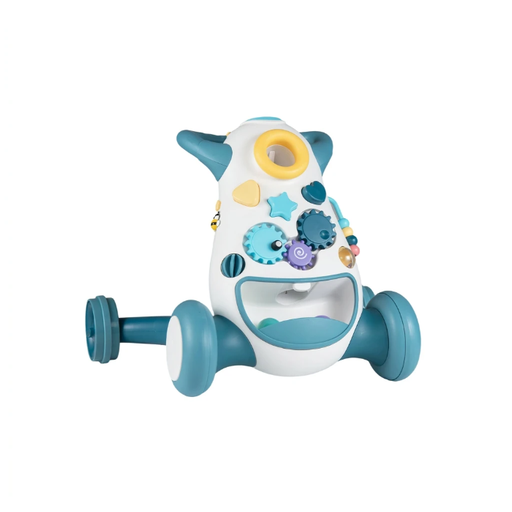
Why it suits this profile: A practical choice for parents looking for a walking aid and simple activities in one product. The product description states that it’s suitable for ages 10 to 36 months.
According to the product specifications, the rear wheels have two speed settings, so you can adjust the rolling resistance rather than relying on a system that simply rolls freely.
Three balls, three shape blocks, gears, music and lights. Dimensions: 56,5 x 46 x 44 cm.
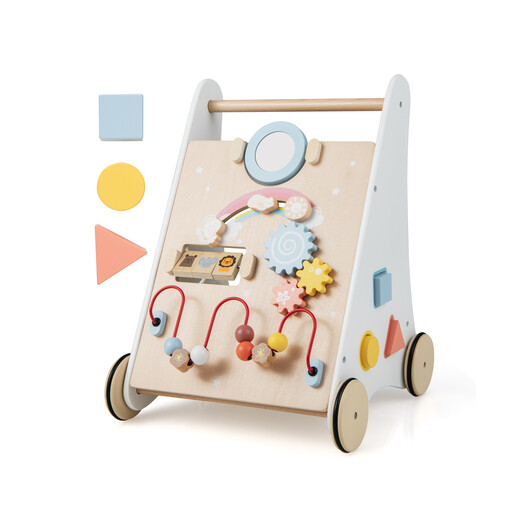
Why it suits this profile: A good choice if you’re looking for a wooden baby walker with an understated design and several play options for use at home.
The product description mentions rubber wheel rims, rounded corners and a smooth surface. Still, check all the connections after assembly.
Linden wood and MDF, seven activities, a storage basket and a weight of 2,2 kg. Suitable from 12 months according to the product specifications.
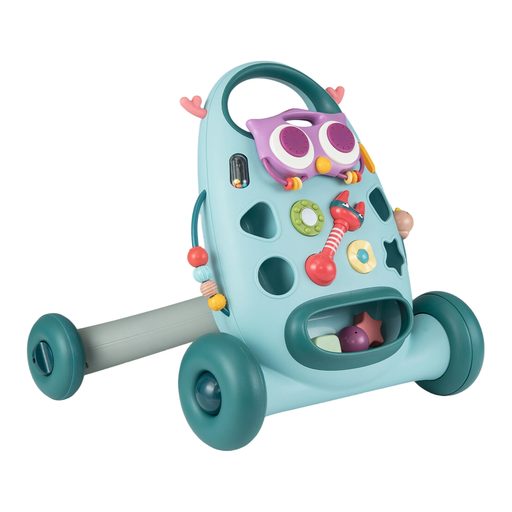
Why it suits this profile: A handy option for households where the activity panel needs to be used separately too, for example at the table or on a play mat.
The playboard is removable and the rear wheels have speed settings. This means you can use the play and walking functions separately.
Shape sorter, bead maze and moving elements. Dimensions: 57 x 42 x 45,5 cm; suitable for ages 12 to 36 months according to the product information.
We’ve put together a complete, up-to-date list of products that meet these strict selection criteria and the applicable European safety requirements.
It varies by model. Some products are listed as suitable from 10 months, while others are listed from 12 months. Also consider your child’s development: sitting independently and pulling themselves up in a controlled way matter more than the age stated on the packaging.
How long it lasts depends on the materials, assembly and how often the toy is used. A model for ages 10 to 36 months may be usable for longer than one with only an age recommendation of 12 months and up. Before each use, check that the frame is still stable and no parts have come loose.
A simple wooden baby walker doesn’t use batteries. A baby walker with music and lights may need batteries, so check whether they’re included. Adjustable volume and features you can switch off are useful in a flat or during quiet times.
