
Vandaag of morgen in huis

Kwaliteit gegarandeerd

Welkomstaanbiedingen ontgrendelen: GRATIS bezorging | Tot 80% korting | Gratis 30 dagen JoyPlus-proefperiode
Download de app
A night light for a baby’s or child’s bedroom may seem like a straightforward purchase. However, models can vary considerably in how they work, their brightness, battery life and safety features. A light that looks appealing in the shop may prove impractical at home: too bright for a night feed, quick to run out of charge or difficult to clean.
So don’t focus only on a cute design. Think about the features you’ll need every day.
Bright white light can be impractical when feeding, changing or checking on your baby. Look at the light output in lumens, the colour temperature and whether the light can be dimmed. Warm white light around 2600–3200K usually feels softer than cool daylight, but the right setting depends on the room and how you’ll use it.
A manufacturer may quote a long battery life, but this is often measured at the lowest brightness setting. At maximum brightness or with a colour-changing mode, the battery usually runs down more quickly. Check:
RGB colours, an app, sounds and a motion sensor can be useful, but they’re not right for every room. A sensor may switch on unexpectedly in the middle of the night. An app may require Wi-Fi and extra setup. For a nursery, simple touch controls, a timer or a remote control are often more practical than features you rarely use.
A dimmable night light can be used in a range of situations. A low setting is suitable for sleep or quiet reading; a brighter one can help when changing your baby. Check whether the brightness adjusts smoothly or in set steps. A warm white light is a practical choice if you want to avoid harsh lighting at night.
An LED night light uses little power. According to the product information, the models featured are designed for long-term household use. However, always check the heat output, ventilation and placement instructions.
A night light with a timer switches off automatically, so it won’t stay on all night. A night light with touch controls is quick to operate when your hands are full. For a model with a motion sensor, check its range. Some sensors only respond in dark conditions and within a limited distance.
Use a motion sensor in a place where you need light briefly, such as by the changing table or in the hallway. Make sure the device is stable and out of your baby’s reach. A light isn’t a toy unless the manufacturer specifically says it’s suitable for play.
Look for rounded edges, a stable base and a casing that’s easy to clean with a soft cloth. For rechargeable models, keep the charging cable out of children’s reach. Use only the specified power source, for example 5 V / 1 A.
Don’t put a lamp in the cot, and only hang a device if the instructions say this is allowed. For electrical products, warnings about water, heat, damaged cables and lithium batteries matter more than a decorative design.
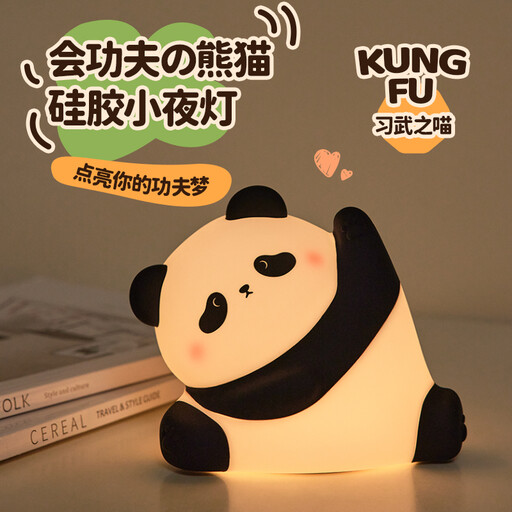
Why it suits this profile: This soft panda design combines a rechargeable battery with three brightness levels and touch controls. According to the product description, it’s intended for nurseries, children’s bedrooms and night feeds.
The three light settings make it easier to choose a lower brightness than with a lamp that only has an on/off switch. There’s no need for disposable batteries.
1200mAh rechargeable battery, three brightness levels and a soft silicone design, according to the product information.
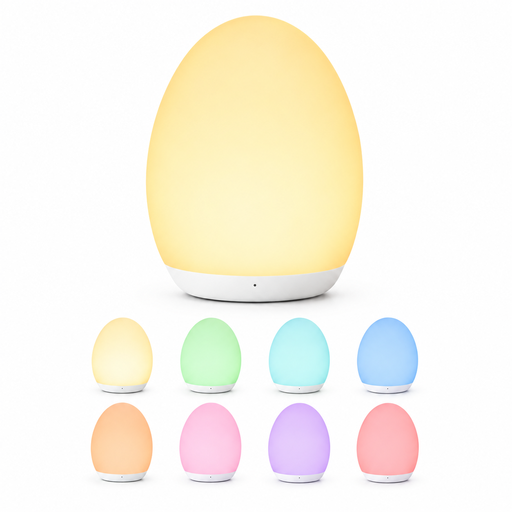
Why it suits this profile: This model is for parents looking for one compact light for night feeds, nappy changes, bedtime and travel. According to the product information, it has warm white light, eight colour settings, a timer and a memory function.
The product information lists different operating modes and makes clear that the maximum battery life applies only at the lowest brightness setting.
2000mAh battery, touch controls, a 1-hour timer, eight colours and no app or Wi-Fi required, according to the product description.
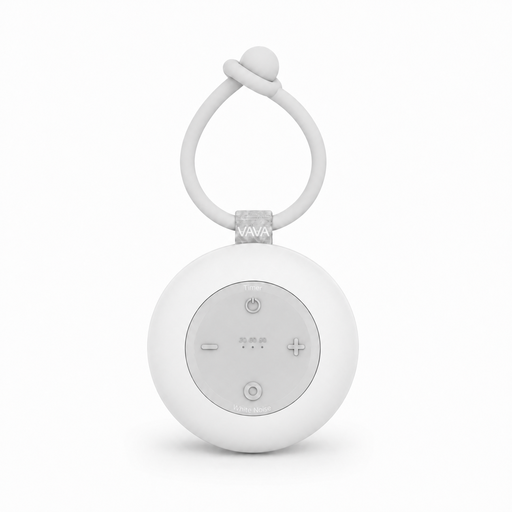
Why it suits this profile: A good choice if you want to use sounds as well as light at bedtime, when travelling or during night-time care. According to the product description, it has 18 sounds, five light settings and timers for 30, 60 and 90 minutes.
According to the product information, the light and sound functions work independently. The child lock helps prevent accidental operation.
USB-C charging, a 1000mAh battery, five light settings and three timer options, according to the product description. Sound can support a bedtime routine, but it doesn’t guarantee sleep.

Why it suits this profile: A cute night light for children that can also be used as a decoration. Its design suits a toddler’s or child’s bedroom and, according to the product description, it’s easy to operate by tapping it.
According to the product information, the built-in 30-minute timer stops the light from staying on unnecessarily long while your child is falling asleep.
Three brightness levels, a 1200mAh rechargeable battery and a stated battery life of 8–10 hours, according to the product information.
We’ve put together a full, up-to-date list of products that meet these strict selection criteria and the applicable European safety requirements.
Yes, as long as you can dim it sufficiently and it’s placed securely out of your baby’s reach. A warm white setting is practical for feeding and changing. Avoid shining light directly into your baby’s eyes, and don’t place an electrical device in the cot.
That depends on the battery capacity, brightness and features. A product that quotes a long battery life at minimum brightness, for example, may run for considerably less time at maximum brightness. Check the different operating modes and charge the light during the day.
A low-power LED light usually uses very little electricity. A timer, sensor or automatic switch-off can help reduce consumption further. With a rechargeable night light, you’re mainly paying to charge the battery; actual battery life still depends on the light setting you choose.
