
Vandaag of morgen in huis

Kwaliteit gegarandeerd

Welkomstaanbiedingen ontgrendelen: GRATIS bezorging | Tot 80% korting | Gratis 30 dagen JoyPlus-proefperiode
Download de app
Choosing the right baby nappies may seem straightforward, but a pack full of marketing claims won’t always tell you what you need to know for everyday use. A nappy, for example, may be highly absorbent but still leak if the leg cuffs don’t fit snugly. A large monthly box may also seem like good value, even though your baby could quickly grow into the next size.
As a Joybuy Product Recommendation Officer, I focus on information you can check: weight range, number of nappies, materials, fastening, absorbent core and practical fit.
Sizes vary between brands and models. Your baby’s weight is a more useful starting point than their age. For example, a newborn weighing 2–5 kg may need size 1, while another baby may move up to size 2 sooner.
Check the weight guidance for:
A nappy that’s too small is more likely to leave gaps around the legs or waist. One that’s too big may slip out of place.
Claims such as leak-proof nappies or protection for a certain number of hours are not a guarantee for every baby, sleeping position or amount of moisture. According to Pampers’ product information, Premium Protection features a Stop & Protect pocket at the back and more than 1,000 absorbent micropores. These are the brand’s product specifications; how well the nappy works also depends on the size, fit and changing it promptly.
BC Babycare Royal nappies are described as having 360-degree leak protection and an absorbent core with SAP. Here too, check that the leg cuffs are pulled outwards and that the nappy isn’t too loose.
A monthly box of nappies can be handy for families using the same size consistently. First, work out the price per nappy:
Total price ÷ number of nappies = price per nappy
Also consider how many you use each day. Newborns are often changed more frequently than toddlers. If your baby is growing quickly, it’s best not to buy several large boxes in the same size straight away.
Always check the weight limits on the product page and packaging. For example, BC Babycare Royal nappies are available in size 1 for 2–5 kg, size 4 for 9–14 kg and size 5 for 12–17 kg. The size 4 pack contains 40 nappies, while the size 5 pack contains 36.
A good fit means:
Many absorbent nappies use superabsorbent polymer, often referred to as SAP. This material absorbs moisture into the core. BC Babycare states that the Royal range has a composite core with SAP and a core weight of 460 g/m². This is a technical product specification, not a guarantee of a set period of use.
Some models have a wetness indicator. BC Babycare Royal is described as having an indicator with three colour-changing stripes. This can help you check the nappy at a glance, but also pay attention to your baby’s comfort and change them promptly.
For parents looking for nappies for sensitive skin, ingredient and material claims matter more than general words such as “soft”. According to the manufacturer, Pampers Premium Protection is dermatologically tested, contains no EU fragrance allergens according to the product information, and is listed as OEKO-TEX Standard 100 certified. BC Babycare mentions a slightly acidic surface pH of 5.5 and skin-conditioning additives.
This information describes the product features as stated by the brands. If redness or irritation persists, it’s advisable to stop using the product and seek medical advice.
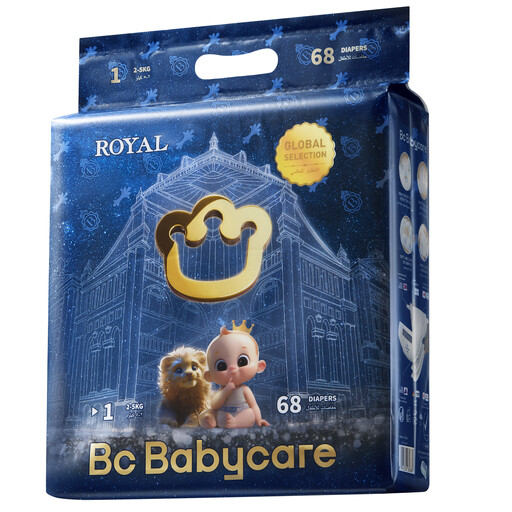
Why it suits this profile: A pack of 68 nappies gives new parents the chance to try size 1 in practice without immediately buying a month’s supply.
The size is linked to a weight range of 2–5 kg, and the pack states that it contains 68 nappies. This makes it easier to compare than relying on age guidance alone.
SAP in the absorbent core, breathable PE film and a wetness indicator with three colour-changing stripes, according to the product information.

Why it suits this profile: A good choice for parents who use the same size consistently and value having a large supply for everyday use.
The size, count of 204 nappies and fit details are clearly stated. Still, check first that your baby is comfortable in the specified size.
According to Pampers: more than 1,000 absorbent micropores, a Stop & Protect pocket, a cut-out designed to protect the navel and dermatological testing.

Why it suits this profile: Handy for active children who prefer to stand or walk during nappy changes rather than lie still.
The nappy pants have an elasticated waistband and tear-away sides. This makes changes easier when a traditional nappy becomes awkward during lots of movement.
Size 5 for the stated weight range, 144 nappy pants, wider protective leg cuffs and an adhesive tab for rolling them up after use.
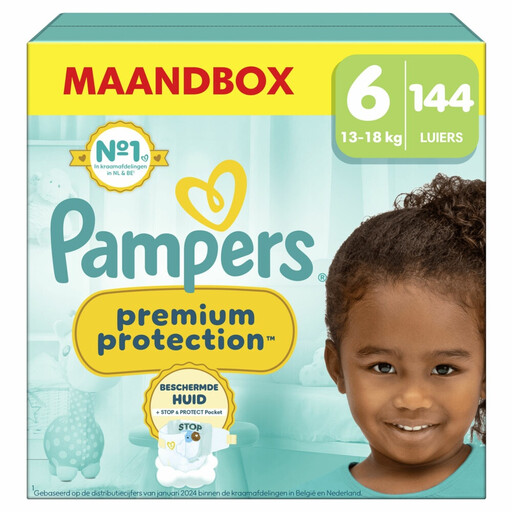
Why it suits this profile: A practical option for families whose child is comfortably in a larger size and uses nappies regularly.
The pack contains 144 nappies and states a weight range starting at 13 kg. This helps you match the supply to how many you actually use.
According to the product information: SAP in the core, a Stop & Protect pocket, an OEKO-TEX listing and no EU fragrance allergens.
We’ve put together a complete, up-to-date list of products that meet these strict selection criteria and the applicable European safety regulations.
Use your baby’s weight as a starting point, then check the fit. Look for leaks, red marks, gaps around the legs and a waistband that slips out of place. If you’re unsure, try a smaller pack before buying a monthly box.
It depends on how much urine or poo there is, the time of day and the model. Check the nappy regularly and change it straight after a poo. A product claim about absorbency or how long it can be worn is made by the manufacturer and isn’t a set guideline for every child.
Not necessarily. Size 5 nappy pants are particularly useful for children who move around a lot or stand during changes. Check the stated weight range and make sure the elasticated waistband and leg cuffs fit comfortably. If there’s skin irritation or a poor fit, another model or size may be more suitable.
