
Vandaag of morgen in huis

Kwaliteit gegarandeerd

Welkomstaanbiedingen ontgrendelen: GRATIS bezorging | Tot 80% korting | Gratis 30 dagen JoyPlus-proefperiode
Download de app
Buying baby nappies sounds simple until you have to choose between disposable nappies, newborn nappies, pull-up pants, monthly boxes and different brands. A low price per pack does not always reflect the cost per use either. The fit, your baby’s weight and the number of nappies in a box are just as important.
As a Joybuy Product Recommendation Officer, I filter product information based on verifiable points. This helps you see more quickly which specifications are relevant and which marketing claims should be treated with some caution.
Baby nappies by size are generally based on weight, not just age. For example, a six-month-old baby may need size 3 or size 4, depending on their build and the fit of the nappy. Always check the weight range on the packaging.
A nappy that is too small can leave red marks around the legs or waist. A nappy that is too large may not fit snugly enough, which can lead to leaks. The size indication is therefore a starting point; the fit around the waist and legs is decisive.
A monthly box of nappies may seem practical, but a large supply is less convenient if your baby grows quickly or if a particular model does not fit properly. When trying a new size or brand, start with a smaller pack. Pay attention to:
Once you are happy with the fit, a larger pack may offer better value for money.
Words such as “soft”, “hypoallergenic” or “suitable for sensitive skin” do not automatically describe how every baby will react to a nappy. According to Pampers’ own research, certain Pampers nappies have been dermatologically tested, contain no EU fragrance allergens and are sometimes OEKO-TEX Standard 100 certified. According to BC Babycare’s product information, certain models have a surface with a pH of 5.5.
This information can help when comparing products, but it is not a medical guarantee. Stop using the nappy if persistent redness or irritation occurs and seek advice from a healthcare professional if necessary.
Use your baby’s weight as the main selection criterion. The range includes:
The ranges may vary by brand. According to the product information, BC Babycare Royal Nappies size 4 are intended for 9–14 kg, while Pampers Baby Dry Pants size 5 are offered for 12–17 kg. So do not compare the size number alone.
An absorbent core often consists of cellulose, fluff pulp and/or superabsorbent polymer (SAP). Product information for several BC Babycare Royal models states a core weight of 460 g/m² and 14.5 grams of SAP. For Premium Protection models, Pampers states that they contain more than 1,000 absorbent micropores and a Stop & Protect pocket at the back.
These are technical product details, not a guarantee that a nappy will remain leak-free in every situation. Above all, check that the nappy fits properly and change it regularly. Elasticated waistbands and raised leg cuffs can be practical for active babies.
Compare the price per nappy rather than just the total price. A smaller pack may cost more per nappy, but it can be a wiser choice when trying a new size. Examples from the range include:
A monthly box is particularly useful when you already know the product and have enough storage space. Store nappies in a dry, clean place away from direct sunlight.
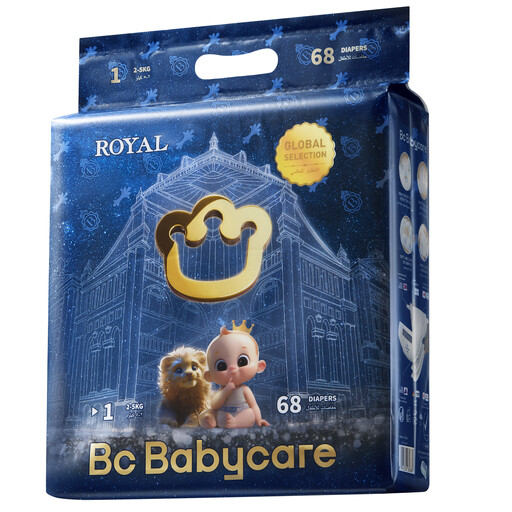
Why it suits this profile: A manageable pack for parents who want to try newborn nappies before buying a larger supply.
The weight range is clearly stated, so you do not have to choose based solely on age or a general size.
68 nappies, a wetness indicator according to the product description, and a material composition containing fluff pulp and SAP.
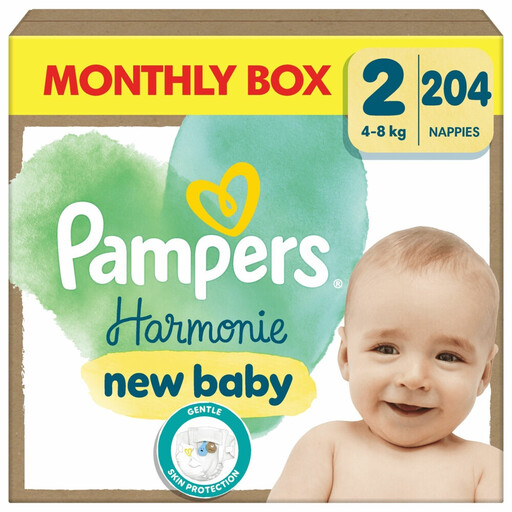
Why it suits this profile: A large pack for parents who want to use a particular model for sensitive skin and change nappies regularly.
The product information states 0% perfume and lotion, dermatological testing and OEKO-TEX Standard 100 certification; check this on the packaging too.
204 nappies, a Stop & Protect pocket and cellulose from FSC-certified forests according to the product description.

Why it suits this profile: Pull-up pants are practical for active babies and toddlers who move around a lot during changes.
According to the product information, the model has a 360° anti-leak design and an elasticated waistband that moves with your child.
Weight range of 9–14 kg, 38 nappies per pack and a core containing SAP according to the product specifications.

Why it suits this profile: A large box reduces the number of orders when your baby has been wearing the same size for some time.
The packaging states the exact quantity of 204 nappies, allowing you to calculate the price per nappy and your usage more accurately.
According to the product information: more than 1,000 absorbent micropores, a navel-friendly cut-out and dermatological testing.
We have put together a complete, up-to-date list of products that fully meet these strict selection criteria and the applicable European safety regulations.
This varies according to age, feeding and changing routine. Newborn babies often use more nappies per day than older babies. Track your actual usage over one week and multiply it by approximately four. This helps prevent a monthly box from being too small or unnecessarily large.
Look out for recurring leaks, red marks, open edges or difficulty fastening the nappy. First check that the nappy has been put on correctly. If the problems continue, compare the weight range with the next size up. The transition from size 3 to size 4 or from size 4 to size 5 may vary by brand.
Not as a rule. Pull-up pants are particularly practical because of their pull-on design and flexible waistband. Compare the price per nappy with ordinary disposable nappies and consider how many your child uses each day. For active children or those practising independent changing, the convenience may make the higher price per nappy worthwhile.
