
Vandaag of morgen in huis

Kwaliteit gegarandeerd

Welkomstaanbiedingen ontgrendelen: GRATIS bezorging | Tot 80% korting | Gratis 30 dagen JoyPlus-proefperiode
Download de app
A baby monitor with a camera lets you see and hear your little one when you’re not in the nursery. However, not every model is right for every household. A wifi baby monitor with an app works differently from a system with its own parent unit. And an indoor security camera can offer plenty of features, but isn’t always designed for use next to a cot.
The main pitfalls often aren’t about resolution, but the practical details.
A higher resolution can show details more clearly, but it says nothing about the range, the connection or the quality in the dark. So also check the type of night vision, the viewing angle and whether the picture stays stable via wifi or a direct connection.
With an app-based baby monitor, you view the picture on your smartphone. That’s handy when you’re out and about, but it depends on your wifi, the app and your account settings. A model with its own screen often works more directly indoors. Some systems combine both options.
A camera with local storage usually uses a microSD card. With cloud storage cameras, extra costs may apply. According to the product descriptions of various models, cloud storage isn’t always free. So check before you buy:
A direct baby monitor connection with a parent unit means you don’t have to rely on the internet or an app for every image. The Philips Avent SCD882/26, for example, states a range of up to 50 metres indoors and up to 300 metres outdoors according to the product information. In a home with concrete floors, multiple storeys or lots of wireless equipment, the actual range may be lower.
A wifi baby monitor, on the other hand, offers remote access. Check whether the model supports 2.4 GHz, 5 GHz or both. 2.4 GHz generally has better range through walls; 5 GHz can be suitable for higher data speeds over short distances. A smart baby monitor with an app also requires a secure wifi network, a strong password and regular updates.
A baby camera with night vision usually uses infrared images. Some models also offer colour or smart night vision modes. Pay attention to the stated distance: the JOOAN C17C, for example, lists infrared vision up to 6 metres, while some other models give a range of around 10 metres.
A fixed camera can be sufficient for a cot that doesn’t move. For a larger room, pan-tilt, automatic tracking or a 360-degree camera are more practical. Motion detection and sound detection can send alerts to your phone, but check whether you can set zones and sensitivity. Otherwise, curtains, pets or changing light can cause unnecessary notifications.
With two-way communication, you can listen and talk back through the camera. That’s useful for speaking to your child from a distance, but also for a pet camera, elderly monitoring camera or indoor security camera.
Always place the camera out of the child’s reach. Keep power cables away from the cot and securely mount a wall or ceiling model. A camera is a tool and does not replace supervision by an adult. Don’t point the lens at private areas and let housemates or visitors know when recording is taking place.
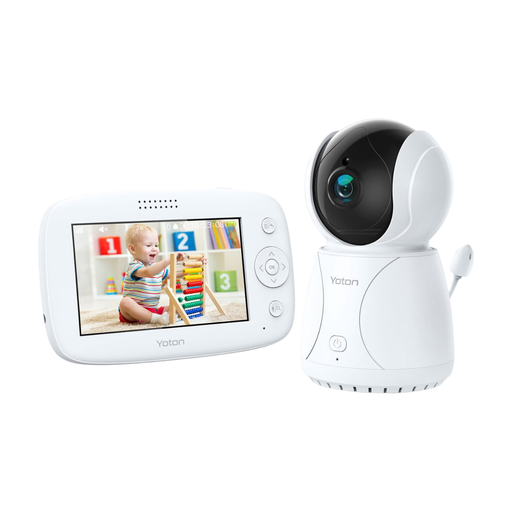
Why this fits the profile: This model combines a 4.3-inch screen with a rotation function, night vision and two-way communication. You don’t need a smartphone app to view the picture indoors.
The dedicated LCD monitor avoids reliance on an app or cloud account. According to the product information, the temperature sensor is intended only as an indication and not as a medical device.
4.3-inch screen, rotation function, night vision and two-way communication.
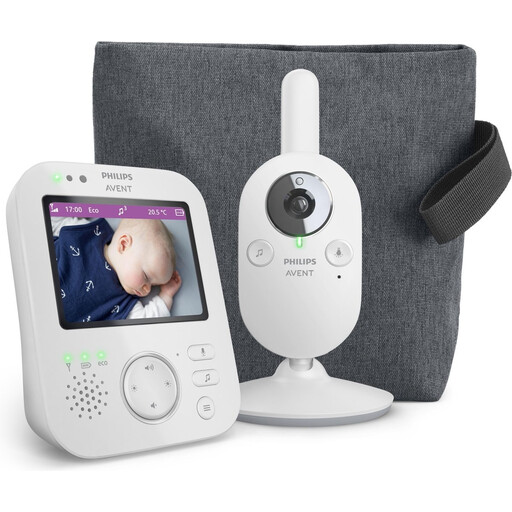
Why this fits the profile: Ideal for parents looking for a traditional system with a parent unit, VOX mode and a secure private connection.
The product description mentions a secure connection without emphasis on a cloud subscription. This makes the system suitable for indoor use without a smartphone.
2x digital zoom, VOX mode, night vision, lullabies and stated range of up to 50 metres indoors.
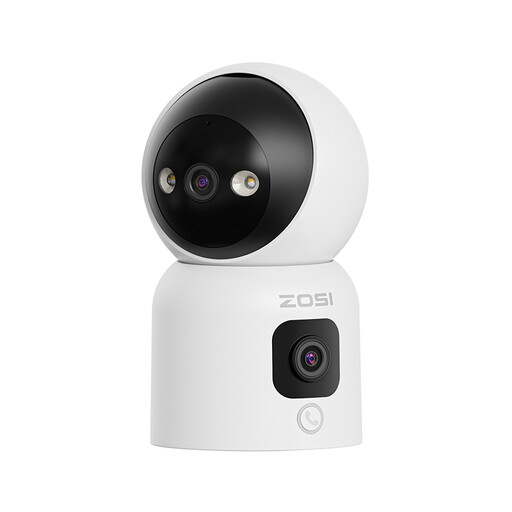
Why this fits the profile: This dual-lens camera suits households that want to monitor one room for a baby, pet or elderly family member in a versatile way.
According to the product description, the camera offers local storage up to 256 GB alongside a cloud trial. Motion zones and person detection are also available to make alerts more targeted.
Two 2 MP lenses, multiple night vision modes, two-way communication and support for 2.4 and 5 GHz wifi.
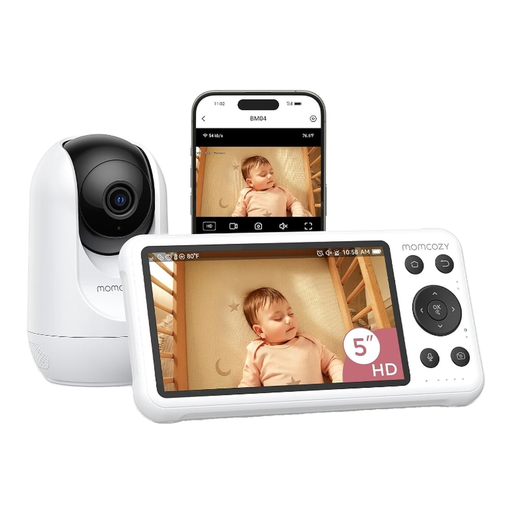
Why this fits the profile: This dual-mode system combines a 5-inch parent monitor with access via wifi and a mobile app.
You’re not solely reliant on your phone: the product information mentions a separate monitor. For access outside the home, wifi and the associated app are required.
1080p picture, motion and cry detection, night vision, local recording and two-way communication.
We’ve put together a full, up-to-date list of products that fully meet these strict selection criteria and comply with current European safety regulations.
No. A baby monitor with its own parent unit can communicate directly with the camera. For a wifi baby monitor or model with an app, wifi is usually needed for remote operation. Also check whether the camera only supports 2.4 GHz or also 5 GHz.
The lifespan depends on power supply, heat, moisture, cable quality and software support. A model with a fixed power supply can run continuously, but check the adapter, cable and mounting regularly. With a battery-powered system, the battery capacity decreases over time. Keep the firmware and app updated as long as the manufacturer offers support.
Basic functions may be included, but cameras with cloud storage sometimes charge a subscription. Local storage with a suitable microSD card can limit recurring costs. Check before you buy which features work without a subscription and whether notifications, playback and long-term storage are billed separately.
