
Vandaag of morgen in huis

Kwaliteit gegarandeerd

Welkomstaanbiedingen ontgrendelen: GRATIS bezorging | Tot 80% korting | Gratis 30 dagen JoyPlus-proefperiode
Download de app
A baby monitor with a camera can be useful when you’re working during the day, want to listen in at night or check from another room that your child is sleeping peacefully. However, models vary considerably in connectivity, range, battery life and privacy. A large screen or high resolution doesn’t automatically mean a baby monitor is right for your home.
So the most important question isn’t which baby monitor has the most features, but which ones you’ll actually use. Read on to find out what to look for in a video baby monitor, which marketing claims to view with a critical eye and which models suit different family situations.
Manufacturers often quote the range under ideal conditions. In a typical home, concrete walls, floors, metal and other wireless devices can affect the signal. So a quoted range of, say, 300 metres doesn’t mean you’ll get a reliable picture over that distance in every home.
Look for the difference between indoor and outdoor range. A baby monitor with a parent unit is practical if you don’t want to rely on a smartphone or Wi-Fi network. Also check whether the camera itself always needs to be plugged into the mains.
A baby monitor with night vision usually uses infrared to show a picture in a dark room. This helps you check on your baby at night, but doesn’t tell you how motion is detected. Some models switch the screen on in response to sound, while others analyse movement and send an alert.
Check the exact description. For example, “smart detection” on a Wi-Fi baby monitor might mean an app notification, while a model without Wi-Fi may only sound an alert or activate the screen.
A Wi-Fi baby monitor lets you check in from outside the home using an app. This usually requires an account and an internet connection, and may also involve cloud storage. Check whether you can set a strong password, whether two-step verification is available and where images are stored.
A baby monitor without Wi-Fi usually connects directly to the parent unit. This can make setup easier and limits the number of online connections. The downside is that you generally can’t view the picture remotely on your phone.
A resolution of 720p or 1080p gives you an idea of how much detail the picture can show. In a dark room, positioning still matters: a camera placed too far away will show less detail, whatever its resolution. A camera that pans and tilts or has digital zoom can help you keep an eye on a moving child.
Also check:
With a direct connection between the camera and parent unit, you don’t need a router. For example, the Philips Avent SCD882/26 lists a range of up to 50 metres indoors and up to 300 metres outdoors. These are the model’s specifications; actual performance depends on your home and any obstacles.
A parent unit is especially practical if you need to keep your phone free or don’t want to use an app. For a Wi-Fi baby monitor, check whether the camera supports only 2.4 GHz or also 5 GHz. A dual-band model may work better with some routers, but it still needs a stable network.
Don’t just look at the maximum battery life; check the conditions it applies to as well. For example, the VAVA VA-IH006 PRO lists up to 24 hours in audio-only mode, compared with up to 10 hours with the screen switched on.
Features that may be useful for some families include:
A temperature sensor is a room-monitoring aid, not a medical measuring device. Use the reading as a general guide and always follow the instructions.
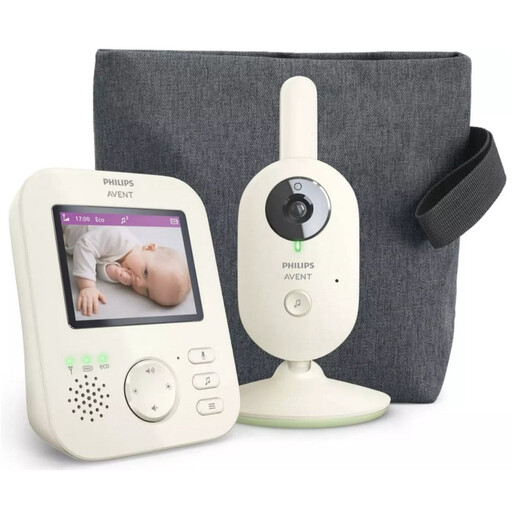
Why it suits this profile: This baby monitor with a parent unit uses a direct wireless connection and doesn’t need an app. That makes it straightforward to use as a first purchase.
The product specifications list the indoor and outdoor ranges separately. ECO mode and VOX help limit unnecessary continuous screen use.
2.8-inch colour screen, infrared night vision, zoom, two-way communication, two lullabies and background sounds.
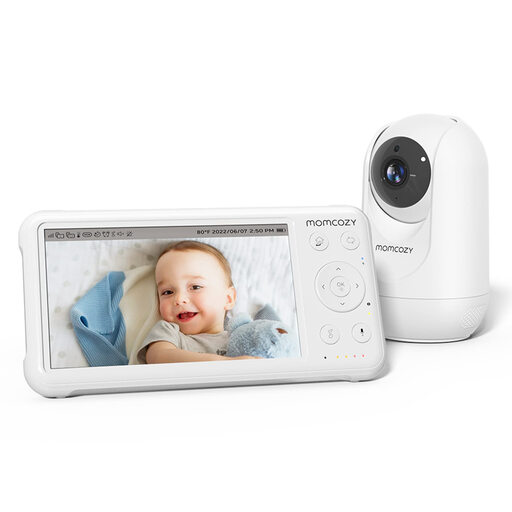
Why it suits this profile: This model combines a 5-inch 1080p screen with a camera that pans and tilts, a temperature sensor and support for up to four cameras.
The stated battery life, range of up to 960 feet and features depend on specific conditions of use. The quoted range applies in an open space.
1080p display, PTZ controls, night vision, two-way talk, lullabies and a built-in 5000mAh battery in the parent unit.
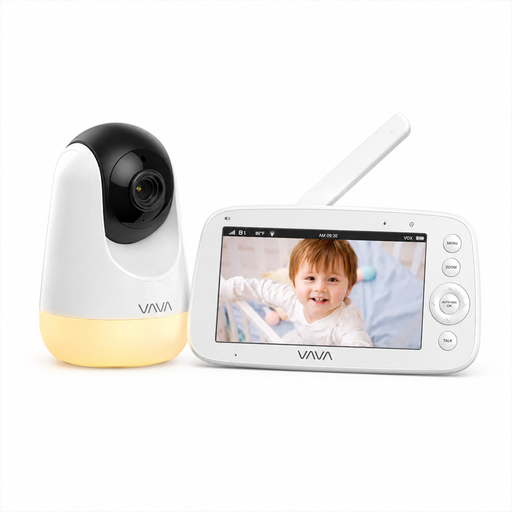
Why it suits this profile: This baby monitor without Wi-Fi uses a direct 2.4GHz connection and is suitable for families who don’t want to use an app, account or cloud service.
The stated operating time distinguishes between video mode and audio-only mode, helping you match your battery expectations to how you use it.
5-inch 720p screen, infrared night vision, two-way talk, five lullabies, temperature information and a parent unit with a 4500mAh battery.
Place the camera on a stable surface or secure it firmly to the wall. Keep cables out of your child’s reach, and don’t position the camera near the cot, bedding or other items they could grab. Once it’s set up, check the picture from the spot where you’ll usually use the parent unit.
Use a temperature sensor as an indication of the room temperature, not as a substitute for supervision. A baby monitor is an aid and doesn’t replace the responsibility of a parent or carer.
We’ve put together a complete, up-to-date list of products that meet these strict selection criteria and the applicable European safety regulations.
No. A baby monitor without Wi-Fi uses a direct connection between the camera and parent unit. Choose Wi-Fi if you want to check in using an app while you’re away from home. Choose a direct connection if simplicity and fewer online connections matter more to you.
That depends on screen use, signal strength and settings such as VOX. Manufacturers often give separate battery life figures for audio-only and continuous video. Check both before choosing a model.
A temperature sensor gives you an indication of the room temperature. The reading may vary depending on its position, ventilation and distance from heat sources. So don’t use the sensor as a medical device, and follow the product instructions.
