
Vandaag of morgen in huis

Kwaliteit gegarandeerd

Welkomstaanbiedingen ontgrendelen: GRATIS bezorging | Tot 80% korting | Gratis 30 dagen JoyPlus-proefperiode
Download de app
A baby monitor with a camera can give you peace of mind during naps and bedtime, but not every model is right for every home. A large screen says little about the range in a terraced house, and a camera packed with smart features may be less suitable if you don’t want to send images over the internet.
So focus on the connection, where you’ll place the camera and which features you’ll actually use. Below, we’ve set out the key points to consider, along with some popular options based on verifiable product specifications.
Manufacturers often state the range in an open space. Walls, ceilings, metal structures and other wireless devices can reduce the range in your home. A long-range baby monitor may cover a considerable distance outdoors, while its connection is weaker in the loft or behind several concrete walls.
So check:
A Wi-Fi baby camera can send images to your smartphone when you’re away from home. This requires a stable internet connection, an app and often an account. Notifications may also depend on your internet connection and phone settings.
If you’ll mainly be monitoring your baby at home, you could consider a baby monitor without Wi-Fi. A direct connection between the camera and parent unit works without an app or cloud service. This can make set-up simpler and reduce the number of digital links involved.
A baby monitor with motion detection can send alerts when the camera detects movement. However, curtains, pets or changing light can also trigger motion detection. Some models may also require you to adjust the sensitivity, detection zones or notification settings to limit unnecessary alerts.
Use notifications as an aid, and always check whether the feature can be adjusted. A monitor is no substitute for supervision by an adult.
For a baby camera in the nursery, a clear picture matters more than a high pixel count alone. Look for:
A baby monitor with night vision will usually switch over automatically when the room gets dark. Infrared images may be in black and white. Some Wi-Fi cameras also offer colour night vision, but check whether this requires extra lighting or specific settings.
A model with a parent unit often has its own screen for viewing and listening. According to the product information, the Philips Avent SCD892/26 uses a linked handset connection. Its stated range is up to 50 metres indoors and up to 300 metres outdoors. These are guide figures; actual performance depends on your surroundings.
A Wi-Fi model offers more flexibility, such as viewing through an app when you’re out and about. If you use Wi-Fi, set a strong password and check which storage options are available. For local storage, find out whether you need a memory card and whether one is included.
A baby monitor with a talk-back function lets you speak to your baby from another room. VOX mode, which activates the screen when it detects sound, can also help reduce power consumption. Also look at:
A temperature sensor provides information about the room, but it doesn’t replace checking the temperature yourself or following appropriate safe-sleep advice.
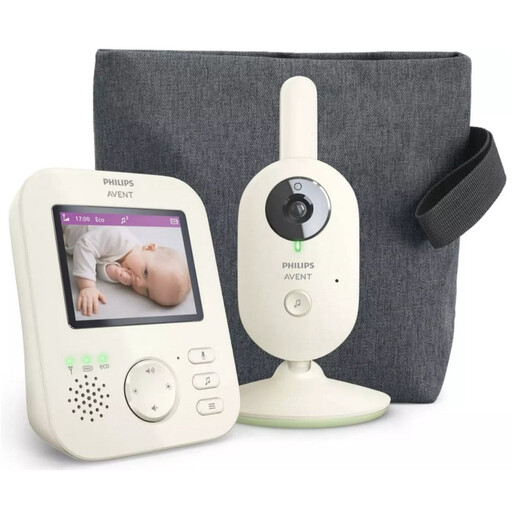
Why it suits this type of buyer: A straightforward model with a parent unit, ideal if you want to watch and listen at home without relying on a smartphone app.
The product information lists a dedicated handset connection, VOX mode and a range of up to 50 metres indoors and 300 metres outdoors.
2.8-inch screen, infrared night vision, two-way audio, digital zoom and lullabies.
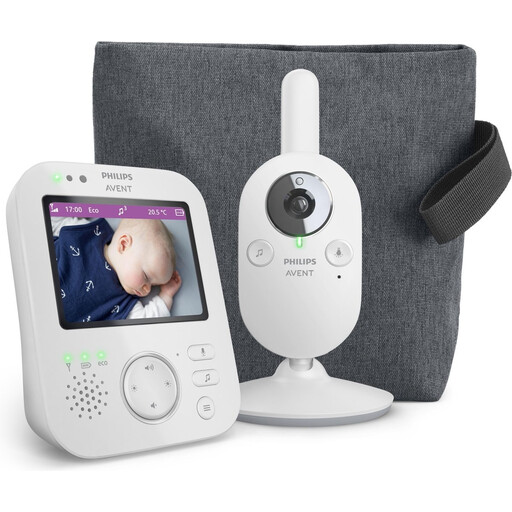
Why it suits this type of buyer: A good choice if you value a larger 3.5-inch colour screen, zoom and a carry case.
The specifications distinguish between indoor and outdoor range and provide an indication of the connection and coverage.
3.5-inch LCD screen, 2x digital zoom, VOX mode, infrared night vision and talk-back function.
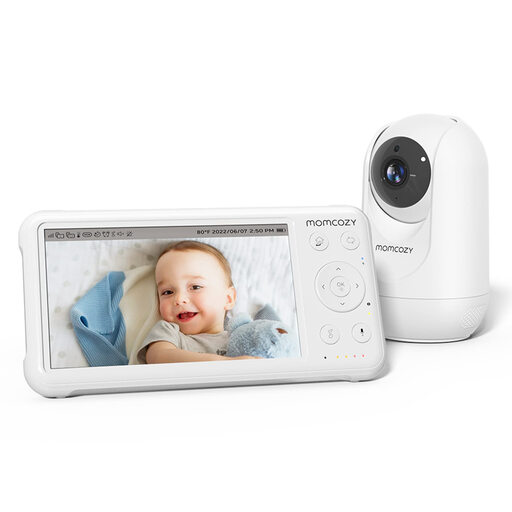
Why it suits this type of buyer: A handy option for families who want to combine multiple cameras, a temperature sensor and a large screen.
The stated range is given as an open-space range, making it clear that walls and floors can affect the distance.
5-inch 1080p screen, night vision, pan-tilt-zoom, temperature sensor, talk-back function and support for up to four cameras.
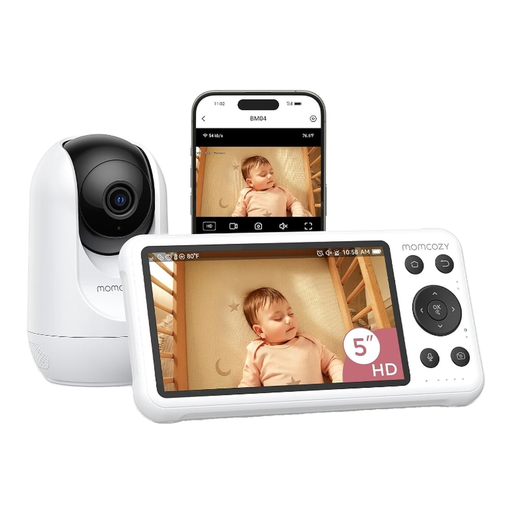
Why it suits this type of buyer: A dual-mode system for parents who want both a dedicated screen and access through a smartphone app.
The product information lists motion and cry detection, local recording and the option to secure Wi-Fi with a strong password.
1080p picture, 5-inch parent unit, night vision, motion and cry detection, two-way audio and app control.
We’ve put together a complete, up-to-date list of products that meet these strict selection criteria and the applicable European safety requirements.
Place the camera securely and out of your child’s reach. Keep cables away from the cot, sleeping area and play space to reduce the risk of entanglement. Point the camera towards the sleeping area and make sure it cannot fall.
Before buying, also check:
Many consumer products sold in the EU come with a legal guarantee of at least two years, but always check the seller’s information and any additional terms.
A model without Wi-Fi doesn’t send images over your home network or through a cloud app. This can reduce the number of digital privacy risks. However, a direct wireless connection is still a wireless signal. So follow the pairing instructions and avoid placing the parent unit outside your home unnecessarily.
It varies by model and how you use it. A screen that stays on continuously uses more power than VOX or audio-only mode. For example, the VAVA VA-IH006 PRO states a battery life of up to 10 hours with the screen on and up to 24 hours in audio-only mode. According to the product information, its stated range of 300 metres applies in an open space; indoors, it may be shorter.
Not necessarily. Motion detection is most useful if you want to receive alerts or keep an eye on a larger part of the room. For simple viewing and listening, night vision, clear audio, a stable connection and a good parent unit are often more important. Also check whether you can adjust the sensitivity and detection zones.
