
Vandaag of morgen in huis

Kwaliteit gegarandeerd

Welkomstaanbiedingen ontgrendelen: GRATIS bezorging | Tot 80% korting | Gratis 30 dagen JoyPlus-proefperiode
Download de app
A baby activity table can be a valuable addition to your little one's toy collection. With buttons, spinning wheels, music, and simple role-play elements, such a table invites independent discovery. Yet many models look alike. A low price or a long list of features doesn't automatically mean the toy suits your child's age, your home, or daily use.
Watch out for these three common pitfalls:
Don't just look at "6 to 36 months" on the product page. Ask yourself how your child will actually use the toy. A young baby usually plays lying down or sitting on the floor. A toddler who pulls themselves up benefits more from a stable table with sturdy legs.
A 2-in-1 design can be practical. With some models, the legs are removable, allowing the toy to be used first as an activity panel on the floor. Later, you reattach the legs for use as a standing table. Check that the construction is stable on a smooth floor and that the child cannot easily shift the table.
For toys for children aged 6 to 36 months, rounded edges and a securely closed battery compartment are key checkpoints. Product information about ABS plastic, BPA-free materials, and CE or EN71 markings can be useful, but read the full safety information.
When a brand states that the toy meets European CE and EN71 requirements, present this as a statement from the brand's product description. Additionally, check:
A CE marking is not a substitute for supervision. Do not leave a baby or toddler alone with toys that are damaged or contain parts that could come loose.
A musical activity table for babies works with piano or instrument sounds, melodies, and sometimes light signals. That can be appealing, but in an apartment, during naptime, or in a shared living room, volume control is important.
Look for a dial, mute function, or quiet play mode. Also check if batteries are not included. This prevents disappointment on a birthday or when opening the gift. With electronic toys, it's wise to regularly check the battery compartment and remove batteries when the toy is not used for an extended period.
A table is especially valuable when its features match the child's interests and motor skills. Pressing buttons, turning gears, and striking keys are examples of motor development toys. Music and different surfaces can also provide sensory variety, without needing to attach medical or developmental claims.
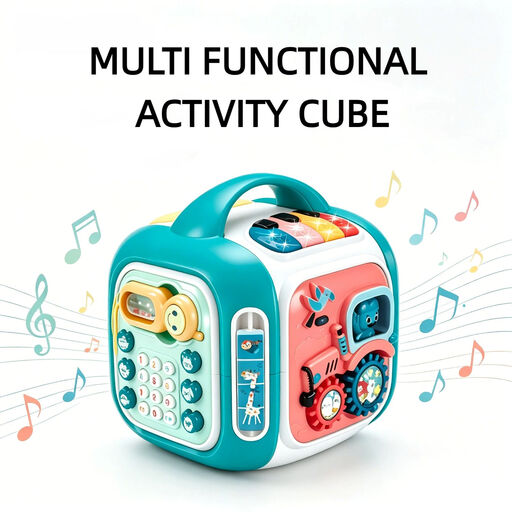
Why This Fits Their Persona: A compact choice for families with limited space or for use on the go, at grandparents' house, or in a restaurant.
The activities are combined into one cube, meaning fewer loose accessories around the play area. The product information mentions rounded edges and a recommended age of 1 to 3 years.
Piano, guitar, telephone, gears, and music functions; dimensions approx. 23 × 23 × 24 cm and a handle for carrying.
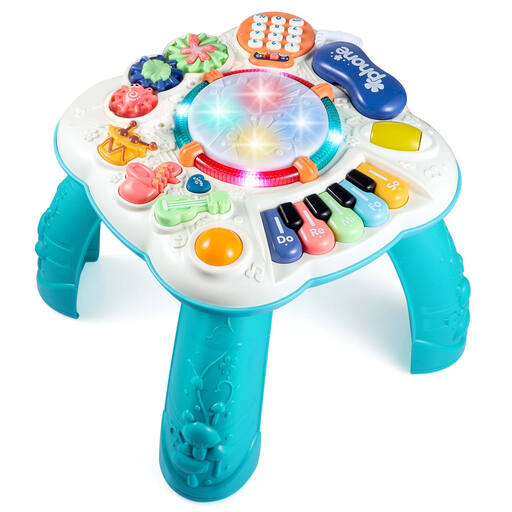
Why This Fits Their Persona: Ideal for parents seeking a single product that can grow from floor toy to a standing interactive baby play table.
According to the product description, this model has removable legs, volume control, and a quiet mode. The manufacturer mentions ABS, BPA-free materials, and rounded edges; verify this information on the packaging as well.
Six play zones with piano, drum, telephone, gears, and instrument sounds; size approx. 30 × 30 × 31 cm. Batteries are not included.
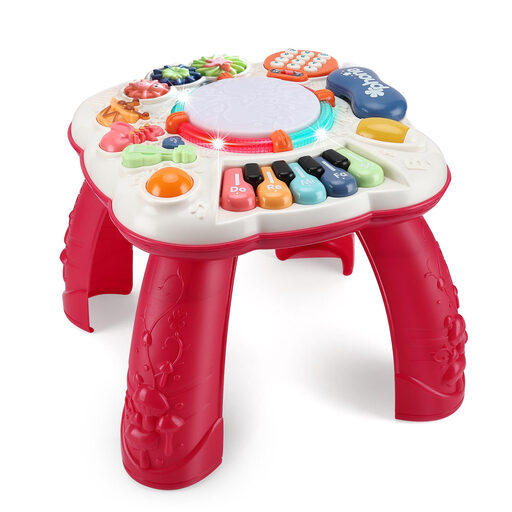
Why This Fits Their Persona: An option for families where the toy is used daily and multiple children want to explore together.
The product information mentions a sturdy ABS construction, rounded edges, and six different play modes. The adjustable sound level helps when used in a living room or apartment.
Suitable according to product information for 6 to 36 months; includes a piano keyboard, light-up drum, telephone, and spinning gears.
Not every educational toy for toddlers is an activity table. For children aged 3 and up, magnetic building sets, a cash register game, or a construction set may be more suitable. These products are not suitable for babies due to small parts or magnets.
Those looking for Montessori toys for 1 to 3 years can focus on open-ended activities where the child chooses an action: turning, pressing, listening, or combining. An activity table with clear, separate functions aligns better with this than a product where everything plays automatically.
For extra inspiration, you can also browse the category educational science toys. Check the age limit and safety warnings for each product there.
Browse a current selection of toys and compare age, features, materials, and usage scenario before you order.
This varies per model. Some tables state 6 months to 36 months, but are initially used as a floor panel. For standing play, your child must be able to sit or stand independently and steadily. Always follow the age indication and the manufacturer's warnings.
The lifespan depends on material, use, and maintenance. A model with removable legs or multiple play modes can remain usable longer as your child grows. Regularly check the legs, screws, edges, buttons, and battery compartment. Stop using it as soon as a part is damaged or loose.
In addition to the purchase price, you need to account for batteries. Batteries are not included with the mentioned models. Consumption depends on how often music, lights, and sounds are used. A volume control or quiet mode also makes the toy more practical for daily use.
