
Hosting a group
If you’re making smoothies for friends, compare the jug’s usable capacity with the number of servings you’re planning. For example, Philips lists an effective capacity of 1.8 litres for the HR3652/00.


If you’re making several glasses at once, a jug blender is a sensible place to start: compare its usable capacity with the number of servings you want to pour. A standard blender is generally enough for soft ingredients such as avocado; extra features are mainly useful if you also want to blend ice or frozen fruit. Check the cleaning instructions and relevant product safety information for each specific model.
If you’re making smoothies for friends, compare the jug’s usable capacity with the number of servings you’re planning. For example, Philips lists an effective capacity of 1.8 litres for the HR3652/00.
If you want to tidy up as soon as you’ve poured the drinks, it’s worth checking the cleaning instructions for the jug, lid and blade unit separately. The Consumers’ Association assesses smoothness and leftover pieces as part of its blender testing.
If you sometimes add ice or frozen fruit, check whether the manufacturer recommends using them with the exact model. The Consumers’ Association says a standard blender is enough for smoothies if you don’t need any special features.
Start by working out how much smoothie you want to make in one go; then consider extra features and cleaning. When looking at a specific blender, also check the applicable voltage and CE marking. The Netherlands Food and Consumer Product Safety Authority states that this marking is compulsory for electrical equipment covered by the Dutch Electrical Equipment Decree, which can include kitchen appliances. The low-voltage rules described apply to 50–1000 V AC or 75–1500 V DC.
| What to consider | What should you check? | Who should pay particular attention? |
|---|---|---|
| Capacity per batch | Compare the jug’s usable capacity with the total amount you want to pour; don’t confuse it with the jug’s external dimensions. | If I want to pour several glasses for friends at once, I’ll match the capacity to the number of servings. Around 36% of consumers put serving a group first. |
| Cleaning | Check whether each part is dishwasher-safe and how the blade unit should be cleaned. | After making several servings, I want to know how to clean the jug, lid and blades according to the instructions. Around 29% of consumers prioritise ease of cleaning. |
| Ice and frozen fruit | Check whether the manufacturer recommends this use for the exact model; wattage alone doesn’t tell you how a smoothie will turn out. | If you want to blend ice or frozen fruit as well as avocado, check whether the model is designed for it. Around 21% of consumers prioritise these chilled options. |
| Storage space | Weigh up a compact blending cup against the total quantity you need and the number of batches required when entertaining. | If I’ll mainly use the blender myself and have limited cupboard space, a smaller cup may be more appealing, even if entertaining means making several batches. Around 14% of consumers choose compactness as their top priority. |
The stated capacity may differ from the effective capacity. Philips lists a 2-litre jug and an effective capacity of 1.8 litres for the HR3652/00. For the Tefal BL435831, both 1.25 litres and 1.75 litres are listed; compare portions using the usable capacity of the exact model.
Check the usable filling capacity and compare it with the number of servings you’re planning.
Extra features aren’t automatically necessary for a smooth avocado smoothie. The Consumers’ Association assesses smoothie results for factors such as leftover pieces and smoothness, not just motor specifications.
Start with the ingredients you use, and only compare ice functions if you want to blend ice or frozen fruit.
Philips says the blade unit of the HR3652/00 should not be put in the dishwasher.
Check the instructions for the jug, lid and blade unit separately.
Philips lists an effective capacity of 1.8 litres for the HR3652/00, designed to prepare larger quantities.
Blendforce II models, including the BL435831, are jug blenders for anyone looking for a jug and straightforward controls.
According to nutribullet, the NBF450DG Combo comes with a 1650 ml jug and a 900 ml cup.
Bosch lists a 1.5-litre blending jug for the VitaPower Serie 4 MMB6172S.
According to Braun, the PowerBlend 3 range includes jug models; some also come with a Smoothie2Go cup.
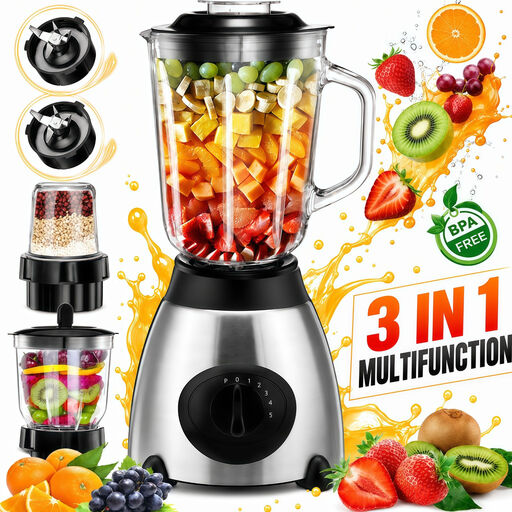
The models below are jug blenders suitable for smoothies. Compare the stated jug capacity with the amount you want to make for your guests, and check the specifications and safety information for the exact model.
 No image available
The stated jug capacity gives you a useful benchmark when comparing how much you need for your guests.
1300 W; 1.5 l jug; 4 Black Titanium blades; 2 speeds; ice crushing.
 No image available
The stated capacity helps you choose a jug to suit the amount of smoothie you want to pour.
1.5 l jug; 6 blades; ice crushing; smoothie blender.
 No image available
The 1.5-litre jug gives you a clear starting point for comparing portions for your guests.
600 W; 3 speeds; ice crushing.
 No image available
The stated jug capacity helps you decide whether this model suits the amount you plan to make in each batch.
1200 W; 1.5 l jug.
 No image available
The stated working capacity gives you a starting point for comparing how much you need to make several glasses.
1000 W motor; 1.5 l jug.
Not necessarily. The Consumers’ Association says a standard blender can make smoothies and purée ingredients. Compare extra features mainly with the ingredients you actually want to use, such as ice.
Compare the jug’s usable capacity with the total amount you want to pour. The jug’s stated capacity isn’t always the same as its effective capacity. For example, Philips lists an effective capacity of 1.8 litres for the HR3652/00, which has a 2-litre jug.
It depends on the model and the part. For example, Philips says that the removable parts of the HR3652/00 are dishwasher-safe, except for the blade unit. Follow the instructions for your exact model.
The Netherlands Nutrition Centre’s food storage guide recommends keeping opened fruit smoothies in the fridge for 1–2 days. This isn’t a guarantee of how long every homemade recipe will keep, especially if it contains dairy or other ingredients. Keep the smoothie chilled and consider the recipe as a whole.
Check the applicable voltage and CE marking for the exact model. The Netherlands Food and Consumer Product Safety Authority states that the CE marking requirement applies to electrical equipment covered by the Dutch Electrical Equipment Decree. The low-voltage rules described apply to 50–1000 V AC or 75–1500 V DC. A CE marking is not an assessment of smoothie-making performance.