
Vandaag of morgen in huis

Kwaliteit gegarandeerd

Welkomstaanbiedingen ontgrendelen: GRATIS bezorging | Tot 80% korting | Gratis 30 dagen JoyPlus-proefperiode
Download de app
An automatic pop-up camping tent sounds simple on paper: take it out of the bag, unfold it and you’re ready to go. In practice, most disappointments aren’t caused by the pop-up mechanism itself, but by unrealistic expectations about space, waterproofing and ventilation. If you focus only on claims such as “sets up in 3 seconds” or “blackout”, you could end up with a tent that’s less suitable for a Dutch campsite, festival or short outdoor trip.
An instant camping tent springs open quickly, but you still need to secure it properly. This may mean using tent pegs, guy lines, an outer flysheet and sometimes awning poles. This step is particularly important in windy conditions. Check that the tent has clearly marked attachment points and that the instructions explain how to use the frame and guy lines.
A rating such as PU2000 mm tells you how much water pressure the material is designed to withstand, according to the product specifications. It doesn’t mean the tent will stay dry in every situation. The condition of the seams, how the outer tent is positioned, the ground beneath it and drainage all matter too.
Check whether the groundsheet has taped waterproof seams. Also, don’t pitch the tent in a dip where rainwater could collect. Even a well-maintained tent may perform differently in prolonged heavy rain than it does in a short shower.
A blackout camping tent keeps light out, but dark layers can also trap heat during the day if the windows and doors are left closed. Look for a combination of blackout fabric and large mesh panels. Good ventilation is especially welcome on warm summer nights and when several people are sleeping in the inner tent.
“Fits 2 to 5 people” is a capacity guide, not a guarantee that everyone will sleep comfortably. Check the open dimensions, height and available living space. A tent measuring 240 × 240 cm offers a different experience from a model with extra awnings or a separate porch.
For couples, a spacious camping tent can also provide room for luggage and a chair. Families should check whether sleeping mats, bags and shoes can be stored neatly without blocking the ventilation openings.
The selected models have a PU2000 mm rating for the outer fabric and groundsheet. Polyester is relatively easy to care for, but sharp stones, branches and folding the tent incorrectly can damage the material. Pitch it on level ground and check the campsite before you set up.
A hard-wearing groundsheet with finished or taped seams is a useful feature. However, pitching the tent correctly is still important: don’t let the outer fabric press against the inner tent, and tension the guy lines if wind is expected.
The product descriptions for these models list UPF50+ and a blackout coating. According to Mobi Garden’s product specifications, the coating is designed to limit light and UV rays; for one model, the manufacturer states that it blocks at least 99.9% of UV rays. Treat this as a brand product specification, not a general guarantee for every situation.
Also look for:
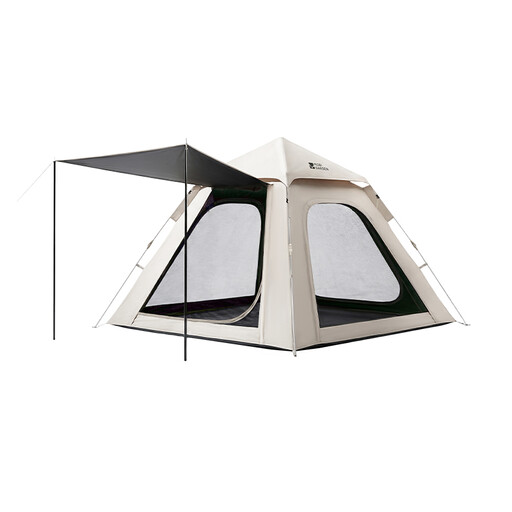
Why it suits this type of camper: This quick-pitch tent is aimed at beginners looking for a compact option for camping, picnics or short trips. It has a stated capacity of 2–5 people and packs down to 77 × 15 × 15 cm.
The manufacturer lists a pop-up structure, large mesh doors and windows on five sides, and a PU2000mm rating for the fabric and groundsheet. Tent pegs and guy lines are still needed.
240 × 240 × 155 cm, blackout layer, UPF50+ according to the product specifications, and an automatic fibreglass frame.
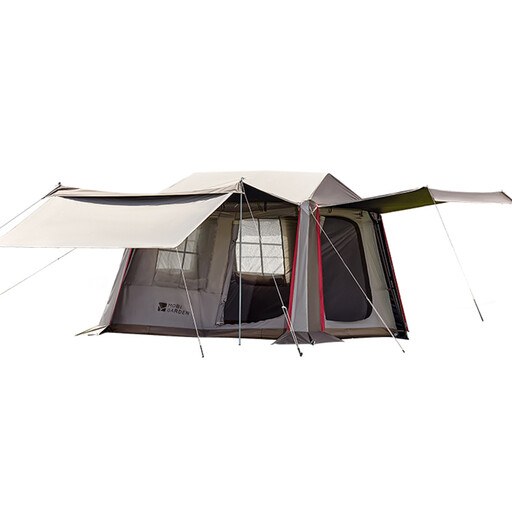
Why it suits this type of camper: A family camping tent with extra living space, suited to those staying at a campsite for longer and who value a practical layout over a compact pack size.
The automatic aluminium frame reduces the number of separate assembly steps. The tent has mesh windows on four sides and several pitching options for ventilation and privacy.
270 × 240 × 190 cm, approximately 5.9 m² of tent space and approximately 15.2 m² with the awnings. Aluminium frame, PU2000mm and UPF50+ according to the product specifications.
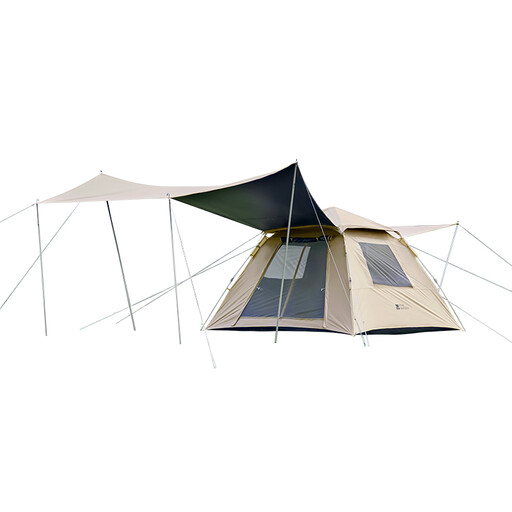
Why it suits this type of camper: A pop-up tent with a tarp is ideal for campers who want an outdoor seating area without bringing a separate awning. The stated tarp dimensions are 338 × 300 × 190 cm.
The tent combines a pop-up frame with a separate canopy. Large mesh openings help with airflow, while the outer fabric and groundsheet are rated PU2000mm.
Capacity for 2–5 people, approximately 7.8 kg net weight, packs down to 86 × 18 × 18 cm, and UPF50+ according to the product specifications.
An automatic tent will last longer if you don’t force or twist the frame. Watch your fingers as you unfold it, and check that the joints can move freely. After use:
Don’t cook, smoke or use an open fire inside the tent. Use a head torch, torch or suitable tent lamp for lighting. The manufacturer also warns that shoes with stones or mud on them can damage the groundsheet.
We’ve put together a complete, up-to-date list of products that meet these strict selection criteria and the applicable European safety regulations.
Lay the tent on level ground, unfold the frame according to the instructions, then push or pull the marked frame sections open. Secure the corners with tent pegs, attach the outer flysheet and tension the guy lines. The pop-up mechanism speeds up pitching, but the tent still needs to be properly secured.
That depends on how often you use it, UV exposure, wind, damp and maintenance. Always let the tent dry before storing it, and avoid dragging it over stones or branches. An automatic frame also needs to be folded with care; forcing it can put strain on the frame or joints.
A blackout layer limits light and, according to the product description, can help keep bright sunlight and heat out. The effect depends on the sun, the outside temperature and ventilation. Open the mesh windows or doors when conditions allow, and choose a tent with several ventilation openings.
