
Actor who plays back rehearsals
Wants to record dialogue, timing and delivery quickly, then play them back straight away. Zoom and Tascam describe models with built-in microphones for recording without a separate microphone.


For a solo rehearsal that you want to record and play back quickly, a recorder with built-in microphones is an obvious choice. If you want to use a separate studio microphone, check that the recorder has the right input and, if needed, phantom power. Whichever option you choose, microphone placement, room reflections, storage and power still matter: 32-bit float won’t eliminate echo or a poor set-up.
Wants to record dialogue, timing and delivery quickly, then play them back straight away. Zoom and Tascam describe models with built-in microphones for recording without a separate microphone.
Wants to create an editable monologue recording and capture both quiet and loud passages. Zoom and Tascam list 32-bit float support for specific models.
Wants to connect an existing or future microphone, so pays attention to the input type, power and ability to record separate tracks. For the H4essential, Zoom describes two XLR/TRS inputs with phantom power.
Best for: quickly recording and playing back a rehearsal without first connecting a separate microphone.
Trade-off: the recording also depends on the room and microphone placement; a 3.5mm input is not an XLR input.
Best for: using a compatible external microphone or choosing a microphone separately.
Trade-off: check the microphone connection and power requirements; you don’t need an external microphone for every solo rehearsal.
| What to consider | What to look for | Who should prioritise it? |
|---|---|---|
| Clear speech | Check that you can position the recorder appropriately and assess the recording using headphones. | When I record a monologue in my room, I mainly want to assess my voice clearly and take reflections into account. Around 40% of consumers give speech clarity in the recording space their highest priority. |
| Varying speaking volume | Check that the exact model supports the WAV format you want, and listen to a test recording with both quiet and loud passages. | For a monologue with quiet and loud passages, I want a file that suits my post-production. Around 30% of consumers prioritise varying speaking volume and an editable file. |
| Microphone connection | Compare the connection and power requirements of your specific microphone with the recorder’s inputs and power supply. | If I want to use an existing or planned external microphone, the connection needs to be compatible. Around 20% of consumers choose primarily based on the microphone connection. |
| Multiple takes | Check the controls and playback features you want, the memory card required and what’s included in the box. | For several rehearsal takes in a row, I want to be able to operate the recorder easily and play back my recordings. Around 10% of consumers make this workflow their main selection criterion. |
A recording format won’t fix room reflections or poor microphone placement. Zoom warns that the H1essential can pick up reflections when placed directly on a table, which may reduce clarity.
Make a test recording in your chosen location and play it back before recording a final take.
The Zoom H1essential has a 3.5mm mic/line input; the H4essential has two XLR/TRS combo inputs with phantom power. The connection and power supply determine which microphone you can connect.
Compare your microphone’s connection and power requirements with the specifications of the exact recorder model.
A different recorder, microphone or suitable cable may also be needed for another microphone set-up.
The Tascam DR-05XP manual lists a microSD card and two AA batteries as requirements. You can check in advance what’s included with the version on offer.
Before buying, check what’s in the box and which storage and power options are compatible with the version you’ve chosen.
You may need to buy a memory card or batteries separately.
The H1essential is a compact recorder with built-in X/Y microphones. The H4essential also offers connections for external microphones.
The DR-05XP has built-in omnidirectional microphones and can also be used as a USB-C audio interface.
The R-07 is a compact recorder for anyone who values remote control and saved recording settings.
The products below are portable voice recorders for recording spoken material and processing or playing it back. Check each model to make sure its listed features suit the way you record monologues.
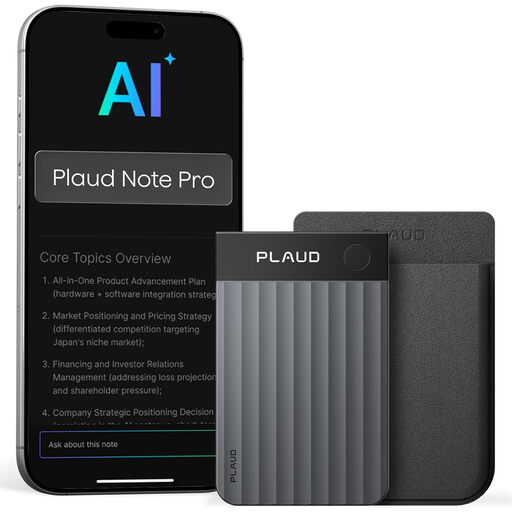 No image available
A good fit if you want to record spoken material and use the listed transcription and summarisation features.
 No image available
Suitable if you want to record speech and value text-based processing.
The product name lists 64 GB and a transcription function.
 No image available
An option if you want to record spoken material and use the listed transcription and summarisation features.
The product name lists 64 GB, plus transcription and summarisation in 118 languages.
 No image available
Suitable if you want to record monologue clips and replay specific passages.
The product name lists 128GB and model L357.
Yes, the Zoom H1essential and Tascam DR-05XP have built-in microphones. Make a test recording in your planned location; Zoom warns that the H1essential can pick up reflections when placed directly on a table.
The manual lists a microSD card and two AA batteries as requirements. Check what’s included with the version on offer to see what else you need.
The seller is responsible for the statutory guarantee. According to the Dutch government, there is no fixed statutory guarantee period in the Netherlands; the possible remedy depends on what you could reasonably expect from the product and the circumstances of the fault.
Not automatically. The Dutch government distinguishes between making a copy for personal use and distributing or making copyright-protected work available to the public. Before publishing, check what rights or permission are needed for the specific script.
The Dutch Data Protection Authority says that processing personal data solely for personal or household use falls outside the GDPR. If you process or publish recordings featuring identifiable others outside that private sphere, you should assess separately whether the GDPR applies and whether a lawful basis is required.