
Storytellers in a noisy space
You want your own words to remain clear alongside other voices or room echo. Shure highlights the importance of microphone placement and distance from the speaker.


Start by making sure your voice is clear: record a test in your usual practice spot and try positioning the microphone closer to the storyteller. A simple voice recorder may be suitable for quick recording and playback; a handheld recorder or external microphone is more relevant if you specifically need extra inputs or recording formats. No recording format or additional input will, by itself, remove other voices or room echo.
You want your own words to remain clear alongside other voices or room echo. Shure highlights the importance of microphone placement and distance from the speaker.
You want to start a practice session easily, listen back and find your recordings later. Models such as the Sony ICD-PX470 and Philips VoiceTracer DVT4115 are examples of recorders with internal storage.
You want to record several speakers deliberately or edit the files afterwards. Check the connections and file formats of the exact model; Zoom lists two XLR/TRS inputs for the H4essential.
Suitable if: you usually practise alone and want to record and listen back quickly.
Bear in mind: placement and background noise still matter; check the model’s controls, storage and connections.
Suitable if: you want to save or edit separate audio files and can position the recorder conveniently near you.
Bear in mind: 32-bit float recording, as specified for certain Zoom and Tascam models, won’t eliminate room echo or background conversations.
Suitable if: you want to use compatible external microphones or connect speakers separately.
Bear in mind: extra connections require a suitable microphone setup; also check which cables and power supply you’ll need.
| Consideration | What to look for | Who should prioritise this? |
|---|---|---|
| Clear recording of your own voice | Make a test recording in your usual practice spot and compare it with one made with the microphone closer to the storyteller. Check whether the model can be used with a suitable external microphone. | If I practise while other people are in the room, I want to be able to hear my own words clearly when I listen back. Around 36% of consumers say clarity is their top priority. |
| Quick recording | Try starting and stopping a recording, checking its status and listening back straight away on the model you’re considering. | For short solo practice sessions, I want to get started without a complicated setup and immediately check that the recording worked. Around 29% of consumers put quick practice first. |
| Listening back and saving recordings | Check the playback options, file format, storage and how to transfer files to your computer or phone. | If I want to compare different storytelling attempts, I need to be able to find and play back my recordings. Around 21% of consumers say saving and listening back are their top priorities. |
| Recording two speakers separately | Decide whether one combined recording will do or whether you want to connect separate microphones; check the connections on the exact model. | When we practise storytelling as a pair, I want to know in advance whether we’ll make one combined recording or use separate microphones. Around 14% of consumers say recording speakers separately is their top priority. |
32-bit float is a recording format; it doesn’t change the acoustics of the room. Shure explains that background noise and reflections don’t simply disappear when you use a different format.
First, make a short test recording in your usual practice spot and compare it with one made with the microphone closer to the storyteller.
The two XLR/TRS inputs on the Zoom H4essential are most useful if you want to connect compatible external microphones.
Before buying, decide whether you need separate microphones and check which connections and accessories will work with your setup.
Voices that identify someone may count as personal data. The Dutch Data Protection Authority says that consent is generally required to publish personal data publicly online.
Listen back for identifiable voices belonging to other people, and consider your intended use and the applicable privacy rules before sharing a recording.
The ICD-PX470 is a digital voice recorder with internal storage and a built-in USB connector.
Philips says the DVT4115 combines internal storage with MP3 and PCM recording, and can be controlled using a smartphone app.
The H1essential is a compact handheld recorder, while the H4essential adds inputs for a more extensive microphone setup.
The DR-05XP has built-in stereo microphones and a connection for an external microphone or line-level source.
These Joybuy products are suited to recording speech, listening back to practice sessions and managing files.
 No image available
The set includes two transmitters and one receiver, for a recording setup where speakers wear a transmitter.
The product description specifies internal 32-bit float recording and clip or magnetic attachment.
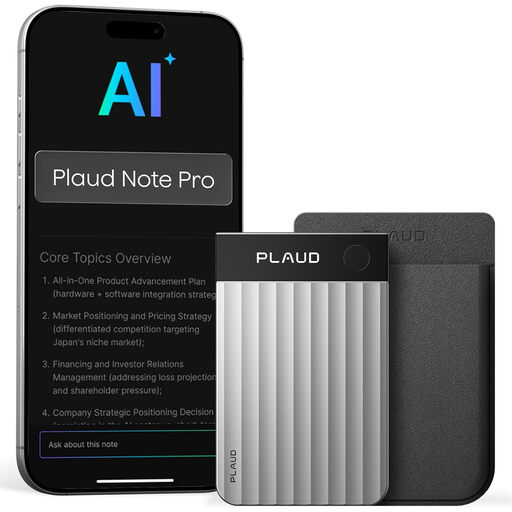 No image available
An option if you want to record audio and use the listed AI notes and summaries.
The product description specifies 32 GB of built-in storage.
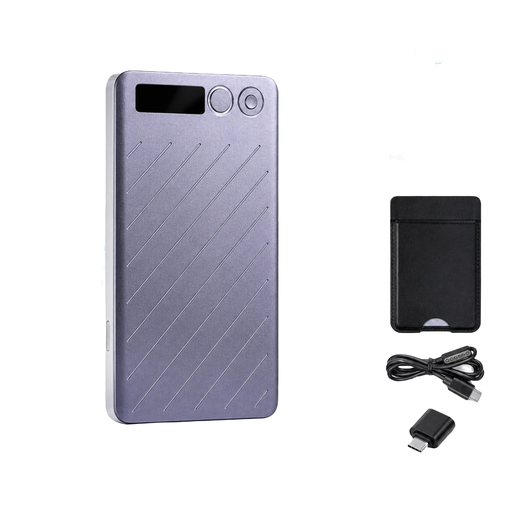 No image available
The title mentions recording and transcription; the description also says recordings can be converted into text and summaries.
The description lists 64 GB of storage and USB-C transfer.
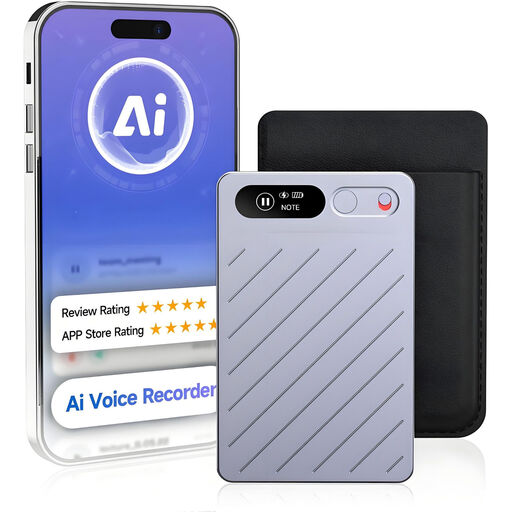 No image available
The description lists one-button recording and headphones for listening back straight away.
Listed features include WAV recording, 64 GB of storage and USB-C.
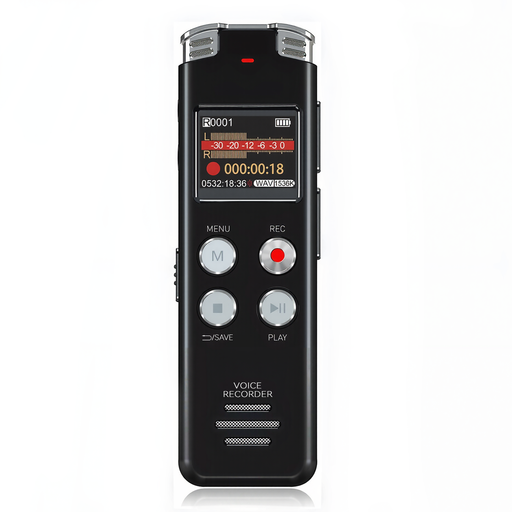 No image available
The description lists one-button recording and A-B repeat for listening back to a passage.
Listed features include 128 GB of storage in the product name, MP3 and WAV recording, and USB-C transfer.
No. Recording format and acoustics are different things. Zoom and Tascam specify 32-bit float for the models mentioned; Shure explains that microphone placement and distance from the speaker matter when there’s background noise. Try positioning the microphone closer to the storyteller.
Position the microphone somewhere practical, make a short test recording and listen back while the room is being used as usual. Before a longer session, check that the chosen model has enough storage and power.
The Dutch government advises contacting the seller if a product you’ve bought develops a problem. Whether you’re entitled to a remedy depends on the circumstances and the product; your statutory rights may still apply after a manufacturer’s or extended warranty has expired.
First, consider the applicable privacy rules. The Dutch Data Protection Authority considers identifiable audio recordings to be personal data and says that consent is generally required to publish them publicly online. The exception for purely personal or household use does not automatically apply to public posts; whether simply recording or practising privately is covered may depend on the circumstances.