
Reader in an echoey room
You want to capture a clear voice without reflections or household noise overpowering the reading. The recording location and microphone position are important considerations.


If you’re only recording your voice and want to keep your setup simple, start with a recorder that has built-in microphones and make a test recording in your usual reading spot. If you’d like to position a separate speech microphone or connect several microphones later, compare recorders with the right external inputs. 32-bit float recording can help with widely varying voice levels, but it won’t remove echo or background noise.
You want to capture a clear voice without reflections or household noise overpowering the reading. The recording location and microphone position are important considerations.
You switch between whispers and powerful passages, so you’ll want to assess the recording format and level control with a test recording of both extremes.
You want to connect an existing or future microphone, so you’ll need to check the inputs, any phantom power requirements and how practical the setup will be.
For read-alouds alone, a recorder with built-in microphones can offer a simple setup. External inputs let you connect a separate speech microphone, but you’ll also need to consider the connection and any additional equipment required.
Choose this option if: you only read aloud and can place the recorder somewhere suitable and stable near your reading spot.
Bear in mind: where you place the recorder as a whole affects how much room noise it picks up.
Choose this option if: you want to position a separate speech microphone or connect several microphones.
Bear in mind: your setup may also need a microphone, cable, stand and possibly a power supply.
The Acoustical Society of America identifies voice reflections and ambient noise as potential unwanted sounds in recordings. Changing the recorder settings won’t replace making a test recording where you plan to read aloud.
| What to consider | What should you check? | Who will find this important? |
|---|---|---|
| Clarity in the room | Make a test recording in your reading spot and listen for reflections, ventilation and other household noise. | If I read aloud in an echoey room, I want to hear my voice clearly on the recording. Around 33% of consumers put clarity first. |
| Varying voice levels | Compare support for 32-bit float and record both quiet and loud passages as a test. | If I whisper and then speak powerfully, I want to assess how both passages are captured. Around 27% of consumers prioritise vocal dynamics. |
| Long recording sessions | Check the storage, power supply and file format you need for the session. | When recording several takes, I don’t want to run out of storage or power unexpectedly. Around 20% of consumers prioritise uninterrupted sessions. |
| External speech microphone | Check the connector type and whether the microphone needs phantom power. | If I want to position my microphone separately, I need to be able to connect it to the recorder. Around 20% of consumers prioritise this option. |
This recording format won’t remove echo or background noise. An unsuitable location can still be audible in the recording, even with this format.
First, make a test recording in the spot where you plan to read and compare microphone positions.
A poor recording location can mean extra time spent re-recording or adjusting the room.
Inputs don’t automatically mean that an external speech microphone, cable or stand is included with the recorder.
Check what’s in the box and compare your microphone’s connection and power requirements with the recorder.
Your setup may also need a suitable microphone, cable or stand.
Storage, power and your chosen file format all play a part in preparing for a long recording.
Before a long take, check your available storage and power, make a test recording and listen back to the file.
Depending on your setup, you may need an additional memory card or power solution.
The H1essential and H4essential are examples of recorders with built-in microphones. The H4essential also has external inputs.
The DR-40XP combines adjustable built-in stereo microphones with external XLR/TRS inputs.
The LS-P5 is a compact recorder with built-in microphones, internal storage and expandable storage.
The R-07 is a compact recorder with built-in stereo microphones, scene settings and remote control.
This selection includes digital voice recorders for spoken-word recordings. Check that each model’s listed recording features, connections and controls suit your read-aloud setup.
 No image available
A good fit if you want to record spoken content and save files in MP3 or WAV format.
The product information lists 128 GB of storage, MP3 and WAV recording, and up to 35 hours of continuous recording.
 No image available
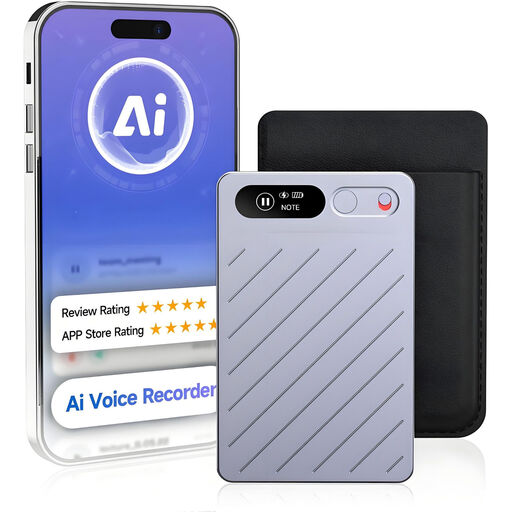
A good fit if you’re looking for transcription and summarisation features as well as spoken-word recording.
The product name lists transcription and summarisation in 118 languages; check which features and requirements apply to the way you plan to use it.
 No image available
A good fit if you want to make WAV recordings and need storage for longer sessions.
The product information lists 64 GB of storage, WAV recording at 512 kbps/48 kHz, and up to 22 hours of continuous recording.
No. 32-bit float is a recording format, not acoustic treatment. Choose a quiet spot, reduce reflections where possible and listen back to a test recording of your voice in the room.
Place the microphone on a stable surface, speak towards the correct side and try different distances and angles while listening back. RØDE recommends a distance of 6–10 cm for many of its own microphones; this isn’t a universal distance for every recorder or voice.
Check the power supply, available storage and file format, then make a test recording and listen back to it. The OM SYSTEM LS-P5 manual recommends making a test recording before important recordings.
For a standard online purchase by a consumer, ACM ConsuWijzer says you generally have a statutory cooling-off period of up to 14 days after delivery. Check which exceptions and returns conditions apply to your purchase.
Not without permission. The Dutch Government states that you may copy a copyright-protected book for personal use, but you need the rights holder’s permission to distribute or publish it. Check the rights for the specific text before publishing.
Contact the seller. ACM ConsuWijzer says that, in addition to any manufacturer’s warranty, you have a statutory guarantee if the product doesn’t meet the expectations you could reasonably have had when used normally. This doesn’t mean there is one fixed guarantee period for all recorders.